








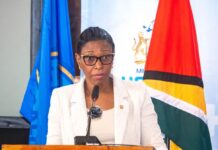

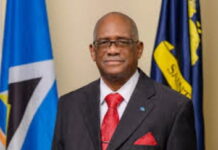














HAGUE, CMC – Venezuela Wednesday doubled down on its position that the International Court of Justice (ICJ) does not have jurisdiction to adjudicate the centuries-old border dispute with Guyana.
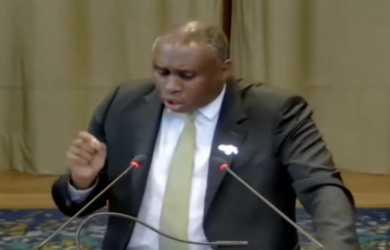
“The 1899 award might be relevant; it may offer context, it is after all the wound that the Geneva agreement was designed to heal, but it certainly does not follow that the award should be permitted to stand in the way of a genuine resolution of the controversy between Guyana and Venezuela. Jurisdiction to entertain a question is not an obligation to answer it and certainly not an obligation not to answer it when doing so,” said Professor Makane Moise Mbengue, the second Venezuelan representative to address the Court.
Earlier, Venezuela’s representative, Samuel Moncada, said, “Venezuela is here today to respond to Guyana’s erroneous and misleading narrative and to set straight the true legal framework of the territorial dispute and the limits imposed also by international law and the Geneva Agreement on Guyana’s attempt to transform the dispute and its obligations fraudulently.”
Moncada said the Geneva agreement is an instrument of peace that encourages parties to find, through direct negotiation, a practical and satisfactory solution to their differences.
“This is the opposite of a court-imposed decision, where, inevitably, one party wins at the expense of the other’s defeat, when the parties commit in the Geneva agreement to overcome the disastrous legacy of colonialism within a framework of friendly and mutually beneficial relations.
He said that, despite Guyana’s repeated assertions, the Geneva Agreement of 1966 remains the legal framework governing this matter.
Guyana brought the case before the ICJ in 2018, seeking confirmation that the 1899 Arbitral Award, which established the boundary between the two countries, is legally valid. The award had been accepted for over 60 years before Venezuela declared it null in 1962 and revived its claim to the territory.
The matter is being addressed under the 1966 Geneva Agreement, which outlines mechanisms for a peaceful settlement. After bilateral efforts failed, the dispute was referred to the ICJ by the United Nations Secretary-General.
The Court has already ruled that it has jurisdiction to hear the case, paving the way for hearings on the merits, during which both sides will present full legal arguments.
The ICJ said that in the first round of oral presentations, lasting two sessions of three hours each, both Guyana and Venezuela will make presentations, and it will continue on Friday, ending on Monday next week.
The Essequibo region comprises roughly the western two-thirds of Guyana, spanning 61,600 square miles. It is a resource-rich region bordered by the Essequibo River to the east and Venezuela to the west, which Venezuela claims as its own.
On Monday, Guyana argued that the land boundary between the two countries was finally and definitively settled by the 1899 Arbitral Award and noted that the award is legally valid and binding and should be respected.
But Mbengue, who, like Moncada, wore a pin depicting a map that included the Essequibo as part of Venezuela, said the real issue for Venezuela has never been the 1899 award, which he described as discredited.
He told the ICJ panel that in their first set of rulings, they did not take Venezuela’s main argument into account.
He said the Court’s findings of jurisdiction do not mean Guyana has a solid case. However, he said the Court must address the question of the Geneva agreement, not the 1899 arbitral award, to achieve a mutually satisfactory solution.
That real issue is the pursuit of a mutually satisfactory agreement to the controversy generated by the 1899 award, a solution that consigns this artifact of British imperialism to the past where it belongs and charts a way forward; this is the only proper meaning of the Geneva agreement. It is as though so far, the only interpretation on the record, for the simple reason that Guyana has offered none,” Mbengue noted.
But even so, Mbengue wants the ICJ to address every aspect of the agreement.
“As a matter of law, the Court should not be constrained by the allegations that Guyana made; in particular, it must carefully ascertain whether Guyana’s request remains within the bounds of what the parties to the Geneva agreement have sought to resolve. Guyana’s claims cannot exist as they do, the framework established by the Geneva agreement, nor can the Court decide on those matters,” Mbengue argued.








 and then
  does not have jurisdiction to adjudicate the centuries-old border dispute with Guyana)