

































CASTRIES, St. Lucia, CMC – The St. Lucia government intends to spend an estimated EC$$1.856 billion (One EC dollar=US$0.37 cents) during the 2023-24 fiscal year, promising to restore the social and economic fundamentals necessary for growing the economy.
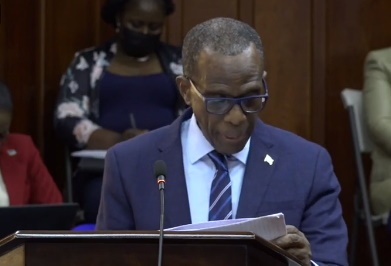
Prime Minister Phillip J Pierre has tabled the Estimates of Revenue and Expenditure, and debate on the fiscal package continues here on Friday.
But he told legislators that the COVID-19 pandemic and its debilitating effects on the economic and social landscape of the country had left many persons poorer and, in some cases, “destitute.
“We will increase the allocation towards poverty reduction. My government intends to provide relief to those persons by continuing our many social programs and collaborating with social partners committed to providing relief to those people.”
Pierre said that in support of his administration’s plans for economic expansion, the government intends to create an enabling environment for businesses to expand and be profitable.
“In the upcoming financial year, my government will be rolling out several programs and initiatives to support MSMEs (Micro, Small, and Medium Enterprises), empower the youth through the Youth Economy Agency, ensure the benefits of tourism are islandwide through
The Community Tourism Project provides food security through the Blue Economy and diversification of the agricultural sector. “
He said the budget is estimated at EC$1.856 billion, with EC$1.442 billion to be spent on
Recurrent Expenditure, EC$302.14 million on Capital Expenditure, EC$218.93 million on interest payments, and EC$112.25 million on principal payments.
The government is anticipating revenue to be EC$1.558 billion comprising of tax revenue of EC$1.260 billion, non-tax revenue of EC$153.0 million with EC$7.6 million going towards capital revenue, and EC$147.04 million in grants.
Pierre said that the statisticians predict a further increase in the gross domestic product (GDP) for the calendar year “as GDP is projected at approximately six billion dollars n compared to EC$5.5 billion in the current financial year.
He said the government also intends to continue to reduce the liabilities/payables and obligations to third parties, emphasizing his administration’s “commitment to fiscal.
Prudence, as we intend to continue to maintain prudent macroeconomic
Indicators.
“Therefore, in the upcoming budget, we are projecting a primary surplus of approximately 0.7 percent of GDP or EC$42.54 million, compared to EC$29.5 million, an increase of 44 percent over this year.”
Pierre said that total expenditure, excluding refunds and principal repayments, is estimated at
EC$1.734 billion, while total revenue and grants are projected at EC$1.558 billion.
During his presentation, Pierre said that the government’s performance improved in the fiscal year 2022- 2023, despite what he said were “the many challenges facing our country, the region, and the world.
“Some of those challenges…include inflation, and global supply chain difficulties, resulting in supply shortages and increasing costs of doing business,” Pierre said, adding, “this remains true for the private sector as it is for the government.”
He said, in addition, there were a few financing challenges that the government faced. Experienced delays in funding approval for some projects and disbursements from funding agencies, leading to a general decline in government expenditure, particularly in capital projects.
“Nevertheless, government operations remained robust while still managing to meet.
financial obligations through the effective and efficient management of its cash resources.”
He said when his administration came to office in July 2021, it met monies due to local suppliers of goods and services to the government over EC$200 million, adding that this figure has now been reduced to “a little over EC$100 million.
“For the 2022-2023 fiscal year, I am pleased to report that the government was able to stay within its budget ceiling, and the economy performed much better than anticipated,” he said, adding that preliminary data up to February this year indicates that the government Will be spending approximately EC$1.571 billion for the fiscal year 2022-23, which is higher than the actual in 2021-22 by 15 percent or an increase of EC$174.8 million. But less than the approved estimates of EC$1.842 billion.










 and then
  during the 2023-24 fiscal year)