
































PORT OF Spain, Trinidad, CMC – The Caribbean Country Director of the World Bank, Lilia Burunciuc, Tuesday warned that Caribbean countries were “lagging” in developing the tourism industry.
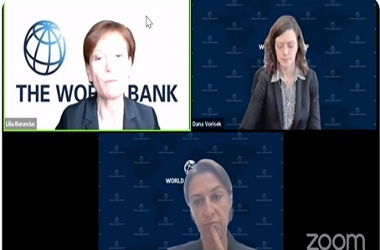
Burunciuc told an online webinar that discussed “Global Economic Prospects for Small States” that even when an examination is made of the tourism sector in the region, “ the Caribbean (countries) are lagging behind the rest of the world in terms of the growth of this sector.
“The growth of the tourist sector in the Caribbean is lower than the average of the tourist sector in the world, which means that probably the current model has exhausted its potential and the region needs to think about doing significant restructuring of the way tourism is being done in the Caribbean so that the sector continues to grow and the sector brings more revenue and more jobs to the people in the Caribbean,” she added.
The statement by the World Bank officials follows the announcement last week by the Barbados-based Caribbean Tourism Organization (CTO) predicting that visitor arrivals to the region this year will surpass the pre-coronavirus (COVID-19) pandemic figures as the Caribbean recorded a significant increase in tourist arrivals last year.
CTO acting Secretary General, Neil Walters, told a news conference that nearly 90 percent of the region’s travel demand for 2019 has already been recovered, and some destinations have already passed their pandemic levels.
“Compared to 2022, it is expected that overall regional arrivals will increase by between 10 and 15 percent. This means that between 31.2 and 32.6 million tourists can be expected to visit the region this year (and) thus arrivals this year might surpass pre-pandemic levels,” he told reporters.
The World Bank said that the Caribbean’s diverse economic features share attributes that make them especially vulnerable to shocks, including dependence on imports of essential goods, highly concentrated economies, elevated levels of debt, reliance on external financing, and susceptibility to natural disasters and climate change.
The Washington-based financial institution said that given that the region is expected to see a slowdown in growth, with an estimated 5. 6 percent growth in 2023 and 5.7 percent in 2024, compared to 7.7 percent last year, there is a need for policies to boost investment growth, tailored to country circumstances but also include comprehensive fiscal and structural reforms, including the repurposing of expenditure on inefficient subsidies.
Earlier, the senior economist at the World Bank’s Chief Economist Office, Dana Vorisek, told the webinar that small states like the Caribbean are highly vulnerable to natural disasters such as hurricanes, droughts, earthquakes, and even volcanic eruptions.
“The frequency of weather-related disasters in the Caribbean has increased over time,” she said, noting that since 1990, natural disasters linked to climate change have caused damage equivalent to six percent of gross domestic product (GDP) per year on average in the Caribbean small states.
“In some cases, damage from a single disaster can be equivalent to more than the size of the economy. Hurricane Maria in Dominica in 2017 and Hurricane Ivan in Grenada in 2004 are two examples of this.
“So the threat of these disasters raises the cost of financing and the need to rebuild following disasters,” she said, noting that there is no way to completely offset the destruction of climate change and natural disasters.
“There are things that policymakers can do to reduce the impacts. But this can be done by rebuilding and refitting infrastructures better able to withstand the impact of disasters, implementing early warning systems, efforts to sequester carbon, and adaptation to safeguard certain industries,….”
Vorisek said the most important thing the international community can do is ensure that large economies implement climate agreements to limit rises in emissions and, in the long term, limit temperature increases.
“Small states are, of course, responsible for a minuscule share of global greenhouse emissions, but they bear a disproportionate share of the cost arising from the extreme weather events that follow,” she added.
”.There is also a clear need for the international community to provide additional financing to these countries to better cope with the outcomes of disasters and also to plan,” she said, adding that, for example, “one urgent need after a pandemic is to begin to offset significant declines in employment and incomes.
She said this situation is expected in the Caribbean and other small states.
Burunciuc told the webinar that the Caribbean needed to cooperate much more to survive in the global environment.
“ A lot has been done in some areas, and in particular in the Eastern Caribbean countries, we see more progress, but I …would not see a good positive outcome for the Caribbean unless countries get together and start acting as a big market.
“There are many areas where this cooperation can take place. First of all, there is the issue of connectivity. I hear about the problems related to connectivity and the movement of goods and people in the Caribbean in almost every meeting with the Caribbean authorities.
“It is a big challenge, and it can only be resolved regionally,” said Burunciuc.
She said the region also needed to invest significantly in renewable energy to become more competitive in the Caribbean.
“Another area I see as a big potential in the Caribbean is digital. This is a region where services are super important. This is also a region that lags as against the rest of the world in terms of its digital infrastructure and penetration…and so there is one area where more investments are needed,” Burunciuc told the webinar.











 and then