





























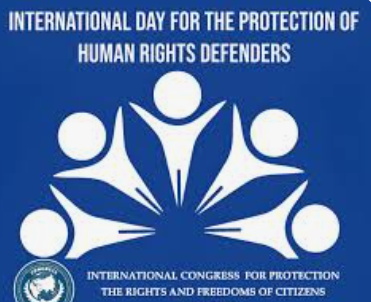
WASHINGTON, CMC – The Inter-American Commission on Human Rights (IACHR) has joined several regional and international stakeholders in calling on countries to guarantee civic spaces that are open and free from intimidation, to uphold and respect human rights.
The IACHR, a principal and autonomous body of the Organization of American States (OAS), said it is collaborating with its Special Rapporteurship for Freedom of Expression (RELE), and the presence of the Office of the United Nations High Commissioner for Human Rights in Latin America (UN Human Rights) in observing International Day of Human Rights Defenders on Tuesday.
The IACHR and UN Human Rights note with concern actions aimed at limiting essential rights, such as freedom of association and expression, as well as free participation in decision-making within democratic societies.
They said these restrictions have a direct impact on the exercise of the right to defend human rights. Individuals and organizations that protect human rights face growing obstacles to carrying out their work of promotion, protection, reporting, and supporting victims.
“Among the main challenges identified are killings or violent deaths, threats, criminalisation, and attacks intended to forcibly halt defense work and instill fear among those who carry it out.
Another challenge that threatens human rights defense is the adoption of laws and administrative measures that impose new requirements for the registration of non-governmental organizations, which, in some cases, appear to be applied arbitrarily.”
The groups said these include conditions not foreseen in the relevant legal frameworks and are under threat of sanctions.
“There are also measures establishing strict controls over the funding sources of civil society organizations, as well as tax burdens and financial penalties that may be difficult to meet.
“In some contexts, restrictions have also been introduced on the use of international cooperation funds for essential activities such as legal representation or strategic litigation, thereby limiting organizations’ ability to support access to justice.”
They said that non-compliance may pose risks to the operational continuity of organizations, including the possibility of losing their legal personality. These conditions generate legal uncertainty and concern regarding the registration status of organizations.
“These measures have had a direct impact on the operational capacity of organizations, leading to the reduction or suspension of activities, the closure of workspaces, self-censorship, and even exile as a form of self-protection. It has also been reported that organizations have decided not to participate in international forums due to fear of reprisals or criminalisation.”
The groups remind states that, while the obligation to guarantee the right to freedom of association does not preclude regulating the registration, supervision, and oversight of organizations within their jurisdictions, such requirements must not prevent, delay, or restrict the creation or functioning of organizations, which play a vital role in ensuring democratic oversight.
“As recalled by international mandates in the Joint Declaration on the Protection of the Right to Freedom of Association in relation to “Foreign Agents” and “Foreign Influence” Laws, the right to freedom of association includes the right of associations, whether registered or unregistered, to seek, receive, and use resources, including those from foreign and international sources, without prior authorization or other undue impediments.”
Additionally, the groups warn of statements issued by various state actors aimed at delegitimizing human rights defense work, using terms such as “terrorists”, “enemies of the State”, or “defenders of criminals”.
They also note persistent high levels of violence, including killings, threats, short- and long-term disappearances, criminalization, and restrictions on freedom of movement. States must adopt the necessary measures to prevent such violence, protect those at risk as a result of their defense work, and investigate and sanction all those responsible.
“On this day, the IACHR and UN Human Rights reaffirm the essential role played by human rights defenders in strengthening democracies and the rule of law and underscore the importance of States ensuring a civic space that is open, pluralistic, safe, and participatory so that defenders can carry out their activities.
“The recognition and protection of human rights defenders ultimately depend on the political will and institutional capacity of States to ensure that they can conduct their work in environments free from any form of threat, intimidation, or harassment,” the groups added.







 and then
  has joined several regional and international stakeholders in calling on countries)