

































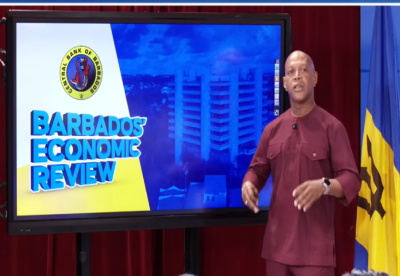
BRIDGETOWN, Barbados, CMC – The Central Bank of Barbados (CBB) on Wednesday projected that the country’s economy will continue to expand this year, supported by tourism, construction, and business and other services.
“Barbados enters 2026 with stable growth, strong external buffers, and a credible fiscal framework. The outlook remains positive, but the global environment requires vigilance,” said Central Bank Governor, Dr. Kevin Greenidge, speaking at the first quarter review of the Barbados economy.
“Sustaining the country’s progress will depend on preserving macroeconomic stability, maintaining fiscal discipline, strengthening competitiveness, and ensuring that public and private investment translates into durable, inclusive, and productivity -enhancing growth.” Watch video
Greenidge told reporters that real gross domestic product (GDP) growth is projected to fall within the range of 2 to 3 percent, as public and private sector investment continues to support economic activity.
He said infrastructure upgrades, renewable energy projects, and tourism-related developments are expected to support employment, enhance productive capacity, and strengthen medium -term growth.
“Measures announced in the financial year 2026/27 budget should also reinforce private investment, improve access to finance, support small and medium -sized enterprises, and encourage higher -value activity in areas such as green technology, digital services, and advanced manufacturing,” said Greenidge as he presented the January to March review under the heading “Resilient Growth, Strong Buffers: Barbados Navigates a More Uncertain Global Environment”.
According to the Central Bank Governor, stable economic growth and contained inflation prevailed during the first quarter of 2026, even as global geopolitical tensions intensified. He said real GDP expanded by an estimated 1.7 percent, supported by sustained activity in tourism, business and other services, and construction.
The unemployment rate stood at 7.2 percent at the end of December 2025, while jobless claims fell during the first three months of 2026, signaling continued labor market resilience.
Greenidge said that the 12-month moving average inflation rate edged up modestly to 1.1 percent at the end of February 2026, 0.2 percentage points higher than a year earlier, reflecting higher prices for restaurant services.
He said point-to-point inflation rose to 1.3 percent in February 2026 from a decline of 0.3 percent in February 2025, driven by stronger demand for restaurant dining, recreation and culture, education, transport, and healthcare services.
“Barbados sustained robust external buffers through the quarter. International reserves stood at three billion dollars at the end of March 2026, equivalent to 25.5 weeks of import cover, well above the 12 -week international benchmark.
“Higher travel credits and a narrower merchandise trade deficit cushioned the reserve position, while lower foreign direct investment inflows and reduced multilateral disbursements following the conclusion of the International Monetary Fund (IMF) -supported BERT 2022 program accounted for the modest BDS$33.4 million (One BDS$=US$0.50 cents) decline over the quarter.”
Greenidge said the government delivered a strong primary surplus while sustaining record capital investment in the financial year 2025/26. He said stronger domestic activity and gains in personal income supported a $126.3 million increase in tax revenues, led by higher value-added tax (VAT) and personal income tax collections.
“At the same time, total expenditure rose by $23 million, reflecting elevated spending on capital projects and current transfers to state-owned enterprises. The primary surplus reached $647.3 million, equal to 4 percent of GDP, while the overall deficit narrowed to $58.3 million, or 0.4 percent of GDP. Economic expansion and the primary surplus reduced the debt -to-GDP ratio by 2.7 percentage points to 94.6 percent at the end of the financial year 2025/26.”
Greenidge said that financial system conditions remained sound, with improving asset quality, ample liquidity, and capital buffers well above regulatory requirements.
He said during the first quarter, credit and deposits expanded by 0.8 percent and 1.4 percent, respectively, providing additional support for economic activity.
“Loan quality strengthened further, supported by a decline in non -performing loans, while liquidity remained elevated. Deposit -taking institutions also continued to maintain capital levels well above the regulatory requirement.”
Greenidge said that broad-based economic expansion continued in the first quarter of 2026, supported by both traded and non-traded sectors. Stronger cruise activity and higher agricultural output drove a 1.6 percent expansion in the traded sector.
In the non-traded sector, sustained construction activity across both public and private projects, together with growth in business and other services, supported a 1.8 percent increase in output. As a result, real GDP expanded by an estimated 1.7 percent in the first quarter of 2026.
Greenidge said that in the tourism sector, long-stay arrivals strengthened during the first quarter of 2026, with broad-based gains across all major source markets.
“Total arrivals rose by 1.2 percent to 237,194 visitors. Arrivals from the United Kingdom increased by 1% to 91,429 visitors, reflecting improved airlift from Heathrow. Other European markets continued their gradual recovery, with arrivals rising by two per cent to 13,252 visitors, supported by KLM flights, which resumed in late 2025 after a hiatus of more than one year.”
Greenidge said regional travel also strengthened, with CARICOM arrivals expanding by 3.2 percent to 21,478 visitors.
He said North American markets also contributed positively during the quarter. Arrivals from the United States rose by 0.5 percent to 64,275 visitors, supported by additional seat capacity from key gateways including Washington and Charlotte, despite temporary disruptions to flight schedules during the period. Canadian arrivals increased by 1.3 percent to 35,825 visitors.
The Central Bank Governor said that the island’s external position remained strong in the first quarter of 2026, supported by higher tourism earnings and an improved current account balance.
He said that the current account deficit narrowed by $49.8 million to $6.3 million, reflecting stronger travel credits, a smaller merchandise trade deficit, and an improvement in the income account.
Greenidge said that the government recorded a strong primary surplus in the 2025-26 financial year.
“Tax revenue increased by $126.3 million, led by higher VAT and personal income tax collections. Total expenditure increased by $23 million, as higher capital spending, goods and services, wages and salaries, and grants to public institutions outweighed declines in interest payments and grants to individuals.
“As a result, the overall fiscal deficit narrowed to $58.3 million, or 0.4 percent of GDP, compared with a deficit of $128.9 million, or 0.8 percent of GDP, in the financial year 2024/25. The primary surplus totaled $647.3 million, equivalent to four per cent of GDP.”
Greenidge said higher personal income tax receipts supported the increase in direct tax revenue, with personal income tax receipts totaling $504.1 million, an increase of $38 million from the previous fiscal year, reflecting higher performance-related bonuses in the financial sector.
Property tax collections remained broadly stable at $222.8 million, while corporation tax receipts declined by $5.9 million to $1,020.8 million. Withholding tax receipts fell by $14.9 million to $39.3 million.
He said non-tax revenue and grants declined, as one-off receipts from the previous year were excluded from the base. Non-tax revenue and grants fell by $32.7 million to $18.8 million at the end of financial year 2025/26, mainly reflecting the non -recurrence of the dividend received from the Industrial Credit Fund for Export Barbados in financial year 2024/25.
Greenidge said that the government recorded its highest level of infrastructure spending to date, with capital expenditure totaling $647.9 million at the end of the financial year 2025/26, up by $35.3 million from the previous financial year.
Looking ahead, the Central Bank Governor said targeted policy measures should support growth while strengthening resilience.
“In tourism, lower regional travel fees and extended concessions are expected to encourage intra -regional travel and provide greater certainty for investment in tourism properties and services. In agriculture, expanded rebates, climate-smart support, and targeted incentives should help reduce operating costs, improve energy efficiency, and strengthen domestic food production. These measures should support growth while contributing to food security and economic resilience.”
He also said global conditions remain uncertain and present downside risks to the outlook.
“Global growth is expected to slow in 2026, while geopolitical tensions, higher energy prices, and trade uncertainty continue to weigh on confidence. Weaker growth or heightened uncertainty in key source markets could reduce external demand, soften travel activity, and affect demand for local exports. These risks reinforce the need to maintain strong macroeconomic buffers and continue diversifying sources of growth.”
Greenidge said that inflation is expected to rise moderately but remain contained. Higher international commodity prices and geopolitical tensions could push domestic prices higher, particularly for fuel, electricity, and transport.
“However, temporary policy measures, including electricity subsidies, fuel -related interventions, and hedging strategies, should help cushion households and businesses from the full impact of higher oil prices. Against this backdrop, inflation is expected to remain within a range of 2 to 2.6 percent over the short- to medium-term.
“The external position is expected to remain stable in 2026. Continued tourism earnings, together with anticipated current transfer inflows, should support international reserves and keep import cover above the 12 -week international benchmark. However, sustained geopolitical disruptions or higher global oil prices could raise import costs and weigh on tourism activity. Barbados’ strong reserve position remains an important defense against short-term external shocks.”
Greenidge said that fiscal discipline will remain central to macroeconomic stability. He said the government continues to target a primary surplus of 4.1 percent of GDP in the financial year 2026/27 while advancing its capital program and providing support to households.
“Maintaining this balance will require careful management of cost-of-living measures, continued reform of state -owned enterprises, and disciplined execution of public investment. These efforts remain essential to achieving the medium -term objective of reducing public debt to 60 percent of GDP by the financial year 2035/36.”
The Central Bank Governor said that the financial system is expected to remain stable and supportive of growth.
“Strong liquidity, improved asset quality, and robust capital buffers should allow deposit -taking institutions to continue supporting lending to the non -financial private sector. These conditions should help reinforce economic activity while preserving financial system resilience.”






 and then
  on Wednesday projected that the country’s economy will continue to expand this year)