

































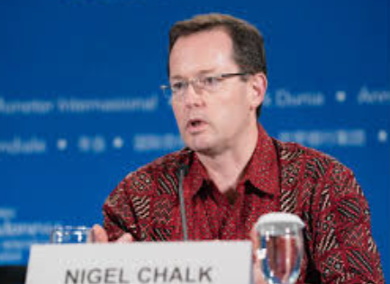
WASHINGTON, CMC – The Director of the Western Hemisphere Department at the International Monetary Fund (IMF), Nigel Chalk, says Washington is “very concerned that tourism-dependent Caribbean economies are likely to be the hardest hit” as a result of the ongoing conflict in the Middle East that has so far resulted in high oil prices.
“Their debt is high, their fiscal space is small, and they’re quite large net energy importers, despite investments that have been made in these countries in shifting towards renewables.
“We also don’t know what the potential impact of this war and the shifts in energy prices may have on flights and on tourism. And so, that’s another thing that we’re keeping an eye on,” said Chalk.
Last Friday, the IMF said that Caribbean Community (CARICOM) countries will register mixed economic growth over the next two years, ranging from 3.1 percent among the region’s tourism-dependent countries to 19.1 percent among its commodity exporters.
The IMF said the region will register average growth of 5.7 percent in 2026 and 8.6 percent in 2027. Caribbean tourism-dependent countries will register growth of 0.9% and 2.5% over the next two years.
The non-dependent tourism countries will have growth rates of 7.9% and 11%. 3 percent over the 2026 and 2027 period, according to the IMF projections.
Among the tourism-dependent countries of the Caribbean, Jamaica is expected to register a minus 1.2 percent growth this year, increasing to 3.1 percent in 2027, the same as Grenada, which is expected to register the same percentage this year.
Antigua and Barbuda will record growth of 2.6 and 2.4 percent over the next two years, while The Bahamas will register growth of 2.1 percent this year, declining to 1.9 percent in 2027, while Barbados will record growth of 2.5 and 2.2 percent.
Belize will register economic growth of 2.2 percent this year, decreasing slightly to 2.1 percent in 2027, while Dominica’s growth of 3.1 percent this year will decline slightly to 2.8 percent the following year.
The twin island Federation of St. Kitts and Nevis will register growth of two per cent this year, increasing slightly to 2.5 percent the following year, while St. Lucia’s two per cent growth will decline to 1.7 percent next year.
St. Vincent and the Grenadines will also register a decline in economic growth to 2.7 percent in 2027, down from 3 percent this year.
Chalk said he believes several Caribbean countries have already begun making decisions to cushion the impact of rising oil prices.
“I think several countries in the Caribbean already have mechanisms in place that smooth energy price increases so that not all of that energy price increase is passed through immediately,” he said, adding, “that can buy a little bit of time in terms of how that feeds into the economy.
“But what we don’t want is for countries to increase energy subsidies permanently. Those subsidies are untargeted; they benefit the rich more than they benefit the poor. And in the current environment, you can start that process, maybe with oil prices at US$90, but you don’t know what they’ll be three months from now.
“So, the size of the subsidies you may be creating over time could be quite large and quite unpredictable. So, we think trying to let the market mechanism work, that will allow individuals and firms to make decisions to reduce their energy demand, and that in turn will put less pressure on the economy as we let the market system work.”
Chalk said that in terms of the migration to the US, the IMF does not see a downturn in the region.
“We actually feel this region is quite aside, particularly aside from the Caribbean. But the region is quite well placed more broadly, with decent fundamentals and some fiscal space. So, we don’t see an economic downturn in our forecasts.
“We don’t think that’s going to precipitate a large migration wave. There are important issues related to migration for particular countries. We can think of Venezuela and Haiti, but I don’t think that sort of a sudden push of migration flowing northwards seems likely at this point,” he added.











 and then
 , Nigel Chalk, says Washington is "very concerned that tourism-dependent Caribbean economies)