























BRIDGETOWN, Barbados, CMC – A senior Barbados government minister is suggesting that Caribbean Community (CARICOM) leaders meet “behind closed doors” to discuss “concerns on all sides” amid fears of a widening split within the 15-member regional integration grouping.
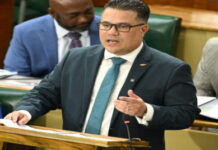
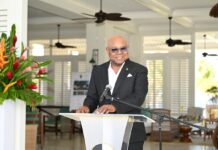
Foreign Affairs and Foreign Trade and Senior Minister, Kerri Symmonds, said. At the same time, he is aware of the “uncompromising voice which is perhaps unaccommodating” from the Trinidad and Tobago Prime Minister Kamla Persad-Bissessar. Still, he does not think, “I’m hearing genuine disharmony.
“I think, though, that it is always helpful for leaders to have dialogue. And if I could risk saying something to my superiors, because all of the leaders are obviously my superiors, I would want to say that it is perhaps best to have the dialogue behind closed doors and that there’s a sharing of concerns on all sides.
“I don’t think that anybody’s concern is illegitimate in this instance because the national security interest of any of our countries is a common national security interest. And, interestingly, in all of this, the missing thing that has not hit the headlines is the basic fact that, in CARICOM’s charter, security is seen as a regional undertaking. We don’t really speak to security as one island and not the other,” Symmonds added.
He said that security for this region is understood to be a common endeavour, “and I think that if we see it through that lens, then we will realise that we’re all pretty much in the same boat, even if we’re not paddling in the same canoe at this particular time.
In recent days, Antigua and Barbuda Prime Minister Gaston Browne has called on Prime Minister Persad-Bissessar to “produce the evidence” that CARICOM, including Antigua and Barbuda, had aligned itself with “the Maduro narco government headed by a dictator” in Venezuela.
She said that Venezuela has been threatening to invade Guyana for years, and since last June, they began making similar threats that Trinidad and Tobago are a part of Venezuela.
“Yet CARICOM has chosen to support the Maduro narco government through the fake zone of peace narrative, which is clearly designed to get the American military to leave the Caribbean region and therefore enable Maduro to remain as dictator in Venezuela.
“An organisation that chooses to disparage our greatest ally, the United States, but lends support to the Maduro narco-government headed by a dictator who has imprisoned and killed thousands of civilians and opposition members, as well as threatened two CARICOM members, is one that has clearly lost its way,” Persad-Bissessar said in a statement.
My priority is in the best interests of the citizens of Trinidad and Tobago,” she added.
Symmonds told reporters that while he is hearing “ an uncompromising tone because, obviously, the new prime minister has to project a certain sense of authority and power…I also believe that this region is simply facing a moment of uncertainty.
“And there will be in a regional relationship of sovereign states, moments where there’s some tension, a moment of some difficulty,” Symmonds said, adding he believes that “we are in a better position in this region in terms of cooperation than the world is in terms of its own collaboration.
“We’re in a better position in terms of trust and dialogue than the world is in terms of its own trust and dialogue among nations. But this is just a moment in time. It is not eternity. They’re inevitably going to be concerned about the need for us to consider several factors arising from national sovereignty and national interest.
The Barbados Foreign Minister said that Prime Minister Persad-Bissessar is speaking about her country’s national interest, and “she is thinking, I believe, largely about the state of the oil and gas sector in Trinidad”.
He said when he listens to Prime Minister Persad-Bissessar, “though she reflects primarily on the interest of Trinidadian people, there are some unshakable considerations that CARICOM stands on.
“The regional organisation is the reason for all of us, being part of it simply because it is through that organisation that we have collective strength, that we have stability,” he said, noting “we all lack a certain amount of capacity.
“We lack technical expertise in many areas. We lack financial resources. May I say Trinidad, at this moment, is facing a massive credit squeeze? Their Central Bank is not allowing any entity to get more than 2,000 US dollars or thereabouts in any given month. These are considerations that I know have to be at the back of the prime minister’s mind.”
Symmonds said that the question of the institutional capacity of any one country, even Trinidad, to go it alone would obviously have to be raised.
“And I don’t think that when I look at the trade statistics, I see that it is going to unplug itself from CARICOM. The trade statistics tell me that, for example, in 2024, Trinidad and Tobago would have earned around one billion US dollars from CARICOM Trade.
“They’re not going to walk away from that. In fact, that is the second largest trading partner that Trinidad and Tobago has outside of the United States itself,” Symmonds said, noting that the Common External Tariffs (CET) makes goods coming into the region much more expensive and works in favour of Trinidad manufacturers “because our consumers are paying a tariff to protect domestic manufacturing.
“But what is the country with the most extensive manufacturing base in CARICOM? That country, as you know, is Trinidad and Tobago and has always been so that they’re benefiting a great deal from CARICOM.
“I hear you talk about CARICOM being an unreliable partner, but my own judgment is that, you know, … it depends on where you sit and what you’re thinking about at the time when you say these things because there are not many people in the world who are going to look to the North and say that that which they see is either paternal, collegial relationship or that that which they see is something that can be depend can be depended on, in the context of reliability.”
Symmonds said that in an unpredictable world where you’re “not getting the sense of fraternity and camaraderie and collegiality that perhaps you may have wanted to see, I don’t know that you’re going to walk away from a CARICOM which has been a trusted, and true proven partner.
“So I hear the noise, and I think what we have to do is to remember what I just described as being the fundamental and the unshakable considerations that keep this, have kept it together. That is as far as I could say to you on that,” Symmonds said.










 and then
  leaders meet “behind closed doors)