





































WASHINGTON, CMC – The Electoral Observation Mission (EOM) of the Organization of American States (OAS) is recommending that Jamaica conduct a thorough assessment of the Voters’ List to determine the need for a new enumeration process, as well as do more to ensure that more women participate in the electoral process.
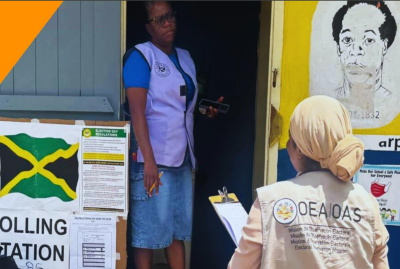
The EOM, headed by former St. Lucia Prime Minister Dr. Kenny Anthony and comprising 23 experts and observers from 16 countries, observed the September 3 general election in Jamaica, which, according to preliminary figures, was won by the ruling Jamaica Labour Party (JLP).
Prime Minister Andrew Mason led the JLP to an unprecedented third consecutive term in office, winning 34 of the 63 seats in the parliament, with the remainder going to the main opposition People’s National Party (PNP).
In its full preliminary report released here, the EOM stated that between 2011 and this year, the Voters’ List expanded by 26.08 percent, rising from 1,648,036 to 2,077,799 electors.
It also noted that the Voters’ List is updated twice annually, on May 31 and November 30. According to the Electoral Commission of Jamaica (ECJ), this process allows for the verification of addresses and the removal of ineligible voters, including deceased persons.
“However, the Mission was informed that challenges remain in ensuring the accuracy of the register. The ECJ collects information on deceased voters from various sources, including newspapers, though no centralized system exists for this purpose,” the report noted.
It stated that electoral authorities also highlighted that declining turnout may be partly linked to the size and accuracy of the Voters’ List. In this regard, officials identified a possible solution in the form of a new voter enumeration exercise, which would allow for a comprehensive update of the Voters’ List.
The EOM said that while such an initiative would be costly, ECJ representatives indicated that it could be completed in less than one year.
As a result, the EOM recommends that Jamaica conduct a thorough assessment of the Voters’ List to determine the need for a new enumeration process. Implement a more frequent cleansing process and consider establishing more formalized information-request mechanisms through institutional agreements and exchanges with the relevant authorities to facilitate the upkeep of the Voters’ List.
The EOM noted that although there is no specific data on the number of voters with disabilities in the Voters’ List, the electoral authority has regulations and procedures in place to accommodate voters with physical and visual impairments.
Voters with disabilities may be assisted by the Presiding Officer or by a friend accompanying them, who may mark the ballot on their behalf.
The EOM said that the ECJ is considering the future implementation of special ballots or voting in Braille and that civil society organisations have called for additional measures, such as the introduction of technology to guide deaf persons and the implementation of portable ramps in polling stations.
The EOM said that to further ongoing efforts to ensure the right to vote for persons with disabilities and older people, it is recommending that the authorities carry out inclusive consultations on the best ways to implement new accessibility measures for persons with disabilities, and to ensure such persons, as well as elderly voters, are prioritized.
They should also consider the issuance of special tags identifying vehicles that transport persons with disabilities.
The EOM noted that the Representation of the People Act (ROPA), first enacted in 1944 before independence, continues to serve as the primary legislative framework for the conduct of elections.
It stated that since its passage, the Act has been amended approximately 37 times to reflect evolving political and electoral realities, but that the legislation has never been fully reenacted as a consolidated instrument.
“ECJ officials underscored that, notwithstanding its colonial origins, the ROPA is regarded as one of the most robust electoral statutes in the Caribbean and has provided the foundation for significant progress in the administration of elections in Jamaica,” the report noted.
Nevertheless, it has been noted that the cumulative effect of successive amendments, many of which are not consolidated into a single text, creates difficulties for electoral actors, observers, and the broader public in interpreting the law and obtaining a clear and complete picture of the current electoral framework.
The EOM stated that such fragmentation may create uncertainty in the application of electoral rules for stakeholders, noting that international standards emphasize the need for electoral legislation to be clear and accessible to ensure legal certainty, a cornerstone of credible electoral processes.
As a result, the EOM recommends that Jamaica consider a comprehensive revision and reenactment of the ROPA to modernize the legal electoral framework further and provide a single, authoritative text that enhances clarity, certainty, and accessibility for all electoral stakeholders.
On the issue of political or electoral finance, the EOM noted the efforts made by Jamaica, and particularly the ECJ, in promoting political finance legislation and regulations in 2016 and 2017, respectively, making the country a pioneer in the Caribbean in this field.
It stated that such advances are in line with previous OAS/EOM recommendations and aim to strengthen equity and transparency in electoral campaign financing.
Furthermore, the legislation established limits on private contributions and expenditures, set standards for impermissible contributors, outlined guidelines for making contributions, required declaration and disclosure by contributors, specified the responsibilities of reporting and disclosure by political parties and candidates, and established penalties.
However, the EOM stated that regarding equity in financing, the information it has obtained indicates that the financing mechanisms created to channel both private and public resources into campaigns, on a reimbursement basis, have not been utilized.
It said that the legal framework establishes a mixed (public–private) political finance system for campaigns; however, in practice, financing remains entirely private.
Jamaica’s legislation establishes two reimbursement mechanisms: the National Election Campaign Fund (NECF), which was intended to be funded by private contributions but administered by the ECJ, and the State Funding mechanism, which uses allocations from the national budget.
“The reality, however, is that parties and candidates generally rely on direct private financing for their campaigns –typically their own funds, party resources, and donations from individuals, companies, and diaspora groups,” the EOM said, adding that based on the information it received, reimbursement mechanisms seem to be perceived as burdensome.
It said that some opinions shared with it suggest further exploring options for public financing of campaigns, aimed at guaranteeing equal access to resources and reducing reliance on private contributions.
In this regard, the EOM recommends that the authorities consider an alternative system of advanced public campaign financing for parties and candidates, subject to strict reporting and accountability rules.
There is also a need to evaluate the current legislation to facilitate access and promote the use of reimbursement mechanisms of state funding, while maintaining accountability standards.
The Jamaican electoral framework emphasises transparency as a cornerstone of campaign finance, defining both the campaign period and the reporting period to set clear timelines for disclosure.
The campaign period runs from the official announcement of elections until 24 hours before polling. In contrast, the reporting period extends from that moment until days after the end of the campaign period.
The EOM said that this extended timeframe ensures that the ECJ can review all relevant financial data. However, it stated that disclosure remains strictly post-electoral, and there is no obligation for pre-election disclosure.
“This reduces the possibility of casting an informed ballot based on financial transparency. More broadly, the Mission’s findings identified access to information as a challenge. Although the various reports submitted to the ECJ are formally public, they are not systematically published in a timely or user-friendly manner.
“Along with compliance with the electoral authority, transparency efforts should also be oriented towards informing the electorate. This transparency deficit had already been noted in previous OAS reports, including in 2011, and continues to limit the effective exercise of the right of access to information, as the Mission was informed.”
As a result, the EOM recommends that Jamaica ensure ordinary and final disclosure reports are proactively published in a timely and accessible manner, and that the authorities also consider the future establishment of partial disclosure reports to be submitted during the campaign period.
Regarding women’s participation in Jamaica’s elections, current campaign finance legislation and policies do not include any form of reserved funding or incentives to promote women’s political participation.
The EOM stated that it had heard from key actors that women’s access to campaign funding remains a challenge and a potential deterrent for those without private wealth or access to campaign funding.
It therefore recommends to the ECJ, political parties, and civil society that they consider targeted measures, such as reserved financing or incentives for parties, to strengthen women’s access to resources in electoral campaigns.
The EOM said that it also heard repeated concerns about gender stereotyping in the political field and different expressions of gender based violence.
It said threats, intimidation, and other forms of gender-based political violence still pose significant challenges to women’s participation, including to prominent women in Jamaican politics.
To address issues that deter women’s participation in politics, the EOM recommends the codification of specific offences related to gender-based violence against women, including candidates.
“Women comprise 50.5 per cent of the population of Jamaica but only hold 28.6 per cent of the seats in the House of Representatives after the last general elections,” the EOM noted.









 and then
  of the Organization of American States (OAS) is recommending that Jamaica conduct a thorough assessment)