

















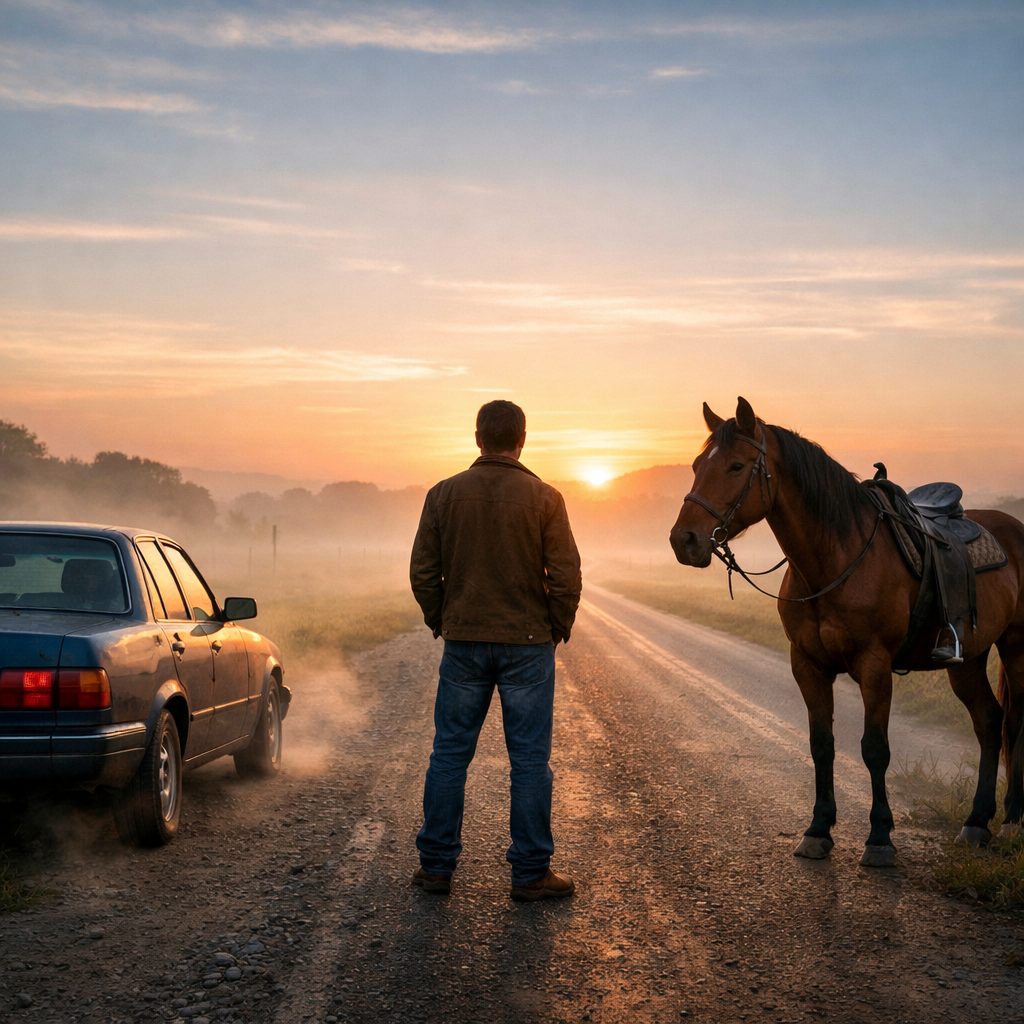
The man stood at the edge of the road just before dawn, mist curling around his shoes like a question he wasn’t ready to answer. To his left was an old car, paint faded, engine ticking softly as if it were thinking. To his right, a horse grazed calmly, breath rising in small clouds. All three had arrived at the same place, yet for very different reasons.
The man had walked all night. He was tired of maps, tired of plans, tired of being told where he should be by now. His feet hurt, but his mind felt strangely light. Walking, he realized, forced him to face every mile honestly.
The car had once been fast and proud. It remembered highways and open skies, long trips filled with laughter and loud music. Now it waited, patient but dependent, unable to move unless someone chose to turn the key. It didn’t mind. It had learned that speed meant nothing without direction.
The horse lifted its head and looked at the man with dark, steady eyes. It had traveled this road many times, not to escape or to arrive, but simply because the grass grew better on the other side. It trusted the rhythm of its body and the memory of the land.
As the sun rose, the man understood something heavy and straightforward at once. He could walk like a man, choose like a man. He could drive like a car, fast and efficient, if he wanted. Or he could move like the horse—steady, instinctive, alive in the moment.
He smiled, patted the horse’s neck, and climbed into the car. Not to rush, not to run away, but to meet the road halfway—human enough to choose, mechanical sufficient to endure, and wise enough to remember that sometimes the journey matters more than how you travel it.








 and then