
































UNITED NATIONS, CMC -Two Caribbean Community (CARICOM) leaders Friday urged the international community to take immediate action to assist Haiti in dealing with a wide range of issues as the global organization seeks to raise an unprecedented US$719 million this year to restore livelihoods in the French-speaking CARICOM country.
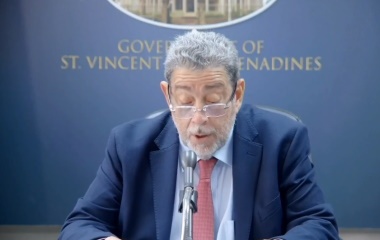
St. Vicent and the Grenadines Prime Minister Dr. Ralph Gonsalves, who is also the ProTempore President of the Community of Latin American and Caribbean States (CELAC), said Haiti, already burdened with a toxic web of multifaceted challenges, continues to grapple with a food crisis that threatens the life of its population.
“It is within this context that we address you with a deep sense of urgency,” Gonsalves said, adding that the situation “necessitates urgent attention, the realization of which we must confirm into concrete action.
“The unprecedented appeal of US$719 million…almost double that of last year is indicative of the severity of the current circumstances,” Gonsalves told the meeting convened on the proposal of the Chair of the ECOSOC Ad-Hoc Advisory Group on Haiti (Canada).
The special meeting focused on mobilizing action for emergency food assistance and emergency livelihood assistance and building sustainable food systems in Haiti.
Gonsalves said that almost five million people are food insecure in Haiti, with an estimated 20,000 people facing famine-like conditions.
“We underscore the need to mobile greater support for the humanitarian response plan to ensure its full operationalization and appeal to not only existing donors to increase their financial contributions but to non-traditional donors to consider supporting collective efforts.”
Jamaica’s Prime Minister Andre Holness, who delivered the feature address at the event dubbed “Savings Lives: Addressing Food Security Needs of Haiti,” said he was determined to add Jamaica’s voice to this advocacy meeting “bearing in mind the total commitment we have made to support our brothers and sisters in our neighboring CARICOM state of Haiti.
Holness informed the meeting that his address comes on the heels of the three-day deliberations on Haiti held in Kingston this week, and Friday’s meeting “could, therefore, not be more timely.”
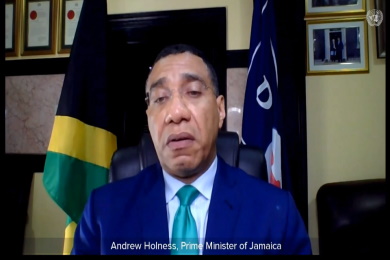
He said it provides evidence of the need for “a continuum of care in the international community’s response to the situation in Haiti.”
He said the statement following the meeting in Kingston “noted that based on the proposals and commitments made, there is a determination to continue consultations…including in Haiti.
“This is a welcome development and represents a continuation of CARICOM’s good office’s role towards restoring the sustainability of this great nation.
“Jamaica and CARICOM have agreed to support Haiti towards reestablishing political stability and, importantly, addressing security concerns. Simultaneously we continue to have our eyes on the humanitarian situation, but we also acknowledge the need to address the security issues which have impeded basic human needs.”
Holness said he is convinced that a broad section of critical stakeholders need to be heard in Haiti “if there is to be any chance for implementable solutions to the challenges in the country.
“It is also clear that Haitian solutions must be encouraged and respected,” he said, noting the critical role CARICOM and the international community would have to play in Haiti’s development.
He said half of Haiti’s population is today facing hunger, “a number that has regrettably grown since the start of the year.
“it is also profoundly alarming that the children of Haiti, the country’s future, are being disproportionately affected as they face a high risk of malnutrition, underdevelopment, illness, and death.
“The humanitarian crisis is compounded by increasing violence and insecurity forcing many to flee their homes or leave the country,” Holness said, adding, “The call is urgent, the need is clear, let us do all that we can, as much as we can to help our brothers and sisters in Haiti.”
ECOSOC President, Lachezara Stoeva, said words are not enough to alleviate the multiple crises afflicting Haiti
“This plan targets 3.2 million Haitian people, whereas around 5.2 million Haitian people are in need. This should be our wake-up call”, she told the group of Prime Ministers, UN aid chiefs, civil society, and other stakeholders gathered at UN Headquarters in New York.
During the high-level meeting, the Executive Director of the World Food Programme (WFP) and the UN Children’s Fund (UNICEF) announced they would travel to Haiti in the next few days to highlight the depth of the crisis there.
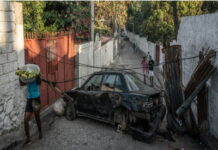
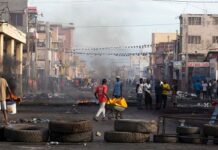
The recent earthquake, flooding, and landslides have exacerbated political and economic turmoil combined with rampant insecurity and violence perpetrated by armed gangs – all of which have triggered a food and health crisis for millions.
“We must learn the lessons of our past efforts in Haiti. A whole-of-society approach that engages the Haitian people would be key to building resilient food systems”, she said, calling for bold thinking combined with immediate action.
Bob Rae, chair of the ECOSOC Advisory Group on Haiti, said the crisis was continuing to deteriorate “at an alarming rate.”
Humanitarian needs have doubled in the last year. Now 1.8 million Haitians face emergency food insecurity, and nearly five million do not have enough to eat. “This represents half of the country’s population,” he added.
UNICEF chief Catherine Russell warned that the country was “on the precipice of catastrophe.”
She reminded the meeting the agency had worked in Haiti for decades and remained deeply committed to supporting all children there.
“Alongside our partners, we are engaging with community leaders and other relevant stakeholders to facilitate the safe movement of humanitarian workers and supplies,” she said.
“We are also expanding our response in health, nutrition, protection, education, water, sanitation, and hygiene. So far this year, we have screened more than 243,000 children under five for wasting, helped nearly 70,000 women and children access healthcare, provided more than 417,000 people with safe water, and reached 30,000 children with learning materials.”
She said that action is now long overdue, announcing her intention to go to Haiti “in the coming days” to assess the collective response and “reiterate UNICEF’s commitment to helping the Haitian people.”
Investments and action are sorely needed for Haiti, she said.
“Let’s work together to make sure this happens. Together we can join the Haitian people to break through the cycle of crises and begin building towards a more peaceful and hopeful future.”







 and then
  leaders Friday urged the international community to take immediate action to assist Haiti in dealing)