











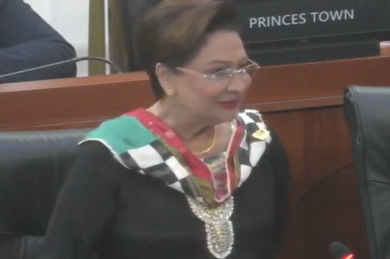
PORT OF SPAIN, Trinidad, CMC – Prime Minister Kamla Persad-Bissessar, Friday, described her recent visit to the United States as just not being diplomatic, but as “a strategic victory for Trinidad and Tobago”.
“A win for our security. A win for our economy, and a win for the future of our nation. Trinidad and Tobago’s government was present. Trinidad and Tobago’s government was heard, and Trinidad and Tobago’s government will continue to stand strong in defence of our law-abiding citizens,” Persad-Bissessar told Parliament in a statement regarding her meeting with US President Donald Trump and her attendance at the meeting of select leaders from across the western hemisphere at the inaugural Shield of the Americas Summit last Saturday.
She said that Trinidad and Tobago stands proud to be part of a new partnership, namely, the Americas Counter Cartel Coalition, which she described as “a strategic alliance designed to confront cartel violence through coordinated security, intelligence sharing, and joint operations across the Americas”.
“I stand here today to inform the people of Trinidad and Tobago that our continued partnership with the United States, and now with partners across Latin America, can only augur well for our nation, especially in the critical area of security.
“Many people do not yet fully understand the significance of this coalition. It is a shield for the people of Trinidad and Tobago,” she said, extending her “deep gratitude” to President Trump for including Trinidad and Tobago in this historic coalition.
Apart from Trinidad and Tobago, the only other Caribbean Community (CARICOM) country included in the coalition is Guyana. The other members, apart from the United States, are Argentina, Bolivia, Chile, Costa Rica, Dominican Republic, Ecuador, El Salvador, Honduras, Panama, and Paraguay.
Persad-Bissessar told legislators that Trinidad and Tobago’s crime crisis cannot be solved in isolation and that the dangers posed by illegal drugs, illegal firearms, and organized gangs are not local problems.
“They are part of a transnational criminal system stretching from South America through the Caribbean into North America. These networks move cocaine, heroin, and synthetic drugs through our waters and ports. In return, illegal firearms and illicit money flow back into our communities.”
She said for small island states like Trinidad and Tobago, the consequences are severe, and that across the Caribbean, gangs now operate with sophisticated financing, advanced weapons, and international criminal connections.
“This is not just a local problem. It is a hemispheric challenge requiring an international response,” she said, adding that is why upon assuming office in April last year, her administration “made it clear that Trinidad and Tobago would stand firmly with the United States and our regional partners in targeting narcotics traffickers and dismantling transnational criminal networks.
“For decades, Caribbean nations have complained that they are not heard on the global stage.
This time we were heard. This time we were seen. This time we were invited,” she said, noting that President Trump had in his address indicated that the US Secretary of War, Pete Hegseth, established “this coalition – a pledge from military leaders and representatives from 17 nations demonstrating that the hemisphere is ready to operationalise hard power to defeat threats to our security and our civilisation.
“These dangers will be addressed using every necessary resource and every legally available authority in partnership with our allies. The proclamation signed on March 7 makes this clear,” she said, noting “criminal cartels and foreign terrorist organizations in the Western Hemisphere must be fully dismantled.
“The United States and its allies will coordinate to deprive these organizations of territory, financing, and resources. Partner nation militaries will be trained and mobilized to dismantle cartel networks and prevent the export of violence. The hemisphere will stand together to keep malign external influences from destabilizing our region.”
Prime Minister Persad-Bissessar said that for Trinidad and Tobago, the benefits are substantial, including stronger intelligence sharing.
She said through this coalition, law-enforcement agencies will share real-time intelligence on trafficking routes, gang leaders, financial networks, and weapons shipments, adding, “With better intelligence, our security forces can act faster and more effectively.
“The Caribbean sits along some of the world’s busiest drug trafficking corridors. Through joint operations, surveillance support, and coordinated interdiction efforts, coalition partners can disrupt shipments before they reach our shores.”
She said one of the greatest threats facing Caribbean countries is the flow of illegal guns and that many firearms used in regional crimes originate outside the region.
“Through coordinated enforcement and investigative cooperation, coalition members can help stop these weapons before they reach our streets. Our police and defence forces will benefit from joint training, advanced technology, and operational cooperation.
“This will strengthen our ability to dismantle gangs, investigate financial crimes, and prosecute organized criminal networks,” she said, adding that the Americas Counter Cartel Coalition now becomes a powerful new instrument in our national security arsenal.
Persad-Bissessar said that during the summit, she was able to speak directly with President Trump, “thanking him for his support of Trinidad and Tobago (and) I reaffirmed our commitment to working together in the interests of our people and our hemisphere.”
She said she also met with the summit’s special envoy, Kristi Noem, the dismissed Secretary of Homeland Security, to discuss border security and ongoing cooperation.
Persad-Bissessar told Parliament that before the summit, Defence Minister, Wayne Sturge, attended the Americas Counter-Cartel Conference, where he placed the challenges facing Trinidad and Tobago directly on the table and made it clear “we are on the front lines of this fight, and we need stronger support to disrupt drug cartels and protect our national interests, including our vital energy sector”.
She said that a joint security declaration was signed by 17 countries, reaffirming their shared commitment to peace, sovereignty, and stability in the region, and that the diplomatic successes continued with several bilateral meetings, including one with US Secretary of State Marco Rubio and Deputy Secretary of State Christopher Landau to discuss further engagement in the region, including developments involving Venezuela.
She said that following the summit, she visited United States Southern Command (SOUTHCOM), where she met with Commander General Donovan and extended an invitation for him to visit Trinidad and Tobago later this year.
“Our discussions focused on strengthening defence cooperation and combating designated terrorist organizations operating within the Caribbean. Once again, I used that opportunity to make our case directly: Trinidad and Tobago needs greater support in areas such as cybersecurity, forensics, ballistics, and intelligence,” Persad-Bissessar added.

 and then