






































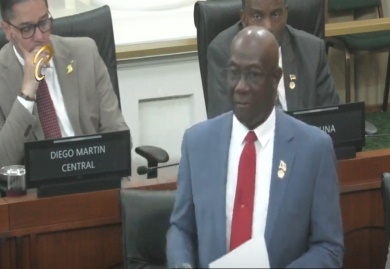
PORT OF SPAIN, Trinidad, CMC—Prime Minister Dr. Keith Rowley on Monday said that his government has no intention of devaluing the local currency, dismissing suggestions that the country is facing a shortage of foreign exchange (forex).
In recent times, the opposition and others in the public domain have called for the government to introduce policies to devalue or float the local currency, which is trading at approximately One TT dollar to US$0.16 cents.
“We have noticed a recent deliberate attempt to pressure the government to devalue the currency. Let me save them from wasting their time today,” Rowley told Parliament.
“There will be no devaluation of the currency because, Madam Speaker, the pressure on the government to devalue the currency is coming from people who have foreign exchange largely, using their attempt in the country to make it an issue, ignoring the fact that any devaluation could only result in increased costs across the board,” Rowley told legislators.
He said that if the government devalues the local dollar, “it would make those with foreign exchange wealthier because they will get more Trinidad and Tobago dollars.
“So, to pressure the government to devalue the currency, we must be the only country in the world where people are demanding to devalue the currency to increase their wealth from those who have to pay it. This is special interest pressure. The government will not bow to it,” Rowley said to loud applause from the government legislators.
Regarding the issue of foreign exchange, Rowley said the amount of foreign exchange available within the banking system during the period 2023-24 is “about the same” as that available in 2014, when the People’s Partnership government was in office.
“That is approximately seven billion US dollars. So there has been no reduction in the market,” he said, adding that of this total, the government directly injects 2.5 billion annually.
He said the banks acquire the remaining 4.5 billion dollars directly from the United States dollar-earning clients.
Rowley said this year, “There is an increase in demand for foreign exchange due to the economic growth and an increase over the years in a taste for foreign goods and for the use of online purchasing.”
He said that Finance Minister Colm Imbert is currently meeting with stakeholders to determine the reasons for the increase in demand and to arrive at a consensus on the way forward.
He said this may involve more regulation of the method and manner of banks’ distribution of the government’s foreign exchange that the Central Bank of Trinidad and Tobago injects into the commercial banking system monthly.
He said that the finance minister has already met with the leaders of the four largest commercial banks in the country and will meet with business organisations over the next month.
“I simply want to add that there is a misalignment between the appetite to spend foreign exchange and the ability to earn foreign exchange,” Rowley said, noting, “We do not create foreign exchange in this country except by earning it.”
Je said the government has arrangements in place to ensure that certain basics are funded, such as medicine, food, and manufacturing.











 and then