




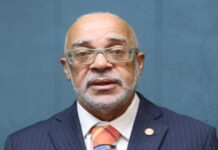






























PORT OF SPAIN, Trinidad, CMC – Trinidad and Tobago’s Defence Minister Wayne Sturge says the Government has recorded significant gains in the fight against drug and gun trafficking since taking office eight months ago, but has raised concern over 28,000 rounds of ammunition that remain unaccounted for and the continued entry of illegal firearms through legal ports.
He told the Trinidad Express that the scale of criminality inherited by the current administration could not be reversed quickly. Still, he insisted the Government is moving aggressively to strengthen national security.
“We have already removed the URP (Unemployment Relief Programme), which fuelled turf wars, and we have started the employment drive to assist with social and economic issues,” Sturge said. “We are very concerned that we have 28,000 rounds of TTR ammunition unaccounted for…. A substantial reduction in the availability of ammunition for use by the criminal element will be a big win for the Government and the law-abiding.”
He also defended the effectiveness of a radar system installed in Tobago by the United States military, saying it has played a role in recent drug interdiction successes.
“I am advised that the radar did in fact play a part in the recent drug busts,” the defence minister said. “A routine Google search would show that radar systems most times do not operate in isolation but as a component of a larger system, which may include satellite systems as well as military-grade drone systems.”
Sturge said the country’s capacity to detect illegal trafficking was severely limited before the installation of the radar systems.
“Before the acquisition of the military radar systems installed, our capacity was limited; the results now speak volumes, and the criminal element would concede that deliveries are at a bare minimum and mostly through ports of legal entry, which we will address shortly,” he said.
According to the minister, the enhanced surveillance has sharply reduced the flow of drugs into the country.
“The radar systems have significantly improved surveillance, making it extremely difficult to penetrate our borders with the type of regularity which the criminal element hitherto enjoyed,” Sturge said. “I am virtually certain that a visit to the various drug blocks would reveal an extreme scarcity of drugs on a scale not previously seen. Availability is at an all-time low.”
He added that before the acquisition of the radar systems, Trinidad and Tobago was “severely hamstrung” because of limitations in both radar capability and naval assets, but said the presence of the US Navy in the Southern Caribbean has brought “tangible benefits.
He confirmed that information obtained through the radar system is shared with local law enforcement, “through appropriate channels.
The defence minister also linked reduced gun and drug smuggling to efforts to curb gang violence.
“We are satisfied that gun and drug smuggling is at an all-time low due in large part to the presence and assistance of the US Navy in the region,” he said. “Once we eradicate or further significantly reduce the import of illegal drugs, firearms, and ammunition, particularly through legal ports of entry, we are certain that we would, as a consequence, be better placed to reduce gang violence.”
He noted that while long-term solutions require social and behavioural interventions, immediate reductions in violence depend on cutting off access to weapons and ammunition.
“In the short term, violent crime is reduced by eradicating the proximal causes, that is to say, once there are no guns or no ammunition for use, settling turf wars would of necessity revert to what obtained before, bottle fights, knives, cutlasses,” Sturge said. “Once the proximal causes of violence are dealt with decisively, we can treat the root causes of violent crime and criminality through behavioural change and socio-economic programmes in the medium to long term.”
Meanwhile, the Ministry of Foreign and Caricom Affairs said earlier this month that permission has been granted for the United States military to transit through Trinidad and Tobago’s airports, as part of ongoing cooperation between the two countries.










 and then