




































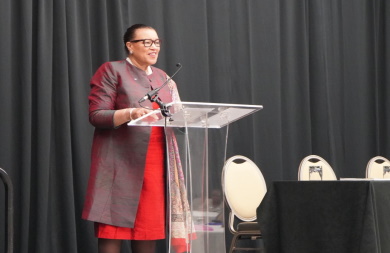

PORT OF SPAIN, Trinidad, CMC – A three-day conference discussing methods of reversing the tide of violence committed by young men began here on Wednesday with the
Commonwealth Secretary-General, Patricia Scotland, noted that the level of violence in young males “is unacceptable.
“The pain and trauma of their loss to their families, communities, and us as a generation is unbearable. The pain cuts deep into our hearts, diminishes all of us,” Scotland told the event organized by Lifeline, a local non-profit organization.
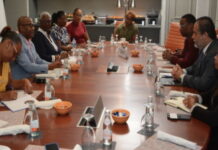
It has brought together participants from across the Caribbean, the United States, the United Kingdom, and Canada, with the ultimate objectives of understanding the importance of collaboration in reducing male-perpetrated violence, strengthening public-private partnerships in the quest for an end to male-perpetrated violence, and the creation of action plans for the development of Multi-Agency Risk Assessment Committees (MARAC).
Scotland told the “The Violence Self and the Young Male V: Collaboration is Essential conference that 30 years after the first conference was held here, she is saddened that “we are still talking about this issue” and that “little seems to have changed.
“Sad that the world has chosen to let it be so and even sadder knowing that what should and could have been done has not been done,” she said, urging that “change is possible” and that 30 years later, “if we choose, can be the judges of change.
“We have the power and the opportunity to be the change if we are prepared to act together,” she said, noting that “the level of violence in young males between the ages of 15-29 is unacceptable.
“We know the damage starts early in their lives. We know it is critical if a child is to thrive and grow into a healthy adulthood, that child must be loved, nurtured, given clear and consistent boundaries, and given a sense of safety.
“We know that each one of us needs to have made a secure attachment to another human being by the age of 22 months and that whatever we achieve by the age of 22 months will be the best indicator of what we are likely to achieve by the age of 22 years.”
The Commonwealth Secretary-General said domestic violence is the most significant cause of morbidity for women and girls, affecting one in every three women.
“We also know that children brought up in such homes, be they boys or girls, will be disproportionately affected by such violence.
“They are less likely to meet their developmental and educational milestones, more likely to appear in the criminal statistics, suffer mental health issues, including suicide, be unemployed, suffer from alcohol or drug addiction, and suffer disproportionately from other forms of dysfunction.”
She told the conference that such signs are generally discernible by the age of seven years and that their families often suffer from poly-crises- housing, debt, unemployment, and the level of stability and security, are limited.
“Their vulnerability is apparent. But the systemic response to the complexity of their needs is fragmented. We know a coordinated, holistic response is the only thing that will stem the pain suffered by the children trapped in this spiral of deprivation- none of which is usually of their making.
“If we don’t act by the time they are seven, we are likely to lose our chance to change their path to violence easily,” she said, adding, “If we do nothing by the time they are 11, we will probably lose them by the time they are 14 or 15 unless a serious intervention has been made. “
Scotland said that if a child is kept out of the criminal justice system before they reach 16, they are less likely to offend.
“The greater majority of young offenders were victims before committing a crime. When caught, it is unlikely that that crime was their first offense,” she said, insisting, “We can save them if we decide to work in unison, craft a multi-disciplinary safety net which requires us all to play our part: central and local government, business and community, third sector, philanthropists, and individuals.”
She said the MARAC approach has worked to address domestic violence, saved lives, and saved money, adding, “I believe it can work to keep violent young men too, allowing us to assess them and their needs and allowing us the chance to help them in a way that will help heal their pain and stem the violence.
“It has worked before, and I believe it can and will work again, particularly if used together with a Family Intervention program, similar to that which was successful in the United Kingdom,” Scotland said, recalling that from 2001-2010, as a British government minister she was entrusted with reform of the civil and criminal justice system and offender management which included the juvenile justice system and saw the benefit of applying such a holistic approach.
“We managed to reduce crime to the lowest level since 1981, reduce first-time entrants into the criminal justice system by 21 percent, reduce domestic violence by 64 percent, saving lives and the costs of domestic violence to the criminal justice system by £7.1 billion.
“I believe that we can- if we work together- do the same for those we love across the Commonwealth, especially for our vulnerable young men. All we have to do is choose,” she added.
Delegates will discuss several topics during the conference, including “Making Collaboration Central to National Policy on Violence,” “Administrative Systems which facilitation Collaboration,” and “Setting up and Operationalizing MARAC.











 and then