





































PORT OF SPAIN, Trinidad, CMC – The Energy Chamber of Trinidad and Tobago says a revitalised Venezuelan oil industry could potentially be one source for providing crude oil if the oil refinery in south Trinidad is restarted.
“If the refinery does restart, as everyone in the industry hopes, then the refinery operators will have to find new sources of crude to import. A revitalised Venezuela oil industry could potentially be one source,” the Energy Chamber said.
It said that over the past few years, there has been considerable discourse in the country about the opportunities to import natural gas from Venezuela to Trinidad for processing into petrochemicals or liquefied natural gas (LNG), and re-exporting the final products to international markets.
It said this remains a significant area of interest, especially with the Dragon gas field.
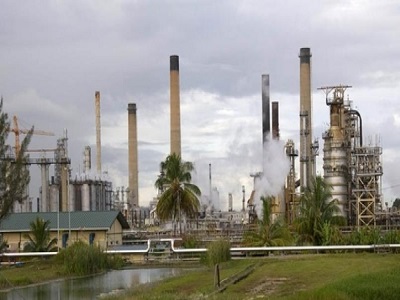
“While the current focus is on gas, there was a time in the past when Trinidad and Tobago imported substantial volumes of crude oil from Venezuela, primarily as feedstock for the now mothballed Point-a-Pierre refinery.”
The Energy Chamber said that in 2000, Trinidad and Tobago imported over 18 million barrels of crude from Venezuela, which at the time accounted for more than half of the country’s imports. It said this is equivalent to just over 50,000 barrels per day, roughly equal to the country’s current domestic production.
“To some, it might be surprising that Trinidad and Tobago imported oil at all. However, this was mainly done to supplement domestic production for the refinery, as local output fell. Annually, the country imported around 30 million barrels (over 80,000 barrels per day) of crude from sources around the world, including Venezuela, other parts of Latin America, Canada, Russia, and Africa.”
The Energy Chamber said that the crude oil imported from Venezuela did not all go to the refinery for processing, and that some volumes were imported, stored, and re-exported.
“There was also Venezuelan crude that was processed at Point-a-Pierre to create lube oils for export.”
The Energy Chamber noted that in the early 2000s, PDVSA, the state oil company of Venezuela, was actually a member of the Energy Chamber, then called the South Trinidad Chamber, regularly attending and speaking at the Trinidad and Tobago Energy Conference.
“Over time, however, this relationship slipped, as did the imports of crude from Venezuela. The imports eventually stopped in 2009, after which other sources were sought. During the peak years, Venezuelan oil played a critical role in supporting refinery operations, supplying the volumes needed to sustain output.
“The refinery has a capacity of approximately 175,000 barrels of oil per day. Domestic production from Trinidad and Tobago alone could not meet this demand; therefore, imports were necessary to keep the refinery operational.
“In 2018, when the refinery closed, domestic production was 63,000 barrels per day. Production continues to slip, however, and domestic production now stands at approximately 53,000 barrels per day,” the Energy Chamber said.
Following the United States military invasion of Venezuela earlier this year, President Donald Trump has indicated that Washington will run the South American country for the foreseeable future.
Venezuela is sitting on 303 billion barrels of crude, about a fifth of the world’s reserves, according to the US Energy Information Administration (EIA).
The Trinidad and Tobago government has already indicated that it is exploring the possibility of regional and international partners being involved in the restart of the state-owned oil refinery that was shut down in 2018 when the former government said the cost of upgrading the refinery would have loaded the company with an unsustainable debt burden estimated at TT$12 billion (One TT dollar=US$0.16 cents).
Energy and Energy Industries Minister Dr Roodal Moonilal said the Kamla-Persad Bissessar administration has given serious consideration to the “Interim Report of the Refinery Restart Committee” led by former energy minister Kevin Ramnarine, last month.
Last December, Prime Minister Persad-Bissessar said her government would restart the state-owned Petrotrin oil refinery and that the findings of the committee “are clear, restarting the Guaracara Refinery is technically, commercially and financially viable even after seven years of closure and neglect”.









 and then