






































NEW BLACK INSTITUTE REPORT EXPOSES ‘INVISIBLE TAX’ ON BLACK NEW YORKERS, LEADING TO FAMILIES PAYING MORE FOR CAR INSURANCE BASED ON ZIP CODE, NOT DRIVING RECORD
By Caribbean Times
NEW YORK—A new report from The Black Institute exposes what many Black and Caribbean New Yorkers have long suspected: auto insurance companies systematically charge families in Black neighborhoods thousands of dollars more than in other neighborhoods, not because of how they drive but because of where they live.
The report, Car Insurance Premium Pricing in Black and White: Analyzing Risk, Race, and the Cost of Living Crisis in New York, documents how insurance companies use so-called “proxy variables” such as zip code, education level, occupation, and credit score as stand-ins for race in calculating premiums. The result is an invisible tax that falls hardest on communities of color already stretched thin by New York’s cost of living.
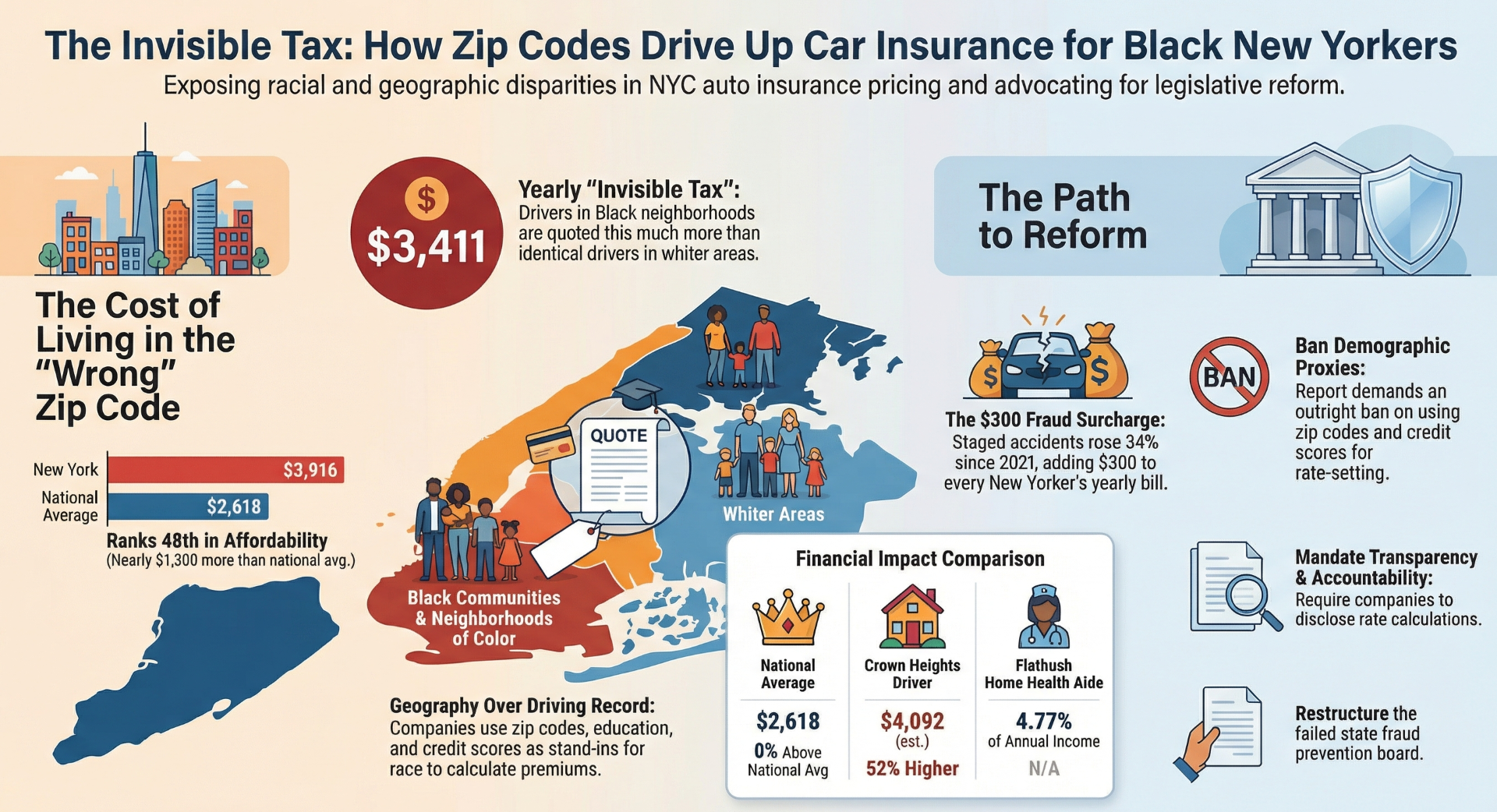
New York already ranks 48th in the nation for insurance affordability, with the average New Yorker paying $3,916 annually—$1,298 more than the national average. But the numbers get worse when race enters the picture. According to data cited in the report, drivers with clean records but low credit scores in predominantly Black zip codes are quoted an average of $3,411 more per year than drivers with identical profiles in whiter, more affluent areas. That is a month’s rent, a child’s school supplies, or a family’s grocery bill for three months gone because of an address.
For the Caribbean community and Black working families across the boroughs, this is not an abstraction. It is the home health aide in Flatbush working double shifts who watches 4.77 percent of her annual income vanish into insurance payments. It is the livery driver in Crown Heights paying $341 more per month—52 percent above the national average—just to stay legal on the road. It is the small business owner in Bed-Stuy raising prices on every customer because his delivery driver’s coverage costs more than anyone in Albany seems to notice.
“These families are being penalized for living in their own neighborhoods,” said José Bayona, spokesperson for Citizens for Affordable Rates, the coalition fighting for reform in Albany. “A clean driving record should mean something. A working family in East New York should not be paying more than a driver upstate just because of their zip code. That is not risk calculation; that is discrimination, and it needs to stop.”
The report, prepared by researcher Keenan Thom and presented by The Black Institute, a Brooklyn-based action tank founded in 2010, draws on national studies, New York-specific data, and a detailed analysis of how the state’s No-Fault insurance system has become a breeding ground for fraud rings that drive up costs for everyone. New York recorded 1,729 staged accident incidents in 2023 alone, up 34 percent from 2021, and staged crashes and inflated medical claims account for 75 percent of all insurance fraud cases in the state. These schemes add an estimated $300 per driver per year, and it is honest, hard-working New Yorkers who foot the bill.
The Black Institute is demanding action on multiple fronts, according to the report: an outright ban on the use of zip code, credit score, and other demographic proxies in rate-setting; mandatory transparency from insurance companies on how rates are calculated; aggressive prosecution of fraud networks exploiting the No-Fault system; and a full restructuring of New York’s Motor Vehicle Theft and Insurance Fraud Prevention Board, which a state audit found had failed to meet, mismanaged nearly $330,000 in funds, and left the communities most in need of protection without resources.
The Citizens for Affordable Rates coalition, which includes community organizations serving Caribbean, Latino, South Asian, and Black immigrant populations across the five boroughs, has been sounding the alarm on these issues for years. The Black Institute’s report now provides the research muscle to back up what these communities already know from experience.
“The Legislature has a blueprint in front of them and a mandate from the people paying these bills,” Bayona said. “The only question left is whether Albany will stand with working families in Brooklyn, the Bronx, and Queens, or continue to let insurance companies write their own rules at the community’s expense.”
The Black Institute’s report calls on state and city lawmakers to act this legislative session to close the loopholes that make fraud profitable, ban the race-adjacent pricing practices that punish Black and immigrant neighborhoods, and build an insurance system that measures risk by how people drive, not by who they are or where they come from.
For New York’s Black and Caribbean communities, the time for incremental change has passed. The numbers are in. The research is detailed. Now Albany must act.
About The Black Institute: The Black Institute is a Brooklyn-based action tank dedicated to shaping public policy from a uniquely Black perspective. For more information, visit www.theblackinstitute.org
About Citizens for Affordable Rates (CAR): CAR is a coalition of citizens, advocates, and organizations dedicated to tackling the root causes of high insurance costs in New York. For more information, visit www.citizensforaffordablerates.com











 and then