



































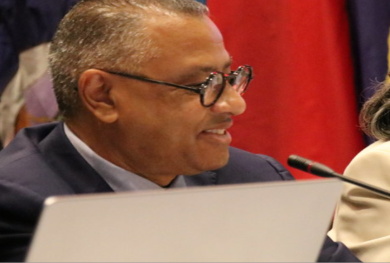
PORT OF SPAIN, Trinidad, CMC – Trinidad and Tobago’s Minister of Planning, Economic Affairs and Development, Kennedy Swaratsingh, said Monday that some of the principal structural vulnerabilities persistently facing the Caribbean have restricted the region’s fiscal spaces and slowed down productivity growth, among other challenges.
Swaratsingh, who is chairing the 22nd meeting of the Monitoring Committee of the Caribbean Development and Cooperation Committee (CDCC), said that the region stands at a critical juncture.
“Some of the main structural vulnerabilities we have persistently been working to alleviate include high debt, exposure to climate shocks, limited economies of scale, and an overreliance on a narrow set of economic sectors,” he told delegates to the conference being held under the theme ”Unlocking Caribbean potential: enhancing growth and development through South-South cooperation.
“ While these factors have restricted our fiscal space, slowed productivity growth, and hampered our ability to invest in more rapid and holistic diversification, human capital, and innovation, we have never given up as a region or made our presence felt on the world stage in terms of advocating for ourselves.
“Over time, we have also been strengthening a solution that is deeper, more structured, and strategic cooperation with our neighbours in the global South, especially within Latin America,” Swaratsingh told the opening ceremony, adding, “This is the focus of our conversation today.
Swaratsingh told the conference, which is being held in collaboration with the Economic Commission for Latin America and the Caribbean (ECLAC), that So
“It allows us to build partnerships that reflect our realities, our ambitions, and the unique vulnerabilities of Small Island Developing States (SIDS). For Trinidad and Tobago and the wider Caribbean, the question is no longer whether South-South cooperation is beneficial.
“The real question, and the one this seminar invites us to answer, is how we can leverage it more deliberately to support structural transformation, increase resilience, and expand opportunities for our society and citizens.”
Among the topics on the agenda are financing for development: finding ways to increase the Caribbean’s access to climate finance and other innovative funding for development mechanisms, as well as digital bridges for Caribbean integration and institutional strengthening: a South-South cooperation perspective
Swaratsingh said that whether in the digital sphere, resilience-building, innovation, the sustainable use of natural resources, or governance reforms, there is tremendous value in learning from the experiences of countries that have tackled similar challenges and achieved meaningful progress.
“For the Caribbean, one of our greatest assets is our proximity to a diverse and dynamic Latin American region. This diversity provides us with a range of development experiences, policy innovations, and institutional models that can help inform our own national and regional strategies.
“As we confront the long-term imperatives of economic diversification, climate resilience, food and energy security, and institutional strengthening, this network of Southern partnerships becomes even more valuable.”
But, Swaratsingh said, cooperation must be purposeful, saying that the Caribbean region must focus on building the capabilities and systems that allow us to translate collaboration into measurable development outcomes.
He said this requires modern, adaptable public institutions; stronger coordination among ministries and agencies; and a clear sense of national and regional priorities, adding that these are the foundations upon which meaningful cooperation is built.
“Equally important is the need for the Caribbean to approach South-South cooperation from a position of confidence. Our region is not only seeking support, but we also have expertise to share.
“The Caribbean has made meaningful strides in areas such as disaster preparedness, renewable energy integration, financial regulation, public service innovation, and cultural and creative industries. These experiences can add value to South-South initiatives and help shape a more balanced model of cooperation.”
Swaratsingh said as chair of the CDCC, Trinidad and Tobago is committed to supporting a more coherent and coordinated Caribbean voice within the broader Latin American and Caribbean framework.
“We believe that our collective priorities, sustainable development, economic transformation, social inclusion, and resilience are best achieved when tackled together. Strengthening our institutional platforms, improving information-sharing, and fostering a culture of collaboration are critical steps in this direction.”
He said today’s event is a critical space to reflect on how South-South cooperation can help us advance these shared objectives.
“But it is also an opportunity to reaffirm long-standing principles of solidarity, mutual benefit, equality of partnership, and respect for national priorities. These principles must continue to guide our efforts as we pursue new forms of cooperation and explore innovative ways of supporting the development of our people.”
He told delegates that they should use the time together not only to examine what is possible, but to identify practical, forward-looking approaches that will carry the region into the next decade of sustainable development.
“The future we seek is resilient, competitive, and inclusive, which depends on our ability to work together, to learn from one another, and to act with clarity and purpose,” Swaratsingh added.











 and then