

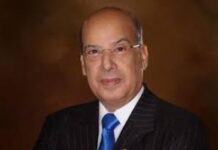






























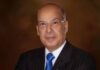
PARAMARIBO, Suriname, CMC – The Court of Justice has awarded the Speaker of the National Assembly, Ashwin Adhin, more than SRD400,000 (One SRD=US$0.02 cents) in compensation in a matter dating back to his arrest in November 2020.
His attorneys had sought SRD10 million in compensation, arguing that their client had been unlawfully deprived of his liberty for nine days.
Adhin was arrested as part of an investigation into the alleged destruction of equipment in the vice presidential office following his party’s loss in the May 2020 general elections. The opposition National Democratic Party (NDP) had condemned the arrest, saying arresting a Member of Parliament who has been a critic of the government “is a serious violation of democracy and also of the right of members of the National Assembly”.
In its ruling on Monday, the Court of Justice found that the then-acting Attorney General had overstepped her authority by ordering the arrest without the legally required permission of the National Assembly, in violation of the Criminalization of Political Office Holders Act, and that the Public Prosecution Service acted contrary to the prohibition against arbitrariness.
Attorney Irvin Kanhai said the Court of Justice, in awarding SRD403,000 to Adhin, a former vice president of Suriname, said it consists of compensation for the nine days Adhin was wrongfully detained, as well as compensation for legal costs and material damages.
Kanhai said SRD 100,000 was awarded for the wrongful detention, while the remainder was awarded to cover the attorneys’ legal costs.
The attorneys had also claimed a substantial sum for non-pecuniary damages, including reputational damage and psychological distress. But the Court of Justice, while it did not dismiss this claim, ruled that Article 77 of the Dutch Criminal Code does not allow for it.
As a result, a separate civil procedure must be initiated to assess non-pecuniary damages.
“The Court is not saying he is not entitled to this. But within the criminal law framework, the Court cannot give a substantive opinion on this,” said Khanai.







 and then
 )