





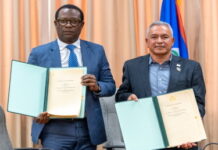














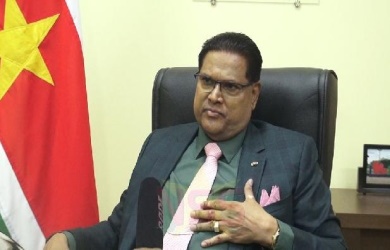
PARAMARIBO, Suriname, CMC – President Chandrikapersad “Chan” Santokhi has acknowledged that there are things he would have done differently over the past three years of his administration, also saying, “I have put a lot of time into preserving the coalition.”
In an exclusive interview with the Suriname-based online publication, Starnieuws, Santokhi said what has never been adequately exposed to the population is the Dutch-speaking Caribbean Community (CARICOM) country’s relationship with the International Monetary Fund (IMF) that resulted in his government having to phase out subsidies to the society.
He said the government also had to sign a memorandum of understanding with the Central Bank of Suriname on monetary issues and ensure that the recovery program was approved in the National Assembly (DNA).
He said that was the deal, adding, “We did it, and then the IMF would receive the financial injection and, at the same time, a budget for a social program.”
He said that while the government has done its part, the IMF has yet to be forthcoming and that it was only seven months later that the IMF agreement became a fact and money became available.
But he said, “We continued with our reform program; we continued with income-raising measures, which is immediately noticeable in society. We continued with heavy cuts, continued reducing subsidies, which is also palpable in society, but that financial support has not been forthcoming.”
He said that Suriname did not know that there was an issue within the IMF with the China issue, something that has to do with geopolitics and not so much with Suriname as a country, especially in debt restructuring.
“But in those seven months, I continued with those tough reforms without being able to support the people because we did not have that financial injection. And if I had known that, I would have started in July and said to slow down, wait a while with the measures, wait until the IMF gives board approval, and only then will we continue.”
He said all these heavy measures must be implemented with an administrative apparatus, and an administrative apparatus is a coalition, which is also a challenge.
“We know we don’t always have the same agenda,” he told the publication.
Earlier this month, the IMF announced that Suriname would receive US$53 million after the executive board of the Washington-based financial institution completed the fourth review under the Extended Fund Facility (EFF) arrangement for Suriname.
It said that the completion of the review allowed Paramaribo to draw the equivalent of SDR 39.4 million bringing total purchase under the EFF arrangement to SDR 197 million or an estimated US$263 million.
In completing the review, the IMF executive board also approved Suriname’s request for an augmentation of access equivalent to SDR 46.8 million or US$ 63 million and an extension of the EFF arrangement to end March 2025.
“With this augmentation, the total access expected under the EFF arrangement is SDR 430.7 million or about US$ 577 million,” the IMF said.
It said Suriname is implementing an ambitious economic reform agenda aimed at restoring fiscal and debt sustainability through fiscal consolidation and debt restructuring, protecting the vulnerable by expanding social protection, upgrading the monetary and exchange rate policy framework, addressing the financial sector’s vulnerabilities, and advancing the anti-corruption and governance agenda.
These policies are supported by the EFF arrangement, which was approved by the executive board on December 22, 2021.
In his wide-ranging interview, Santokhi said he has spent much time preserving the coalition that came to power in 2020.
In February this year, the Suriname National Party (NPS) announced that it was leaving the coalition government after two of its ministers were instructed to submit their resignations.
Education, Science & Culture Minister Marie Levens, and Spatial Planning and the Environment Minister Silvano Tjong-Ahin had been instructed to leave the government as the NPS also announced it was leaving the coalition that included Santokhi’s Progressive Reform Party (VHP). The NPS said it would be “an autonomous group in the National Assembly (and) will act as responsible DNA members.”
Santokhi said, “I have put a lot of time into that unity within that coalition, and fortunately, we see that there are no fundamental differences when it comes to the primary goals that we want to achieve, the measures we want to take.
“ But the shoe pinches, especially when it comes to concerns appointment policy, and that is where the issue lies,” he said, noting that the coalition is slowly coming into line.
“Now it is time for better candidates; how long have I waited to appoint ministers? You have to investigate all sides, then you notice when you have a minister and that the framework is not present there, then you have to framework there too.
“It is a challenge where you have to consider that you also have to invest in that coalition. Otherwise, you will not achieve these goals,” Santokhi said, noting one of the most important lessons was that he should have been a little more challenging with his appointment policy.







 and then