

























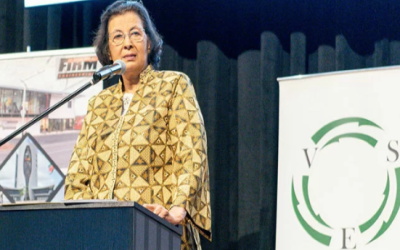
PARAMARIBO, Suriname, CMC – President Jennifer Greelings-Simons says Suriname must now take responsibility for coherent fiscal, monetary, and structural policies, insisting that macroeconomic stability is not an end in itself but a necessary condition for sustainable growth and a fair distribution of wealth.
“We started in a context of scarcity, a fragile, recovering economy, and limited public trust. This doesn’t require grandiloquent rhetoric, but direction, discipline, and implementation,” she told the Association of Economists in Suriname (VES) at its New Year celebration on Thursday night.
In a wide-ranging address in which the head of state called for discipline, consistent implementation, and strong institutions, she said that 2026 will not only be a new budget year but also the start of a new Multi-Year Development Plan (MOP) towards 2030.
She said that the plan should serve as the central strategic framework, bringing together policy priorities, investment choices, and implementation agreements, and be linked to a macro-fiscal framework with scenario analyses for growth, inflation, the exchange rate, and future oil revenues.
The 11th president of the Dutch-speaking Caribbean Community (CARICOM) country, who came to power in July last year, said that her administration is committed to the “one government, one course,” with five national priorities, namely increasing earning capacity, strengthening education and healthcare, enhancing the sense of security, restarting the housing sector, and coherence in policy and implementation.
She said that the economic course rests on three pillars: macroeconomic stability, economic diversification, and investment in people and institutions.
President Greelings-Simons told the ceremony that economic choices are also moral choices, as they determine whether families can thrive and whether entrepreneurs are willing to invest. As a result, the Ministry of Finance and Planning’s planning and analysis capacity is being strengthened.
She said that the gold sector is also being restructured, with the government committed to improved registration and monitoring, stricter enforcement against smuggling and underreporting, and simplification of tax regulations.
She said the goal is an “orderly and socially responsible transition, with small producers gradually integrated into the official system.
The head of state said that in 2026, “speed and care go hand in hand,” and that the Tax and Customs Administration will become semi-autonomous, professionalising tax collection, and that digital filing, risk-based audits, and faster excise duty collection will be further expanded.
” Only then can we restore trust between government and society,” she said, adding that a presumptive tax will also be introduced for sectors where it is difficult to determine actual income and that inefficient subsidies will be phased out, allowing resources to be allocated to targeted support for vulnerable households.
President Greelings-Simons said that legislation for a savings and stabilisation fund must be finalized by mid-2026 and that the new public procurement and anti-corruption law will be implemented, with mandatory asset declarations.
She said state-owned enterprises will be audited and digitised; loss-making companies will be restructured or rationalised; and a credit guarantee scheme will be established for small and medium enterprises (SMEs), as well as investments in agriculture, tourism, industry, and the digital economy.
The local content policy will be legally enshrined, with clear objectives for Surinamese participation in major projects, and the National Employment Agenda will launch in 2026, linked to an investment fund for vocational education and retraining, President Greelings-Simons told the ceremony.
She said that a multi-year plan for energy transition is also in preparation, focusing on solar, hydropower, and energy efficiency. Forest management, agroforestry, and nature tourism are being integrated into land-use policy, partly to utilize carbon credits.
Simons said that good governance means carefully managing public funds, not making unrealistic promises, and ensuring that rules apply to everyone.
“Not perfect, but responsible. Not loud, but reliable. Not for today alone, but for the future of Suriname,” she said, calling on the VES and other professional groups to actively contribute to the national development plan and help build an economy that grows sustainably towards 2030.
With regards to the agricultural sector, the head of state outlined a broad programme that centers on the more productive use of land. She said sustainable management of forests, soil, and water is not a luxury or ideological choice, but an economic necessity.
“More productive use of existing land, especially agricultural land, is essential. We cannot afford to leave so much fertile land unused,” President Greelings-Simons said, emphasising that environmental policy and economic development are not in opposition to each other.
She told the ceremony that sustainable management of natural resources is a prerequisite for agricultural productivity, food security, tourism, and climate resilience.
“In that sense, environmental policy is also macroeconomic policy,” she said, adding that by choosing to develop within ecological limits, Suriname also increases its access to green and concessional financing and strengthens its international reputation as a reliable investment destination.
According to Simons, education and healthcare are not social luxuries but a conscious economic choice. Suriname spends approximately 4-4.5 per cent of its gross domestic product (GDP) on education and about 6 per cent on healthcare.
President Greelings-Simons said it’s not just about spending more, but especially about spending better, and that international experience shows that improved education quality can increase labour productivity by five to 10 per cent.







 and then