























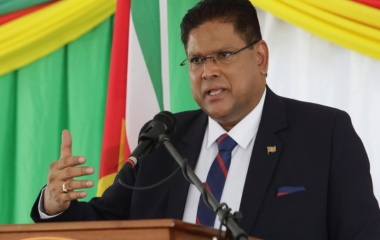
PARAMARIBO, Suriname, CMC -President Chandrikapersad “Chan” Santokhi says his administration has imp[lemented various measures to curb the high foreign exchange rate and that the effects of the policy will be noticeable soon.
He told the National Assembly on Tuesday that various proposals made by Parliament have also been adopted and that there has been consultation between the government, the Assembly, and various stakeholders which will continue.
In addition, Santokhi said that the new Banking Law has also entered into force.
He said that an essential part of the measures that have been taken are aimed at matching the supply and demand for foreign currencies as much as possible, adding, “While these rate control measures are being implemented, the reform path to make the economy healthy continues. The social program is also being implemented with priority”.
Santokhi told legislators that the policy to support local production would be intensified “so that we do not remain dependent in all respects on foreign countries, for those products that can also be produced here.”
He said that another aspect of the exchange rate that is receiving specific attention is the restoration of confidence in the local currency (SRD)
“We maintain our previously stated commitment to an active Central Bank of Suriname to accompany this process and will continue with the intended strengthening of this monetary institution. However, we must consider other ongoing processes, including completing the IMF program and debt negotiations.”.
The Bureau for the National Debt says Suriname is showing signs of economic growth, though slowly, predicting that it could reach 2.3 percent this year, up from 1.3 percent last year.
In its latest World Economic Outlook, the IMF forecasted economic growth of 2.3 percent, rising to three percent in 2024.
But the Washington-based financial institution also said it has been working very hard” with Suriname and hopes to send a mission to the Dutch-speaking Caribbean Community (CARICOM) country as soon as possible.
The acting director of the IMF Western Hemisphere Department, Nigel Chalk, said that during the middle of last year, the IMF got into a position “where we were unable to keep reviews” with Paramaribo.
Chalk said, “Some part of that was the change in some personnel in the government, some part of that was policy related.”
The IMF had previously announced that it had approved a new 36-month arrangement under the Extended Fund Facility (RFF) for Suriname — an estimated US$688 million.
The Suriname government has said it would urge the IMF to change the recovery plan as its implementation weighs heavily on the people.
“We will continue to work with united forces for a better Suriname. A better Suriname that we all want. We will all benefit from it,” Santokhi told Parliament.
“I, therefore, ask everyone, every Surinamer, to contribute to this goal. Your contribution is as important as any other. The government is open to your constructive attitude. Ultimately, we are all responsible for the well-being of the Surinamese people.”
Meanwhile, Santokhi announced that funds have already been allocated for the payment of the SRD1,800 (One SRD=US$0.026 cents) purchasing power enhancement and that the government will be ensuring that the payment is made as quickly as possible.
Finance and Planning Minister Stanley Raghoebarsing said 11,000 and 15,000 people have already benefited.
The government said registered individuals would receive the amount in their account in phases beginning at the end of this month.
Santokhi encourages people earning less than SRD6,000 to register for the program.




 and then