
















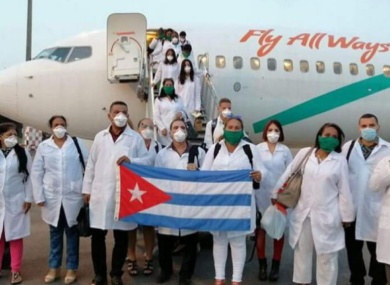
On Wednesday, KINGSTOWN, St Vincent, CMC—Prime Minister Dr. Ralph Gonsalves defended the Cuban health brigade program after the United States announced it intends to revoke the visas of foreign government officials whose countries employ Cuban doctors and nurses.
“Maybe some people in Florida who’re pushing a line don’t quite understand what is taking place, and when they get the information, they’ll see that they’re mistaken,” Gonsalves said on his weekly radio program on the state-owned NBC radio.
Last week, US Secretary of State Marco Rubio said Washington was announcing “the expansion of an existing Cuba-related visa restriction policy that targets forced labor linked to the Cuban labor export program.
“This expanded policy applies to current or former Cuban government officials, and other individuals, including foreign government officials, who are believed to be responsible for, or involved in, the Cuban labor export program, particularly Cuba’s overseas medical missions.”
Rubio, the son of Cuban immigrants who left Cuba in pursuit of the American dream, said in the statement posted on the US Department of State’s website that the new policy also applies to the immediate family of those people supporting the Cuban program.
He added, “The department has already taken steps to impose visa restrictions on several individuals, including Venezuelans, under this expanded policy. ”
But Prime Minister Gonsalves told radio listeners that Caribbean Community (CARICOM) foreign ministers met on the issue, “and they’ve decided to collate all the relevant information, and they are going to treat the issue regionally, and they are hoping to have a meeting sometime in the not-too-distant future at an appropriate level with the American government.”
Gonsalves said that while St. Vincent and the Grenadines do not have a significant number of Cuban medical personnel compared to Jamaica and Guyana, Kingstown pays the Cuban professionals the rate it does for its own professionals.
“It is said that the Cuban professionals who are here under the agreement with the Cuban government had to pay, I don’t know if it’s 10 percent or 15 percent, whatever it is, of their salary to the Cuban government.
“But that doesn’t mean that they’re exploited. They got a free education. And if they’re going overseas and making money from that education, it’s not unreasonable for them to put back something in the kitty for more people to be educated. We put our people on bond. The American federal government lends money, and people must repay the loans,” Gonsalves said.
He said that when a professional comes here and does anything, they must pay a withholding tax.
“Not only here, withholding tax is in America. I think there’s a misunderstanding as to what is happening. Maybe some people in Florida who’re pushing a line don’t quite understand what is taking place, and when they get the information, they’ll see that they’re mistaken,’ he added.
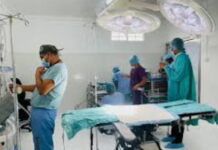
Gonsalves defended the presence of Cuban health personnel here, making reference to the Haemodialysis Unit at the Modern Medical and Diagnostic Complex, which is overseen by Cuban professionals.
“There are 60 persons there on hemodialysis, 60 ordinary Vincentians. They’re getting the hemodialysis free, but the point I’m going to make is that if the Cubans are not there, we may be unable to run the service. Must I allow 60 persons to die?
“Well, people know me. If I gave them free dialysis, they would understand my decision. But the terrible thing about this is a statement from the State Department, from Marco Rubio, who is a person whom I respect; then, in case he must be respected, he’s a high official of the US government — Secretary of State.
“When this thing came out, and that third countries, which may be complicit in what they call the exploitation of Cuban professionals, and that they will deal with them with visas, they started, ‘Well, Ralph and Eloise (wife)will use their visa.”
Gonsalves said he is disappointed that some people were rejoicing at the US position, adding, “They know that I will prefer to lose my visa than to have 60 poor and working people die.
“And that’s only one area. But then they gloat and extend it for political purposes. ‘You see, is what Ralph is doing with Cuba and Venezuela. Vincentians will not be able to go to America.’ That’s not what it says. That is not the issue; it’s the officials if they bring down the hammer.”
Gonsalves said, “Rather than saying we don’t have anything here called the exploitation of the Cubans and to say there must be some misunderstanding, so that can’t apply to us. The NDP(opposition National Democratic Party) can’t resist it; they and their fellow travelers can’t resist it. Pull down the temple”.
Rubio, in his statement, said that Cuba continues to profit from the forced labor of its workers and that that regime’s abusive and coercive labor practices have been well documented.
“Cuba’s labor export programs, which include the medical missions, enrich the Cuban regime, and in the case of Cuba’s overseas medical missions, deprive ordinary Cubans of the medical care they desperately need in their home country,” Rubio said, and that Washington remains committed to countering forced labor practices around the globe.
After the 1959 Cuban Revolution, Havana established a program to send its medical personnel overseas, particularly to Latin America, Africa, and Oceania, and to bring medical students and patients to Cuba for training and treatment. The project has been expanded to include several Caribbean countries.



 and then