







































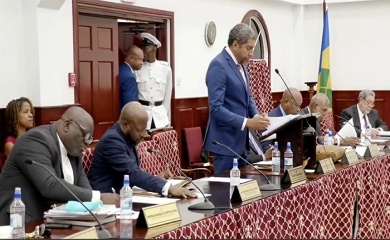
KINGSTOWN, St. Vincent, CMC – Finance Minister Camillo Gonsalves announced a series of new taxes as he presented the EC$1.6 billion (One EC dollar=US$0.37 cents) budget to Parliament on Monday night.
Gonsalves said that from May this year, Vincentians would begin paying an estimated 25 percent increase for their driver and motor vehicle licenses and similar increased charges for related services, while conductor licenses will move from EC$15 to EC$100.
He said also that the fees for the inspection of electrical wiring in domestic and commercial buildings will be doubled or more than tripled depending on the type of building and the number of points, while fees have been introduced for wiremen.
Further, travelers to and from the country will pay at least 37.5 percent more in the Airport Service Charge, which will move from US$40 to US$55, according to the fiscal measures the government is hoping will generate EC$6.7 million more in revenue this year.
“These measures are designed to adjust user fees and licenses to keep pace with the cost of providing the various associated services and to introduce new user fees where new services have emerged,” Gonsalves said ahead of the debate on the fiscal package on Tuesday.
He told lawmakers that driver’s licenses and related fees were last reviewed seven years ago, in 2016, and that “the time has now come to increase these fees, given the passage of time and the inevitable increase in costs incurred in the delivery of this service.”
When the new fees come into effect, drivers will pay EC$125 to hold a permit for one year, up from EC$100. The rates for duplicate licenses or permits, examination of a driver, and temporary driver’s permit will be similarly adjusted.
A person paying for their driver’s license for three years will pay EC$345, up from EC$275, while for five years, the amount is EC$535, up from EC$425. Tutors’ permits are also increasing by 25 percent to EC$250, while an international driver’s license will now cost EC$200, up from EC$150.
Registration and change of owners of vehicles will cost EC$190, an estimated EC$40 more than the current fee, while the cost for inspection of a car will move from EC$90 to EC$115
Gonsalves said the new fees will yield two million dollars in additional revenue.
The government also announced that motor vehicle licenses that were last increased in 2016 will also have a 25 percent adjustment.
The fee for a private motor car not exceeding 2,000 lbs is now EC$500. A vehicle between 2001 and 3000 lbs will attract a fee of EC$650, and those exceeding 3,000 kg will be taxed at EC$815, up from EC$400, EC$520, and EC$650, respectively.
“In light of the condition of our road networks, the increased traffic on the road, and the continuous impact of weather events, Budget 2024 allocates more than EC$70 million for road repair and rehabilitation and the construction of new roads,” Gonsalves said.
He said the government was surprised to find out that the revenue collected from motor vehicle licenses would be sufficient to meet the total costs of upkeep of public roads across the country.
“It is expected to contribute to doing so. The new fees make provision for licenses for new categories of goods vehicles to capture the heavier trucks and larger trailers that now traverse roads daily.”
He said these heavier motor vehicles adversely impact the road surfaces not initially engineered for trucks more than 12 and 15 tonnes and that “this measure will generate additional revenue of $4.5 million,” Gonsalves said.
The Finance Minister said that fees for the electrical installations will also be increased, noting that the costs for electrical inspections were last increased in 1995.
“In 2020, the electrical inspector department was restructured and provided with seven additional technical staff, including a chief electrical inspector and a deputy electrical inspector, moving the staff complement to 15, up from eight in 2019.”
Gonsalves said that this year’s budget has 18 staff and a budget of EC$911,000, including $110,000 for staff training.
“The new fee structure will introduce a small fee for wiremen and increase the fees for electrical inspections for residential and commercial installations,” he said, adding that the new fees are anticipated to bring an additional EC$250,000 in revenue.
Gonsalves said that the increased Airport Service Charge is payable on all airline tickets for travel in and out of the country and goes directly to fund the operations of the Argyle International Airport, telling legislators that even with the increase, the airport service charges here are among the lowest in the region.
“Our overall effective charges on international travel remain low when compared with our regional peers,” Gonsalves said, adding that given the forecast numbers for passenger movement in 2024, the measure is expected to raise an additional EC$6.6 million in revenue and will be in effect from May 1, 2024.
He noted that the government is shifting the annual standard deduction for income tax for a second consecutive year. In 2023, it was moved from EC$20,000 to EC$22,000, and this year, it will be further increased to EC$25,000.
“Think about it: between the end of 2022 and today, the beginning of 2024, the government has increased the personal income tax threshold by 25 percent and removed taxes on an extra EC$5,000 per year of your salary.
“This is a genuine people-centred benefit for every Vincentian taxpayer. The government will forego approximately EC$6.6 million in revenue as a consequence of this measure,” Gonsalves told legislators.
During his budget presentation, Gonsalves announced reforms to the National Insurance Service (NIS), resulting in the contribution rate rising from 10 to 15 percent over the next two years, beginning in June.
He said the changes are expected to ensure that the fund can continue to meet its obligation until 2060, as compared to 2035, if no reforms are undertaken.
The finance minister told lawmakers that the adjustment in the contribution rate is among eight recommendations that capacity had approved “to improve financial sustainability, benefit, adequacy, and coverage.
“These approved reforms, when fully implemented, will secure the financial future of the fund and ensure that the NIS remains the best investment for Vincentian workers to secure their financial future,” he said.
However, he said work on the necessary parallel reforms, namely the improvements to the public pension system, is also well advanced.
“While sections 73 and 88 of our Constitution limit the extent to which public service pensions can be altered for existing workers, we must nonetheless continue to work to ensure the modernization of our public service pension arrangements to ensure their viability for the next generation of civil servants,” Gonsalves said.
He said the government will announce “next steps to this critical process in the first half of 2024″.
Gonsalves said that to improve the NIS’s financial sustainability, the contribution rate will be increased to 12 percent on June 1. It will then move to 13 percent on January 1, 2025, with a one percentage point increase on January 1 until 2027.
“In the case of employed persons, this increased contribution rate will be split evenly between the employer and the employee,” he said, adding that the second reform measure is to change the current age pension to a retirement pension.
“This includes not awarding early-age pensions to those who have not retired or still earn more than 50 percent of their wage ceiling,” he said.
The finance minister told Parliament that early-age pensions would only be paid upon retirement or to older people with lower incomes rather than to everyone who claims before the pensionable age.
The third measure is to increase the reduction factors that apply to early-age pensions from half a percent per month to two-thirds of a percent per month.
“Typically, the reduction factor ranges from six to nine percent. As indicated in the St. Vincent and the Grenadines context, the early-age pension has been a significant driver of pension costs in the past few years and has significantly tempered the cost savings anticipated from the 2014 adjustment to the retirement age — because people are still retiring early.”
The fourth measure is to increase the reference wage period used to compute pension from the five best years to the seven best years of contribution. Due to recent inflationary pressures.”
The government will also introduce a permanent unemployment benefit, which Gonsalves said was one of the main requests from stakeholder consultations. This will begin in January 2025.
“This benefit is necessary to broaden the safety net for workers to cover the risk of loss of income due to temporary unemployment,” Gonsalves said.
He said the International Labour Organization (ILO) promotes this initiative, adding that Barbados and the Bahamas introduced permanent unemployment benefits in the region before the COVID-19 pandemic, and Grenada did so in 2023.
Gonsalves contrasted the current 10 percent NIS contribution rate here to other Organisation of Eastern Caribbean States (OECS) member countries, noting that while it was the same in St. Lucia and Anguilla, those rates were set since 1979 and 1982, respectively.
“The other OECS countries such as Grenada, Antigua Dominica, and Montserrat have recently passed legislation to increase their contribution rates to 16, 16, 15 and a half, and 15%, respectively,” he told Parliament.
“St. Vincent and the Grenadines needs to adjust its contribution rate to meet the growing social security costs occasioned mainly by demographic risks. Since its inception, St. Kitts has had a contribution rate of 11 percent and is currently engaging in its public consultation process to increase that rate.”
The government also announced that as of March 1 this year, no full-time worker will receive a salary of less than EC$50 a day, thereby ensuring that workers make at least EC$1,000 a month.
“In practice, many low-wage workers in St. Vincent and the Grenadines already earn more than the previous minimum wage. So, the initial difference in pay may be more modest than suggested by an average increase of 20 percent,” Gonsalves said.
He, however, said the government expects that the increase “will create upward pressures on all wages as concerns about wage distribution compression cause employers to consider the compensation of people who previously made just slightly above the minimum wage thresholds.”
Gonsalves said that as an employer of many minimum wage, agricultural workers, caregivers, cooks, cleaners, watchmen, and interns, the government must also adjust its wage bill upwards, adding, “We are convinced that this increase is timely, manageable, and progressive.
“We are equally certain that today’s announced increases in minimum wages will benefit workers, the wider economy, and our pursuit of more inclusive development,” he said, adding that the details will be released immediately and will come into effect on March 1.
The minister said that in some extreme cases, the adjustments would result in increases of up to 75 percent for monthly paid workers and 56% for full-time daily-paid workers relative to the previous minimum wages.
“In most cases, however, the increase will be a more modest 20 percent,” he said, adding that apprentices, interns, and other similar categories, including the government’s volunteers Youth Empowerment Service program workers, will receive no less than $40 a day or $800 per month.
Gonsalves noted that the wage adjustment is the fourth since the Unity Labour Party government came to office in March 2001, following increases in 2003, 2008, and 2017.










 and then
  budget)