



























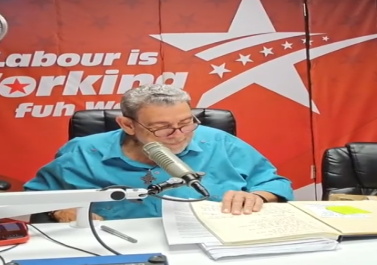
KINGSTOWN, St. Vincent, CMC- Former St. Vincent and the Grenadines prime minister Dr. Ralph Gonsalves, on Wednesday, defended the reappointment of the Caribbean Community (CARICOM) Secretary General, Dr. Carla Barnett, in the face of criticisms from Trinidad and Tobago that condemned the “surreptitious and odious process” used in the reappointment.
“Unfortunately, the government of Trinidad and Tobago has put such a distinguished public servant like Dr. Carla Barnett in this embarrassing position, but I know she’s a strong woman.
“She’s not going to allow this thing, this opposition from Trinidad and Tobago, to shake her. But the fundamental point is this, a vote was properly taken, and that’s the end of the matter,” said Gonsalves, who until last November 27 last year, was one of the longest ever serving heads of government within the 15-member CARICOM grouping.
Opposition Leader Dr. Ralph Gonsalves
Trinidad and Tobago is calling for a CARICOM meeting to address the reappointment, insisting that it was “deliberately uninvited” to the meeting in St. Kitts and Nevis in February, where the agreement was reached.
CARICOM and Foreign Affairs Minister Sean Sobers said that Port of Spain would seek a meeting of CARICOM to challenge the reappointment, and that fresh elections could also be placed on the table.
Trinidad and Tobago has said that three letters sent to the relevant personnel on the issue have all been ignored, with Sobers saying, “No acknowledgment and no response is very, very troubling.”
Trinidad and Tobago’s absence from the leaders’ retreat where the voting took place was “no accidental oversight,” adding that the prime ministers of The Bahamas and Antigua and Barbuda had also left the CARICOM summit ahead of its closure.
He said the leaders of the two countries would have, like Trinidad and Tobago, appointed someone to lead their delegation.
“However…none of us were invited to attend. It doesn’t matter. We were told that we were not able to attend, which is a breach of the treaty,” Sobers said, referring to Article 11.2 of the Revised Treaty of Chaguaramas that states any head of government may designate a minister or other person to represent them at any meeting of the Conference.
Prime Minister Persad-Bissessar has already condemned the “surreptitious and odious process” used in Barnett’s reappointment, saying it could have long-term effects on the people of Trinidad and Tobago.
In a statement posted on her Facebook page, Persad-Bissessar said that she was again calling on the 15-member regional integration grouping “for transparency on the surreptitious and odious process used to reappoint” the Belizean-born economist for another five-year term.
“Trinidad and Tobago remains committed to CARICOM, but until this matter is transparently resolved, the organization and its secretariat should absolutely expect no quarter from my Government.”
But, speaking on his Unity Labour Party (ULP) radio station on Wednesday, Gonsalves, an attorney, told listeners that he was surprised at the outburst from Port of Spain, particularly when the CARICOM chairman and St. Kitts and Nevis Prime Minister Dr. Terrance Drew had personally travelled to Port of Spain to ensure Persad-Bissessar’s attendance at the February 24-27 CARICOM summit in Basseterre.
“It is clear that the Prime Minister of St Kitts and Nevis, the chairman of CARICOM, considered it prudent and wise to go to Trinidad and talk to Kamla because of the way Kamla was bashing CARICOM and publicly…:
He said following the discussions in Trinidad and Tobago, both Prime Ministers, Persad-Bissessar and Drew, publicly described the deliberations as “very fruitful, and that Kamla herself said that she was going to the meeting in St. Kitts and Nevis, and everybody in CARICOM breathed a sigh of relief.
“Of course, she delivered a speech at the opening which undermined so many things in CARICOM,” Gonsalves, now the Opposition Leader here, told his listeners, adding that “I have been reliably informed that both the prime minister of Trinidad and Tobago and the foreign minister were invited to come to the caucus of CARICOM heads in Nevis”.
Gonsalves said that CARICOM meets in plenary with everyone, including regional and national public servants, and that there is a big discussion. Still, there are certain sensitive matters that you would discuss in caucus, usually the heads plus one. You may sometimes have a very, very deep caucus with only the heads alone, but that is very rare. “But what I found strange is the assertion by the government of Trinidad and Tobago that they were excluded from the caucus which made the decision,” Gonsalves added.
He said it was made known that Prime Minister Persad-Bissessar would not be traveling to Nevis and that Sobers would be her replacement, but that Sobers said he couldn’t go because he gets seasick.
“Have you ever taken a boat? It’s five minutes between St. Kitts and Nevis. I’ve taken that trip many, many times. So he absented himself, and nobody else was nominated who wouldn’t get sick to attend the meeting…”
Gonsalves said he also found it “strange” when Port of Spain publicly stated that the representatives of Antigua and Barbuda and The Bahamas were also “excluded” because their prime ministers were not present.
“But I know Foreign Minister (E.P Chet) Greene in Antigua, who is a senior minister, and I know Fred (Mitchell), who is the Minister of Foreign Affairs in the Bahamas. I’ve been to heads-of-government, I mean caucus, meetings where they represent their respective governments.
“So I found it strange, but I suspended my judgment on it until I had verification,” Gonsalves said, as he discussed the revised Treaty of Chaguaramas that governs the regional integration movement with particular reference to the voting procedures.
“This law …you can find it online, but those are the volumes of the laws, volume six of the laws of Saint Vincent and the Grenadines. It’s there because I had to take the Caribbean Community Act to Parliament to put the treaty into domestic law, and I am a signatory. I signed this in July, 2001. ”
Gonsalves said that Section 28, in reference to voting in the heads of government conference, “save as is otherwise provided in this treaty, and subject to paragraph two of this article and relevant provisions of Article 27, the Conference shall take decisions by an affirmative vote of all its members, and such decisions shall be binding.
“So the first thing the Conference shall decide by an affirmative vote of all its members, and such decisions shall be binding. What happens there? You don’t usually have a vote. Everybody individually gets a consensus. And the chairman sums up, and he says, everybody’s agreed with this.
“Everybody say yes, or you may say, anybody disagrees with this. They say, Fine, let’s proceed, and then the decision is confirmed. Paragraph two of this article says, for this article, abstentions shall not be construed as impairing the validity of the decisions of the Conference, provided that the member states constitute three-quarters of the membership of the Community and vote in favor of such a decision.
“So if you abstain yourself, but three-quarters of the heads are there…a three-quarters majority satisfies, so when publicly, the Prime Minister of St. Kitts and Nevis said that CARICOM …reappointed Dr. Barnett…she was reappointed by the required majority. ”
Gonsalves told radio listeners that if the Trinidad and Tobago leader “absent” herself and her replacement says “he does get seasick, well, send somebody else….”
Gonsalves, who served as prime minister from March 29, 2001, until November 28, 2025, said he had “seen…the agenda which was approved (and) that in caucus there will be several matters governance of CARICOM, which includes the appointment of the Secretary General, security, questions, and finance.
“So you don’t want to go to discuss those things. It goes on paragraph three. Omission by a member state to participate in the voting shall be deemed an abstention within the meaning of paragraph two of this article. So even if you’re absent, three-quarters can still do it. If they’re not involved in the decision, three-quarters can do it.
“And if you’re there and you decide that you ain’t participating in the voting, if you say to the chairman, say, I ain’t saying yeah, I ain’t saying nay, well, they will take that as an abstention, and they get a three-quarters. That’s what it says.
“I see the reference being made by the government of Trinidad and Tobago to Article 24 of the treaty…but Article 24 doesn’t deal with the voting. It concerns the Office of the Secretary-General. And the Secretary General shall be appointed by the Conference on the recommendation of the Community Council for a term not exceeding five years, and may be appointed by the Conference,” Gonsalves said, noting that if the Community Council, the second highest body within CARICOM, didn’t consider it a matter, it can go directly to the heads.
“It doesn’t have to go through the Community Council, because it is made plain in the treaty itself that a matter can go directly to the heads; it doesn’t have to go to the Community Council. Community Council is a ministerial body for foreign ministers.
“But what Article 24 does is to set out the functions to be performed by the Secretary General and the Secretary General as a member of an international body, because this body, CARICOM, is an international body.
“It’s regional, but it’s also international. It doesn’t get involved in a country’s internal matters… It’s not compromising that way.”
Gonsalves said when Prime Minister Persad-Bissessar used the opening of the CARICOM summit in Basseterre to publicly indicate that she had written to the CARICOM chairman “about a matter where the allegation was made that the government of Trinidad and Tobago and the government of Barbados organised the detention, arrest and detention of a citizen of Trinidad and Tobago who was found in Barbados, and it was done under CARICOM Arrest Warrant”.
Gonsalves said, “That’s not a matter for the Secretary General to respond to.
“That’s an internal matter between Trinidad and Barbados and the Leader of the Opposition, as she was then writing to the Secretary General. Things are fraught with domestic politics. The Secretary General ignores it.
“What Kamala should have done is to write the chairman of the Conference, the Chairman of CARICOM, with the political head, and raise it and say, I’d like you to address this question for me and have this result. Then the political head would say, “Well, send all the information for me. “I go talk to (Dr. Keith) Rowley, and I go talk to me.”
Gonsalves said that the Conference of leaders “shall be the supreme organ of the Community. As the heads of government, the Conference shall determine and provide policy direction for the Community. Save as otherwise provided in a treaty, the Conference shall be the final authority for the conclusion of treaties on behalf of the Community.”
He said the leaders may take decisions to establish a financial arrangement, whereas the Conference can’t.
“Isn’t the Conference may say, let the Community Council consider this, but it’s a matter of urgency. The Conference can deal with it itself, and you, the power of the Conference is undeniable. It’s the supreme body.”
He said he has been informed that CARICOM heads are likely to meet on this question on Friday.
“Now, when this matter comes up, it is for the chairman to say, Well, we are discussing this matter. We all know about it; let’s vote on affirming this matter. In fact, there is no need for them to do that.
“But if Kamala doesn’t like this particular decision, and the heads don’t want to reopen it… and the heads do not want to go along with her, the Secretary General will be reappointed. I know Kamala is threatening to say that she contributes so much money to CARICOM.
“Well, the principal beneficiary in the Caribbean, single market and economy, is Trinidad and Tobago. By far, if she’s not, if Trinidad is not part of CARICOM. Trinidad, businesses don’t have a right of establishment in these countries.”
Gonsalves said that at the moment, Trinidad and Tobago businesses have the right of establishment to provide goods or services.
“They would not get preferential access to the market. They’ll have to pay the additional duties, which are now 15 percent of the common external tariff. So American goods, for instance, would become more competitive. Goods out of Puerto Rico and the dumb replica become more competitive.”
Gonsalves is predicting that the Trinidad and Tobago economy will take a hit. “Unemployment will happen…Well, the treaty says you can give one year’s notice to withdraw. She can give one year’s notice if she wants Trinidad and Tobago to leave, or she can take the matter to the CCJ (Caribbean Court of Justice) to have a determination.”
Barnett became the eighth CARICOM Secretary General on August 15, 2021, by “unanimous appointment” of the regional leaders.




 and then
 )