





























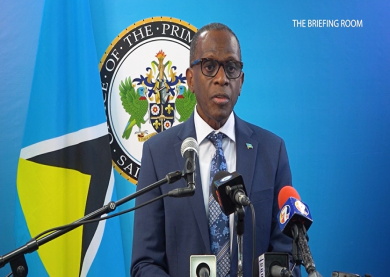
CASTRIES, St. Lucia, CMC -Prime Minister Phillip J Pierre has welcomed the latest statement by the International Monetary Fund (IMF) that the St. Lucia economy is projected to grow by 1.7 per cent in 2025, following a substantial expansion of 4.7 per cent in 2024.
“The economy is then expected to rebound in 2026 from tourism pickup and, over the medium term, gradually decline to its potential rate of 1.5 per cent as tourism stabilizes and planned infrastructure and tourism-related projects are completed,” the Washington-based financial institution said, following a visit to St. Lucia by an IMF delegation as part of the 2025 Article IV consultation.
Pierre, who is due to announce the composition of his new Cabinet later on Friday following his re-election in the December 1 general election, said he welcomes the statement by the IMF, adding that “the assessment affirms that recent fiscal and economic policies have restored stability and set the country on a path of sustainable growth.
“Over the past two years, strong performance in tourism and supportive government measures have helped our economy bounce back. The IMF notes that economic activity has normalized, unemployment has fallen, and macroeconomic indicators reflect improving conditions.
“This confirmation from a leading international financial institution underscores the effectiveness of the policies implemented by the government, policies designed to safeguard livelihoods, support investment, and promote economic resilience,” Pierre said.
Pierre said that the new government ministers will be sworn in at 3.00 pm(local time) on Friday and that “as the government reaffirms its commitment to prudent economic stewardship and inclusive growth, it remains focused on consolidating gains, enhancing fiscal discipline, and advancing structural reforms aimed at building long-term prosperity for all St. Lucians.
In its report, the Washington-based financial institution said the risks to St. Lucia’s economic outlook remain tilted to the downside, acknowledging that weaker-than-expected performance in the tourism and construction sectors may further constrain growth, and that an increase in recognised non-performing loans (NPLs) could depress credit growth.
Senior economist in the IMF’s Western Hemisphere Department, Swarnali Ahmed Hannan, said that geopolitical tensions, escalating trade measures, and prolonged policy uncertainty could dampen global economic activity, potentially weakening tourism and foreign direct investment (FDI) flows to St. Lucia while increasing its import costs.
She said that a global slowdown triggered by escalating trade measures and prolonged uncertainty would weigh heavily on St. Lucia’s economy, given its dependence on tourism flows and reliance on imports.








 and then
  that the St. Lucia economy)