



































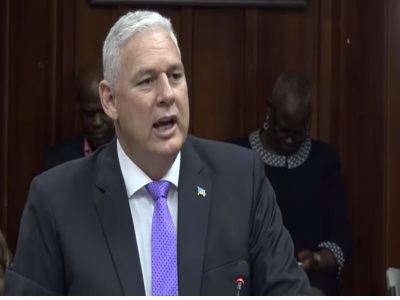
CASTRIES, St. Lucia, CMC – As the Government heads to Parliament Tuesday to amend the constitution to replace the Privy Council with the Caribbean Court of Justice (CCJ) as St. Lucia’s final appeals court, Opposition Leader Allen Chastanet has accused the administration of rushing the process.
In a statement issued on Monday, a day after his United Workers Party (UWP) staged a protest, he insisted there should be no CCJ move without a referendum.
“The Government is hastily doing this without sufficient consultation with the general public or disseminating information on the pros and cons of this move. How many of you can confidently say that you know or understand how this move will impact you?” Chastanet asked citizens.
Noting that the governments of St. Vincent and the Grenadines, Grenada, and Antigua and Barbuda all held referendums on the issue – with citizens voting against the move in all three cases – the former prime minister said putting the matter to a public vote was appropriate for several reasons.
Chief among them, he said, is that it would ensure the decision is made democratically and transparently.
“While it is ultimately up to the Government to decide whether to adopt the CCJ as the final court of appeal, this decision should not be made without the input and consent of the people. A referendum would allow for a public debate on the issue, with both sides of the argument being heard and considered,” Chastanet said.
“A referendum would help to increase public awareness and understanding of the issue. Many people in St. Lucia may need to understand the CCJ and its workings fully. By holding a referendum, the Government can ensure that the public is fully informed about the issue before deciding.
“Finally, a referendum would help ensure the decision is legitimate and binding. If the Government were to decide without consulting the people, there would always be a question of whether the decision was truly representative of the people’s will,” he added.
Chastanet urged residents to contact their Members of Parliament and “tell them no referendum, no CCJ!”
Of the 15 Caribbean Community (CARICOM) countries that signed on to the Trinidad-based CCJ in its original jurisdiction when it was established in 2001, only four have transitioned to having it as their final appellate court – Barbados, Belize, Dominica, and Guyana.











 and then
 )