

































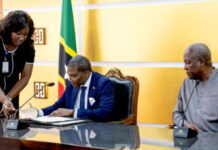



BASSETERRE, ST KITTS, CMC – Prime Minister Dr. Terrance Drew presented a budget of EC$1.09 billion.on Wednesday, It instituted a series of transformative financial relief initiatives, providing much-needed support to the Twin Island Federation.
In the Budget Address in the National Assembly, Drew reaffirmed the Government’s decision not to introduce new taxes in the upcoming fiscal year.
“Our Government is not proposing to introduce new taxes at this time. We are, however, making progress regarding the comprehensive review of the tax regime.”
The Prime Minister also highlighted the progress made in the comprehensive review of the existing tax regime.
“Earlier this year, the Government collaborated with the International Monetary Fund (IMF) to commence this review process. The draft report of this review is expected to be finalized in early 2024, with the results to be shared with stakeholders subsequently. This initiative aims to reconfigure the tax regime to diversify revenue sources and reduce dependence on specific sectors or sources of income,” he said.
Drew’s announcement reflects the Government’s strategic approach toward economic management, emphasizing the importance of a diversified and robust fiscal framework that supports the nation’s growth and development.
He added that his Government remains committed to fostering a conducive environment for economic stability and growth, ensuring that the nation’s fiscal policies align with its citizens’ broader goals of sustainable development and prosperity.
This decision aligns with the stance presented in his maiden Budget Address last December. It demonstrates the Government’s dedication to a stable and predictable fiscal environment for its citizens and businesses.
The announcement of an eight percent general salary increase for all civil servants and pensioners, effective January 1, 2024, was made to recognize their invaluable contributions to the government service.
“This increase reflects our appreciation for your contributions to the Government service as we firmly believe that your efforts should be recognized and fairly compensated,” Drew stated.
In a show of further appreciation, a Christmas Bonus equivalent to 50 percent of their salary will be granted to all civil servants and Government Auxiliary Workers (GAEs), including Pensioners and STEP workers, on December 21.
Not limiting the generosity to the civil service, he also announced a groundbreaking “Workers’ Bonus” initiative, granting non-civil servants a bonus of EC$500 in December.
This bonus will be disbursed through the Saint Christopher and Nevis Social Security Board, marking a historic move in the Federation and the Caribbean.
“We don’t want to just leave the bonus, of course, when the economy has not fully recovered, to just the civil servants. We also want to give a bonus to those not in the civil service”.
Drew emphasized that this unprecedented Workers’ Bonus is the first of its kind in the region, directly disbursed by the Government to non-civil servants.
He noted that these individuals, crucial to the private sector, have faced substantial financial challenges exacerbated by the COVID-19 pandemic. Acknowledging their resilience and dedication, the Government has expressed gratitude through this landmark financial relief initiative.
The Prime Minister also announced plans to establish a Financial Education and Savings Programme.
The Financial Education and Savings Programme, a collaborative effort between the Eastern Caribbean Central Bank (ECCB) and various stakeholders, is a vital part of the Government’s dedicated focus on enhancing the financial literacy and well-being of the nation’s youths.
“In pursuit of this commitment, we present a groundbreaking initiative designed to revolutionize the financial landscape for our youth, one that will instill financial responsibility and investment knowledge in the youth of St. Kitts and Nevis.”
He added, “Covering crucial topics like budgeting, saving, investing, entrepreneurship, and understanding financial markets, this program will empower our youth with the knowledge needed to navigate the complexities of the financial world. Madam Speaker, the savings aspect of this initiative is equally revolutionary. Every young citizen aged 5 to 18, Madam Speaker, will be endowed with a savings account, initially funded with EC$1,000.”
He said that EC$500 will be invested in shares of government majority-owned companies, including the St. Kitts-Nevis-Anguilla National Bank.
Concerning the promise of an increase in the National Minimum Wage Rate, he said this will be introduced in a phased approach starting January 2024 with an increase of EC$10.75 an hour or EC$430 for a 40-hour work-week.
In explaining the details of the phased minimum wage rate increase, he said it would inevitably reach a max of $12.50 an hour or $500 weekly working a 40-hour work week by July 2025.
“It is therefore with great pleasure that I announce that an increase in the minimum wage will implemented effective January 01, 2024. It will be done in a phased approach – the hourly minimum wage will be increased from $9 to $10.75 per hour, effective January 01, 2024. Madam Speaker, our projections are the rate would then be increased to $12.50 per hour from July 01, 2025. The increase in hourly rate will result in a weekly rate of $430 from January 01, 2024, from $360 and $500 per week from July 01, 2025. Our Government is determined to ensure that this important policy initiative improves the people’s standard of living in our workforce.”
Drew explained how the increase in the minimum wage rate will impact people, including increased payouts from social security at a pensionable age.
“Do you know why we need the minimum wage increase, Madam Speaker? Because when you retire, you get more from Social Security. When you have an increased minimum wage, you have more spending power; you are in control, you can approach a financial institution, [and] better your fiscal position to help you to reach more independent living … that is why we believe in adjusting people’s wages so that they work for it, but at the same time we are doing this we are asking our workers to work. So, we will introduce a Productivity Taskforce in St. Kitts and Nevis. We have already started to work because, at the same time, we believe in giving benefits; it has to be a two-way street. We give, and you give, and together we work – more productivity, more wealth, more benefits – that is what we want to bring to the people of St. Kitts and Nevis… so we are matching it with our productivity outlay, which will be introduced to the people in 2024.”
Pointing to auxiliary workers, he said they were remembered.
“I am truly pleased to announce that the new contributory pension plan will be operationalized on January 01, 2024. Yes, in addition, the provisions of the Pensions Amendment Act Cap. 2022.06 shall come into force retroactively from May 18, 2012. This means that all government auxiliary employees and other monthly paid workers employed by the Government on or after May 18, 2012, are eligible to benefit under the Act… Today, I am thrilled to share other great news with our civil servants. But I want to put in place, Madam Speaker, let it soak in a bit that the GAE workers, even those who are retired – you will get your money.”
He also announced that the Corporate Income Tax rate for corporations registered in the Federation will be officially set at 25 percent, effective January 01, 2024.
This decision follows a period of temporary reductions in the Corporate Income Tax rate, which were initially implemented until June 2023 and subsequently extended to December 2023.
This policy, he noted, is an investment in the nation’s future, fostering an environment conducive to business growth, innovation, and community prosperity.
“It is our expectation, therefore, that with a lower tax rate, businesses would use the resultant savings to expand their operations to provide more innovative products and services, reinvest the funds in research and development as well as new technologies, and most importantly, employ more people,” said Drew. “This not only enhances the competitiveness of local businesses at the regional and international level but also drives economic growth and innovation domestically.”









 and then