



























ABUJA, Nigeria, CMC – Former Jamaican Prime Minister PJ Patterson urged African and Caribbean leaders on Wednesday to recognize the opportunities for deeper cooperation provided by the expansion of the African Export-Import Bank (Afreximbank) into the Caribbean.
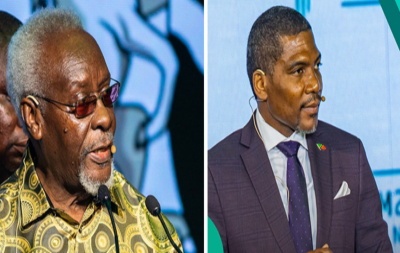
Patterson made the call as he delivered the keynote, “Leveraging a Common Heritage: The Afreximbank Caribbean Initiative,” at the 32nd Annual Meetings of Egypt-based Afreximbank (AAM2025).
He praised the work of Afreximbank in the Caribbean, echoing the sentiments of St. Kitts- Nevis Prime Minister, Dr. Terrance Drew, who, in the opening keynote, praised Afreximbank’s achievement over the last decade and announced that Basseterre would host the AfriCaribbean Trade and Investment Forum next year.
AAM202s, which ends on Saturday, is being held under the theme “Building the Future on Decades of Resilience,” and Patterson said that to build stronger trade and economic relations between Africa and the Caribbean, “we have to acknowledge the very real constraints that exist.
“But we also have to recognize the opportunities that are presented, such as the areas of financial cooperation and investment, and, indeed, the opportunities presented by the changing nature of trade itself,” he told the meeting, which organizers say have attracted 12,000 people to the capital of Africa’s most populous country and largest economy.
Patterson said that both Afreximbank and the University of the West Indies (UWI) regard artificial intelligence as the key to having a broad digital footprint on which “ideas and capital can exert the main thoroughfare into the tributaries where innovation and creativity can create considerable economic value.”
He said the historical, social, and cultural ties that link Africa and the Caribbean should be the launchpad for promoting travel and tourism “across the chasm of the Atlantic for increased synergies in the development of these industries.”
Patterson said that given the centrality of knowledge driven by intelligence, Afreximbank had provided funding for a project in the PJ Patterson Institute for Africa, Caribbean Advocacy at UWI for a pilot study for an artificial investment hub that will link Africa and the Caribbean, which will advance education, research, innovation, and trade.
“We who belong to global Africa must develop artificial intelligence of our own, which we design and which we make certain caters to our values and fulfills our needs,” Patterson said to applause.
“We have survived for centuries because of our resilience in the struggle. When our ancestors were taken across the Middle Passage, they brought with them not only pain but also purpose.
“They kept alive the drum, the dance, the dialogue, and the divine. They planted seeds — cultural, spiritual, and economic — hoping that one day, their descendants would gather to harvest a future of freedom, dignity, and development. Today in this room, we are that harvest,” Patterson said.
“We are the realization of their longing. And if we are wise and bold, we can make them smile. Therefore, we must move forward with courage and clarity. We must honor the past by shaping the future. We must turn this initiative into a movement and this movement into a momentum of unity, prosperity, and pride. Afreximbank is doing everything to make that happen.”
He said that Africa and the Caribbean must deliberately forge partnerships in education, science and technology, cultural diplomacy, and knowledge exchange.
“Our institutions of learning have to engage in joint research. Our artists must collaborate. Our entrepreneurs must network, not just at conferences, but in factories, farms, studios, and fintech hubs.”
The former Jamaican prime minister called on the regions to build “a shared economic ecosystem, not a parallel one.
“The time has come for Continental Africa and its far-flung diaspora to speak with a singular voice. We must develop a typical diplomatic architecture, coordinate our messaging, and resist attempts to dilute our agendas in the name of so-called pragmatism.
“And we must not allow those who exploited us to pick us off one by one and to separate us in the search for prosperity; we must also maintain and entrench our dignity. It. Let me say it frankly: the post-colonial project cannot be fulfilled by economic metrics alone.”
He said that identity matters and our economic emancipation must be rooted in the fullest recognition of who we are.
“The work of the Afreximbank Caribbean initiative must go hand in hand with the Africanization of our consciousness. We must teach our children that they’re heirs to ancient civilization, masters of metallurgy, philosophy, architecture, mathematics, and music, long before Europe ‘discovered’ us and sought to destroy our self-esteem, our native culture, and stealthily control our resources.”
Patterson told the audience that the past is prologue.
“The future is in our hands. We must use our boundless imagination to release our minds and thereby chart our destiny to bring lasting prosperity to this present generation because the young among us are rightly impatient of suffering. We must do it, not just for this generation, but we must blaze the trail to glory for generations yet to be born.”
Meanwhile, in his address, Prime Minister Drew congratulated Afreximbank for “32 years of courage, resilience, and service to its people; 32 years of choosing vision over fear, action over hesitation, and community over competition”.
He said that from its founding, the bank has taken on a mission far greater than commerce.
“It has carried the burden of opportunity, building systems that empower African peoples and economies to chart their course, to finance their progress and to trust their own.”
He said Afreximbank’s mission is still unfolding and as urgent as ever and praised the leadership of Professor Benedict Oramah, President and Chairman of the Board of Directors of Afreximbank, who is presiding over his last annual meetings in that post.
Oramah’s career at Afreximbank spanned three decades, and since becoming president a decade ago, the bank’s total assets and contingencies have increased from $4 million to $ 40.1 billion as of December 2024.
“Under your stewardship, Afreximbank has become more than a financial institution. It has become a living testament to what is possible when leadership is not only competent but deeply conscious,” Drew said.
“You have expanded the horizon of what African leadership and institution building can mean. You have been both strategic and soulful, firm in your technical leadership, but also emotionally intelligent in how you have guided relationships, built trust, and told a new story about what Africa and its diaspora can build together.”
Drew said he was speaking from a place of deep personal reflection, having met Oramah in 2022 in Barbados, just one month after becoming prime minister.
“I was struck not only by his clarity of purpose but his generosity of spirit,” he said, adding this left him “with the firm conviction that the work of connecting Africa and the Caribbean was not just about speeches and symbolism.
“It was about systems. It was about finance. It was about shaping the machinery of cooperation across the Atlantic so that it no longer simply echoed our history but actively built our future.
“From that first conversation, it became clear to me that Afreximbank under President Oramah’s leadership was not simply welcoming the Caribbean into its orbit; it was embracing our kin.”
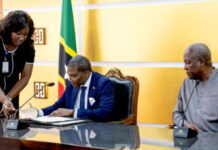
He said that this was why St. Kitts and Nevis was proud to be the very first Caribbean country to sign a memorandum of understanding with Afreximbank.
Since then, 12 Caribbean Community (CARICOM) member states have acceded to the partnership agreement between CARICOM countries and Afreximbank.
The bank is also piloting a regional version of the Pan-African Payment and Settlement System in the Caribbean. This cross-border financial market infrastructure enables payment transactions across Africa.
“That was not a diplomatic formality. It was a deliberate act of trust. As a prime minister and a government, we believed in the bank’s vision and its mission, and we took a step, not just on behalf of our country but on behalf of the entire CARICOM region. That step has proven to be one of the most impactful and future-facing decisions we have taken in recent years.”
Prime Minister Drew noted the team of the annual meetings and told delegates that “resilience must now be matched with reinvention, with the courage to reimagine ourselves as architects, as we build our countries and economies together.
“That is where Afreximbank’s true legacy lies: not only in what it has protected and benefits thus far but also in what it aims to build in the future. Today, the Caribbean is no longer a distant observer of Africa’s Renaissance. We have become an active partner as the sixth region of the African Union,” he said.
The annual meetings are being held here 32 years after they were first held in this same city in 1993 and six years after the last gathering in 2018.
In a welcome note to delegates, ORamah said that AAM2025 “therefore, offers us the opportunity to reflect on over three decades of shared resilience, innovation, and transformation across the African continent,” hence the theme.
“Over the past 32 years, we have mobilized over $250 billion into Africa, empowered industries long neglected by conventional financiers, and served as a lifeline during crises – from the COVID-19 pandemic to commodity shocks and broken supply chains,” Oramah said.
He said the Afreximbank story is “one of defiance against doubt, of institution-building in the face of resistance, and of steadfast belief in Africa’s potential.”
The Afreximbank president further noted that the annual meetings are taking place against a backdrop of global headwinds, including deglobalization, rising protectionism, and geopolitical uncertainty.
“Yet, it is precisely this uncertainty that reminds us of the imperative to build strength from within, charting a future that is unapologetically African and globally impactful,” he said.
“It is expected to be a future where Africa’s youthful population, rich natural resources, expanding intra-African trade, and technological shifts create a new development paradigm.”








 and then