

























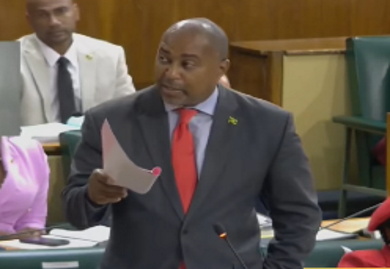
KINGSTON, Jamaica, CMC – The main opposition People’s National Party (PNP) says even before the passage of Hurricanes Beryl and Melissa, the Jamaican government had relied on one-off asset sales to finance successive budgets, including future revenues from the Norman Manley and Sangster international airports.
Shadow Minister of Finance, Julian Robinson, said that over the last two fiscal years, the government’s revenues have been ‘struggling’ to meet its expenditure, and that it has relied on one-off asset sales.
He said in 2023 and 2024, the sales of 12 years’ worth of future revenues from the Norman Manley International Airport yielded J$75 billion (One Jamaican dollar = 0.008 cents), which financed the 2023-24 budget.
“For the 2024-25 budget, the sale of 10 year future revenues from the Donald Sangster airport yielded J$61 billion which allowed the government to finance the 2024-25 budget,” Robinson said, telling legislators that he was making this point “to indicate that without Beryl, with Melissa, the government would have had to find some other asset to sell to meet the demands of the budget”.
He said in relation to the Special Consumption Tax (SCP) on non-alcoholic sweetened drinks, being proposed by the Andrew Holness government, Robinson said, “I know there is a public health imperative, a very big one, but I would say to you, I do not believe the price increases will change behaviour.
The greatest consumers are young children who attend primary schools. We need to change the culture, but when you look at the demands for these goods and the level of the increases, I would posit that it is a relatively inelastic demand, meaning that I don’t believe that you will have much behaviour change”.
He said he is recommending that some of the J$10 billion the government anticipates from the measure be invested in and provided to the local agricultural industry so that unsweetened natural juices can be offered as alternatives to sweet drinks.
He said, in relation to the Environmental Levy, that he is recommending the funds anticipated from this measure be used to build greater resilience “so that we can absorb some of the shocks we naturally will be having in the future”.
Following Thursday’s ceremonial opening of Parliament, Prime Minister Holness said his administration’s decision to introduce new taxes this year was a last resort as it moves to present a credible budget.
The Holness administration had enjoyed a decade-long stretch of chanting the mantra “No new taxes!” and Finance Minister Fayval Williams unveiled a slew of new taxes on Thursday, insisting that the tax package was a last resort.
“We don’t take taxation lightly. It is literally the last resort, but we have to present to the people of Jamaica a credible budget so the people looking at what we propose can have confidence that what we’re doing will be to their benefit….”
He added that the unprecedented shock from last October’s landfall of Hurricane Melissa left the administration with few choices.
But despite the new taxes, Prime Minister Holness says the measures are in place to protect the vulnerable.
The government is proposing new revenue measures that include increases in taxes on property, tourism activities, alcohol, and cigarettes, as well as new taxes on non-alcoholic sweetened beverages and digital services.
The measures, to be implemented over two financial years, were disclosed earlier than usual to allow the Independent Fiscal Commission to review the Budget and provide its assessment of its credibility, said Williams, who tabled the proposed revenue measures in Parliament on Thursday.
The measures are part of the proposed national Budget for the 2026–2027 financial year that starts on April 1.
“The passage and impact of Hurricane Melissa have materially altered the Government’s fiscal environment. The hurricane resulted in unprecedented damage to critical infrastructure, productive sectors, and public assets, placing severe pressure on public finances and reconstruction expenditure, which is expected to extend across the medium term,” Williams told Parliament.
“Against this background, expenditure containment and administrative improvements cannot close the emerging fiscal gaps.”






 and then
  says even before the passage of Hurricanes Beryl and Melissa, the Jamaican government)