





































INGSTON, Jamaica, CMC -The Jamaican government says an estimated 700,000 farmers across six central parishes will benefit from the US$50-million Green Climate Fund (GCF) project aimed at enhancing the climate resilience of vulnerable farmers over the next five years.
The project, titled ‘ADAPT Jamaica: Enhancing climate change resilience of vulnerable smallholders in Central Jamaica’, represents the first-ever single-country climate investment that Jamaica has received from the GCF.
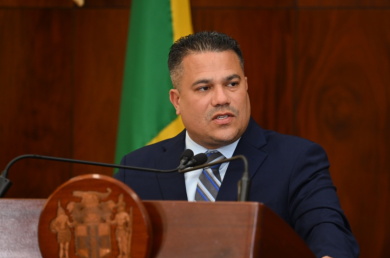
Water, Environment and Climate Change Minister, Matthew Samuda, said that approximately US$40 million of the approved sum will be grant financing and that the government is “actively pursuing an additional US$300 million (for]) projects that are at varying stages of development”.
He said that over the coming months, a number of these projects will be announced, providing benefits to Jamaicans.
The GCF project will be implemented in Trelawny, St. Ann, St. Elizabeth, Clarendon, St. Catherine, and Manchester – areas where climate risks and food security challenges are severe due to increased hurricane activity, longer droughts, and increasingly erratic rainfall over the last two decades.
Agriculture, Fisheries, and Mining Minister Floyd Green said that these areas face high climate exposure, rural poverty, food insecurity, land degradation, and limited access to irrigation and financing.
He said that these parishes are responsible for a combined 70 percent of Jamaica’s domestic agriculture production and that the implementation of the project at the farm level is designed to be practical, visible, and scalable, through the development of model farms and farm clusters.
Green said that through these model farms, the government will “deploy climate-resilient solutions…including things like solar-powered irrigation, reinforced greenhouses that are designed to withstand stronger storms [and] efficient water management systems such as drip irrigation, especially for our vulnerable farmers”.
He said the project will have a strong training component and provide access to simple, affordable tools focused on rainwater harvesting and water-efficient technology.
“We will design a climate information system that will tie directly into our farmers… so our farmers are better equipped to know when we are having these weather changes. It will provide timely practical guidance on weather and crop conditions,” Green said.
He said that a portion of these funds will be routed through the Development Bank of Jamaica (DBJ) to give smallholder farmers greater access to capital to invest in their agricultural enterprises.
“We’ll focus on things like crop zoning, targeted inclusion strategies. We’re going to be focusing on our women. We’re [also] going to be focusing on our youth to ensure that underserved groups have equitable access,” Green said, adding that the Ministry will be using its farmer field school to ensure that our farmers are trained in climate-smart methodology.
Green said a component was built into the project to ensure the Ministry could respond directly to the damage caused by Hurricane Melissa, which resulted in more than US$9.9 billion in losses to the country’s agricultural sector.
“We will be crafting some cash transfers. We will identify house designs that will fit from a cash-for-work program developed to plan an irrigation system under this project. This project will bring forward at least nine automatic weather stations, 35 rainfall loggers, and a national climate information system tailored to agriculture,” he detailed.
Project ADAPT Jamaica is a joint initiative supported by the Food and Agriculture Organization (FAO), the Jamaica Social Investment Fund (JSIF), and the DBJ.









 and then
 )