













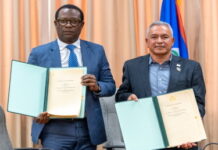

























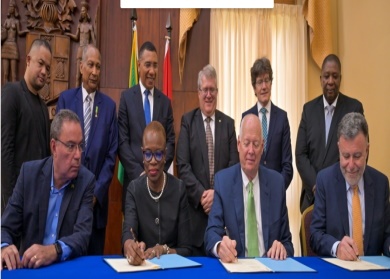
KINGSTON, Jamaica, CMC——Jamaica has signed a Memorandum of Understanding (MoU) with two Canadian-based companies to advance the adoptionCanadian-based companies to advance the adoption of nuclear technologies in Jamaica in the country.
Prime Minister Andrew Holness said the partnership with Atomic Energy of Canada Limited and Canadian Nuclear Laboratories Limited reflects his government’s unwavering commitment to diversifying the country’s energy portfolio with new, clean, and sustainable alternatives.
“(It) marks a pivotal moment in Jamaica’s energy transformation as we take a bold and forward-thinking step by signing this Memorandum of Understanding. This move is about reducing your cost of living, a major part of which is the cost of energy,” he said at the signing ceremony.
Prime Minister Holness said countries such as Canada and France are using nuclear power as a potential solution to energy issues and climate change in a safe and effective manner.
He said France generates approximately 68 percent of its electricity from nuclear power, accounting for 15 percent of Canada’s energy output. The country is also known for maintaining uncompromising atomic standards.
“These examples show that nuclear power can be a game changer with proper technology regulation and the embrace of technological advancement. Today’s nuclear technology, tiny modular reactors, is far safer and more adaptable than before.”
Holness said small modular nuclear reactors offer enhanced safety features, reduced environmental impact, and a cost-effective solution for small countries like Jamaica.
He said that taking advantage of rapidly developing technology will provide long-term benefits for Jamaica.
“Of course, some will say, why not wait until this technology is mature? The problem is that anything that has to do with nuclear power requires a long period and the development of local capabilities.
“If you don’t do it now, then not only will you have to import the capital and the actual small modular nuclear reactor, but you’re also going to have to import the technological skills and expertise, which will increase the cost of deployment. So Jamaica has to see what will come in the future,” the Prime Minister said.
Regarding safety, Holness said that the technology has advanced over the years, noting that modern nuclear reactors are designed with fail-safe mechanisms that significantly reduce the risk of accidents.
“We know that safety is at the forefront of everyone’s minds regarding nuclear energy, and rightly so. But I want to emphasize that nuclear energy today is not what it was a decade ago. We know that some designs shut down automatically for modern nuclear reactors, tiny modular nuclear ones.”
Holness said that as part of the exploration, work will be undertaken with global experts to ensure that every aspect of nuclear energy, particularly waste management, is handled with the highest international standards.
“Countries like Finland and Sweden have developed world-class systems for safety in terms of storing nuclear waste, and we will draw on their experience to ensure that Jamaica follows the best practices for protecting the environment and our people,” he stated.
The Prime Minister said that Jamaica’s journey with nuclear technology began in 1984, establishing the Caribbean’s first and only nuclear reactor at the University of the West Indies (UWI), Mona, with European Union (EU) support.
He said the facility is operated by the International Centre for Environmental and Nuclear Science (ICENS) and has been a beacon of nuclear research for four decades, advancing studies in agriculture, health, and environmental protection.
Holness also disclosed that the government is taking a comprehensive approach to diversifying Jamaica’s energy security. He noted that 85 percent of Jamaica’s energy is derived from fossil fuels, which he described as “a dependency that leaves us vulnerable to external shocks and global oil and natural gas price fluctuations.
“We have already made great strides in diversifying our energy mix. We have done exceptionally well in integrating solar, wind, and natural gas, and we have some hydroelectric power… but there is far more to be done. Given Jamaica’s current energy demands, we know there must be a very well-thought-out mix… that is not subject to intermittency, and nuclear offers that as well,” Holness said.
He also said that Jamaica has commenced exploring the development of pumped hydro storage and waste-to-energy alternatives for power generation.
Meanwhile, Science, Energy, Telecommunications, and Transport Minister Daryl Vaz said a vital aspect of the agreement is the exchange of scientists, engineers, and other specialists.
“This collaboration will foster the sharing of knowledge, skills, and best practices, driving innovation in research, development, and practical applications. We will build a network of experts to benefit Jamaica and Canada. Through organized seminars and meetings, we will ensure that our professionals remain at the forefront of nuclear technology and its peaceful applications,” he said.
Canadian Nuclear Laboratories Limited Board Director Howard Shearer said the discussions initiated with Prime Minister Holness last year aim to diversify Jamaica’s energy mix, among other things.
Fred Dermarker, president and Chief Executive Officer of Atomic Energy of Canada Limited, said the partnership will advance ongoing discussions on nuclear science and related technologies.
“This event (MoU signing) is a testament to the strong and enduring relationship between our nations,” he added.










 and then
  with two Canadian-based companies to advance the adoption)