




























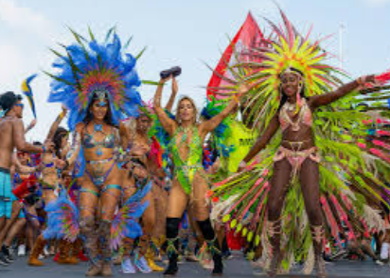
KINGSTON, Jamaica, CMC – The Jamaican government says the annual carnival celebrations have become an economic engine, generating billions of dollars for the local economy.
Tourism Minister, Edmund Bartlett, said research by the University of the West Indies (UWI) indicated that last year’s Carnival generated J$165.7 billion (One Jamaican dollar = 0.008 cents), up from J$111.7 billion in 2024, representing an increase of nearly 48 per cent in a single year.
Bartlett said with a projected 10 per cent more to be earned this year, Carnival in Jamaica is a home-grown experience that turns culture into growth, creativity into commerce, and local energy into global demand.
“At its heart, Carnival in Jamaica is an economic engine. That is not marginal growth. That is acceleration. That is the signal of an event that has moved well beyond entertainment and firmly into the territory of national economic significance,” Bartlett told the launch of the Carnival in Jamaica Economic Impact Assessment Findings.
The study, conducted by researchers Dr. Michael Marshall and Dr. Stephen Johnson, indicated that direct spending related to Carnival reached J$7.7 billion last year.
An estimated 5,400 overseas patrons spent an average of US$5,320.89 per person, a significant increase from the previous year, with total direct-visitor spending estimated at US$23.6 million.
Average spending by local revellers reached approximately J$433,302 per person, contributing an estimated J$3.10 billion in direct spending.
Government operational support through the Carnival Secretariat was approximately J$6.57 million, with private-sector investment, primarily from carnival bands, reaching about J$813 million.
The event demonstrated a strong economic return, with every Jamaican dollar invested generating approximately J$225.95 in economic benefits.
“Numbers like that do not whisper. They shout. They tell policymakers, investors, and partners that Carnival is not just culturally exciting; it makes solid economic sense,” Bartlett said.
“That money did not stop at the gate. It moved through hotels and villas, restaurants and bars, transportation providers, retail outlets, event production, beauty and wellness services, food suppliers, costume design, security, logistics, and entertainment.
“That is the kind of circular economy we want tourism to create – where the visitor dollar does not end with the visitor experience, but continues to circulate through local businesses, local jobs and local communities,” Bartlett said.
The research also showed that Carnival in Jamaica generated J$33.2 billion in household income last year and supported approximately 200,099 full-time-equivalent jobs.
Bartlett said that while many of those jobs were seasonal, “it also shows what happens when a well-produced cultural event moves income, opportunity and enterprise right across the economy”.
He said the Economic Impact Assessment of Carnival in Jamaica is important in demonstrating the value of the Jamaican culture.
Among first-time international visitors last year, 78.7 per cent said they came to Jamaica specifically for the Carnival. Among repeat visitors, that figure rose to 87.7 per cent. Even more telling is that 60.8 per cent of international carnival visitors were returning patrons.
“It shows that Carnival in Jamaica is not peripheral to national development. It is part of it. It shows that culture can be monetised without losing authenticity. It shows that Kingston can anchor growth not only as a capital city but as a creative city, and it shows that when Jamaica invests in high-quality, home-grown experiences, the returns are felt in our economy, in our communities, and in the strength of brand Jamaica,” Bartlett said.
“That is a compelling argument for strategic investment in culture-based tourism. But the real lesson here is not only that Carnival generates money; it is that Carnival generates demand,” he noted.
Bartlett said that as Jamaica looks forward to “Carnival 2026”, the task is not merely to repeat what has been done but to scale it intelligently.
“We must broaden the marketing reach of Carnival in Jamaica, especially in diaspora markets in North America and the United Kingdom, while continuing to build stronger regional appeal across the Caribbean.
“We must deepen the linkages between Carnival and the broader Jamaican economy so that more farmers, designers, manufacturers, transport operators, beauty professionals, entertainers, small tourism enterprises (STEs), and micro-entrepreneurs capture the value this event generates.
“And we must continue to ensure that Local First is not just a policy statement but a delivery tool through which Jamaican creativity translates into Jamaican prosperity,” he said.
Carnival in Jamaica in 2026 takes place from April 8–14.











 and then