
































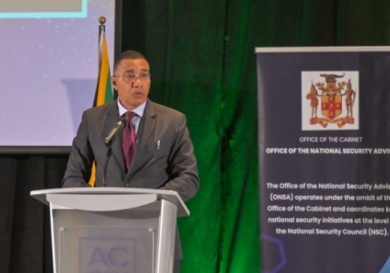
KINGSTOWN, Jamaica, CMC—Jamaica is to sign a Customs Mutual Assistance Agreement with the United States that will establish a legal framework for the Jamaica Customs Agency (JCA) and the United States (US) Customs and Border Protection Agency to exchange customs-related information.
Prime Minister Andrew Holness said the agreement would strengthen both countries’ capacities to safeguard their citizens, borders, national security, and vital economic interests.
Holness, addressing a National Security Council seminar, said that ‘after negotiations with our US counterparts in October last year, Jamaica is now advancing the proposed agreement to the final stage of our internal approval process, which includes Cabinet approval.
“Intelligence sharing of this sort is no longer optional if we wish to thwart transnational organized crime and secure the region. The evidence is clear. Criminal organizations are outpacing our governments in their ability to share information, adapt to enforcement measures, and exploit gaps in our security frameworks,” he added.
Holness noted that by strengthening inter-agency cooperation, deepening partnerships with international law-enforcement bodies, and ensuring security forces are well-resourced and highly trained, the government is positioning Jamaica to not only respond to crime but proactively dismantle the networks that threaten peace and stability.
“Within the Caribbean, we must, therefore, accelerate the implementation of a comprehensive regional intelligence-sharing mechanism that enables real-time information exchange on the movement of arms, narcotics, and criminal actors across borders,” Holness said.
He said that the Trinidad-based Caribbean Community (CARICOM) Implementation Agency for Crime and Security (IMPACS) and the Regional Intelligence Fusion Centre (RIFC) provide a strong foundation for such cooperation.
“But there is room for improvement when it comes to sharing shipping intelligence for commercial freight, which is critical to improving the detection of smuggled firearms. On that note, we must also strengthen our maritime and border security cooperation. The movement of illegal arms and narcotics through our waters is a major enabler of violent crimes in the region,” Holness said.
“However, many nations lack the necessary naval and aerial surveillance capacity to police our borders effectively. As I have said before, we recognize that. But we also recognize that we’re not going to build our economy, grow our economy, and protect our people without sacrificing to acquire these assets on our account,” he added.
Holness said the government also recognizes that capacity-building is still needed, as the security forces must be equipped with the necessary training, technology, and legislative support to combat an evolving threat.
He said the digital revolution had transformed the ways criminals operate, utilizing encrypted communication, cryptocurrency transactions, and sophisticated cyber networks to evade detection.
“We must modernize our law-enforcement capabilities, integrating advanced data analytics, cyber intelligence, and artificial intelligence-driven surveillance into our security apparatus. Investing in these areas will improve our ability to disrupt criminal networks proactively.
As we and other countries in the region continue to build up our security architecture, we must be minded to improve the interoperability of our security forces.
“This means broadening the standardized intelligence-sharing protocols, strengthening joint operations between regional militaries and law-enforcement agencies, and ensuring officers across different jurisdictions are trained in complementary tactics and procedures.
“We have to move towards seamless coordinating mechanisms between our national security forces, our maritime patrol units, and cyber divisions to respond rapidly and effectively to evolving threats,” Holness added.








 and then