





























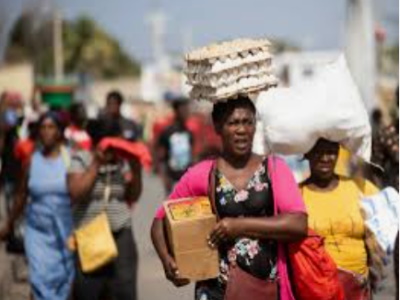
WASHINGTON, CMC – The World Bank says compounding shocks, including health crises, natural disasters, and insecurity, have continued to weaken Haitians’ well-being over the last five years, with food insecurity rising.
In its latest Latin America and the Caribbean Economic Update, the World Bank said that while conflict and social unrest have impeded the collection of household-level data through traditional face-to-face methods, six rounds of phone survey data collected between 2021 and 2025 make it possible to track Haitians’ living standards, jobs, and access to services.
It said food security has worsened, even as the COVID-19 crisis has abated, noting, for example, that about three-quarters of Haitians live in a household where at least one adult went without food for a day in the previous month in 2025, up from about half in 2021.
“Over the same period, the share of Haitians reporting that they were able to meet their basic food and non-food needs more than halved, while many households also shed their assets—behavior that typically only happens during deep and persistent crises— weakening their long-term financial resilience,” the World Bank report noted.
It said incomes are declining and in-work poverty is proliferating in Haiti, even as broad employment patterns remain stable.
Between 2021 and 2025, the share of phone survey respondents who were employed and working hovered around four in 10. Among those who were working, the share engaged in self-employment remained around 6 in 10, and the share in services remained around 7 in 10.
“Yet labor incomes have dropped. For people living in households with wage income, non-farm self-employment income, and agricultural income in the previous year, more than seven in 10 saw incomes from each source fall or be eliminated by the time they were interviewed in 2025. With non-labor incomes, including remittances, suffering a similar decline, Haitians’ options for building economic security appear increasingly limited.”
The World Bank report noted that large gaps in basic services expose Haitians to non-monetary poverty. In 2025, only 65 percent of Haitians had access to improved sanitation, and just 30 percent had access to electricity from any source in their household.
“While access to improved drinking water was more widespread, just over half of Haitians relied on bottled or tanker water—distribution mechanisms that could be disrupted by insecurity. Social assistance coverage was dwarfed by the extent of shocks and food insecurity: only 6.9 percent of the population lived in a household that received any form of social assistance from any source in the previous year.”
The World Bank said addressing gaps in services and infrastructure could support productive jobs and poverty reduction.
It said that expanding social assistance and access to services can improve Haitians’ well-being in the short term, helping protect against severe food insecurity.
“Yet investing in infrastructure can have longer-term effects too. For example, electricity can connect households to input and output markets and enable the use of productivity-enhancing equipment in priority sectors, including agro-industry, textiles, and digital finance.
“Therefore, expanding coverage to key services could provide the foundations for more productive employment, human capital development, and pathways out of poverty,” the World Bank added.









 and then