



















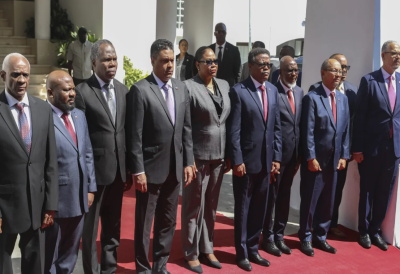
PORT AU PRINCE, Haiti, CMC – The mandate of Haiti’s Transitional Presidential Council (CPT) came to an end on Saturday, leaving the future of the French-speaking Caribbean Community (CARICOM) country in limbo even as the outgoing president said the Council of Ministers “under the direction of the prime minister will take charge”.
The United States has signalled its strong support for Prime Minister Alix Didier Fils-Aimé’sFils-Aimè’s leadership in building a strong, prosperous, and free Haiti.” Still, other parties have nominated individuals they believe are best able to steer the country ahead of presidential elections likely to take place later this year.
In late January, several members of the CPT unsuccessfully sought to oust Prime Minister Fils-Aimè,
“The presidential council has done its work by paving the way for a governance mindful of security and electoral issues,” said Prime Minister Fils-Aimè said at the ceremony.
“Today, we are aware of the challenges and…the government that I have the honour to lead will get to work,” he noted, promising to address the country later on Saturday.
The prime minister was flanked by five of the nine council members, with the notable absentees being Edgar Leblanc Fils and Fitz Alphonso Jean.
The CPT was established in April 2024 to restore political stability, address the security crisis caused by powerful armed gangs, and facilitate a transition of power following the resignation of Prime Minister Ariel Henry.
The nine-member council was created to select a new prime minister and cabinet, prepare for, and oversee the nation’s next elections, scheduled for early 2026. Since April 2024, Haiti has held no national elections.
It left office on Saturday with its tenure marred by infighting, poor governance, and paralysis, as well as persistent allegations of influence peddling, corruption, collusion with armed gangs, and of diverting public resources for personal gain.
Although there is broad agreement among Haiti’s civil and political leaders that the CPT should step down, a consensus has yet to emerge on what structure should replace it.
Among them is the Forum of Civil Society Groups, which it says has links with more than 13,000 “grass roots” organisations, and has named educator Dr. Charles Tardieu as its presidential candidate.
Former CPT member Leslie Voltaire said that, following three days of “inter-Haitian dialogue,” an agreement had been reached on the formation of the next government.
He said that a three-member presidential panel would include himself, a Supreme Court justice, and a representative of civil society. But the choice of a prime minister remained unresolved.
Outgoing CPT president, Laurent Saint-Cyr, in a statement on Saturday, said “we need to put our personal interest to the side and continue progress for security,” adding that the Council of Ministers, under the direction of the prime minister, will take charge.
He reminded Prime Minister Fils-Aimè that failure is not an option.
The ceremony coincided with the 40th anniversary of the downfall of the Duvalier regime in Haiti and eve as he paid “homage” to those killed during that period “because they are convinced this country deserves freedom, peace and a better life for everyone”.
Even as he acknowledged the difficulties faced by the CPT in carrying out its mandate, Saint-Cyr said that the various institutions functioned and that the government remains in place.
“We stopped the country from falling into chaos. The state is not collapsed,” he said, adding “we did not resolve everything, but we have launched the battle”.
The first contingents of the Gang Suppression Force (GSF), which will replace the struggling Kenya-led Multinational Security Support (MSS) mission, are expected to arrive in the country in April. Its mission is to restore state authority and public order, reduce gang territorial control, secure critical infrastructure, and support the Haitian people as they work toward a return to elected governance and long-term stability.
Earlier this week, the United States confirmed that at the direction of Secretary of War Pete Hegseth, the USS Stockdale, the USCGC Stone, and the USCGC Diligence have arrived in the Bay of Port-au-Prince.
“Their presence reflects the United States’ unwavering commitment to Haiti’s security, stability, and brighter future. The US Navy and US Coast Guard stand as symbols of partnership and support, working to ensure a safer and more prosperous Haiti,” the US Embassy noted.
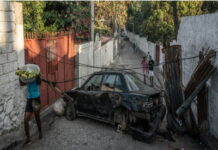
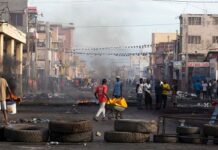
Criminal gangs control almost all of the capital, Port-au-Prince, and are responsible for killing 6,000 people and injuring more than 2,700 last year, according to the United Nations. It said that more than 10 per cent of the population has been displaced by the violence, and another six million face acute food insecurity, including 1.2 million children under the age of five. Haitian police have been conducting large-scale offensives against the gangs in recent weeks, ahead of the CPT mandate coming to an end.
“Today, the fear sits in the camp of the criminal gangs. They all understand they don’t have any other choice; drop their guns or die,” Saint-Cyr said.
The PNH has deployed a significant security presence in the capital, particularly around the Villa d’Accueil, where the ceremony took place on Saturday. Three recently donated armored battle tanks from South Korea have been deployed in response to the risk of a coup or reprisals from armed gangs.





 and then
  came to an end on Saturday, leaving the future of the French-speaking Caribbean Community (CARICOM))