













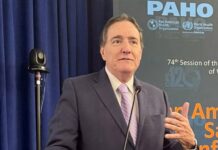



















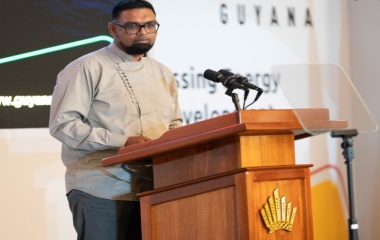
GEORGETOWN, Guyana, CMC – Guyana’s President, Dr. Irfan Ali, Wednesday defended the energy policy of his administration amidst global challenges dismissing those whom he said speaking on the virtues of climate change and the environment but are yet to develop a single approach that can be used to make the natural and national asset of a country a revenue earner.
“They can’t design anything for 80 percent of consumption,” Ali told the opening ceremony of the 2023 International Energy Conference and Expo being held here under the theme “Harnessing Energy for Development.”
He told delegates to the four-day event that “if we are to achieve net zero by 2050, there are a set of required actions which need investment.
“The gap to achieve this is US$1.35 trillion for emerging and developing countries,” Ali told the estimated 1,200 delegates, adding, “if we are going to reduce emissions, we have to start from the highest form of emissions, and that’s coal.”
He said renewable forms of energy require an investment of US$11 billion to “realise the achievable renewable energy target.
“That is what CARICOM (Caribbean Community), we have committed ourselves to (and) to get to this target it requires an investment of UIS$11 billion. Guess what the committed investments so far,” he asked the delegates, telling them, “you are just as I am, silent on the matter.
“Where is the US$11 billion coming from? Who is investing US$11 billion…why can’t we answer these questions,” Ali said, noting that while “we are in support and we are transiting to renewable, but where is the assessment.”
Ali said several regional prime ministers have committed to moving to electric vehicles (EVs) in the public transportation system.
“One prime minister told me I committed, and the next day I made a call to place an order for EVs, and then they told me ten years down the line, maybe five years down the line. This is the reality.
“We can’t be pushed into an environment to make political commitments when in reality we cannot realize those targets unless we are asked to mislead the population continuously,” he said, noting that his administration on coming to office in 2020, “immediately we re-assessed some targets that were committed to.”
He said in a “very frank and open way” that the government made it known that “these are not achieving targets because we are nowhere close to building infrastructure to achieve them.
“Now, how do we get the capital required to move to renewables in this global environment? We can’t get it by saying to the oil company you have to shut down in 10 years or 20 years. We have all agreed that in oil and gas, the shelf life is nowhere close to what some believe it is.
“So how do we sit around a table and say, listen, if we have 70 years, 80 years in oil and gas, how do we find a formula in which you will now rework your business model to stay sustainable after 70 years? How can you take some of your net profit and start investing in renewables?
“How is it you can help in the research and development to reduce your emission level,” he said, adding that this would require all stakeholders to be “around the table.
“You know, there is a lot of talk about Guyana’s PSA (production sharing agreement), and recently I made the point that governments have to make decisions that are in the best interest of the country,” he said, telling the conference that his administration came into office and “met what we have displayed publicly is a one-sided agreement.
“But we have a responsibility to honor an agreement that was made. I spoke about the consequences of walking away,” he added.
In November last year, Guyana’s Vice President, Bharrat Jagdeo, announced new fiscal terms as part of an updated model production sharing agreement. The government had indicated that new words would not apply to the existing Stabroek Block agreement, which has been heavily criticized as being too favorable to the ExxonMobil-led consortium operating offshore.
A 10 percent royalty rate will head the new model agreement, up from the two percent granted to Exxon for the Stabroek Block. The 75 percent cost recovery ceiling has been lowered to 65 percent. The profit-sharing after cost recovery will remain 50/50 between the government and the contractor. And a corporate tax of 10 percent will be instituted, where there was none before.
Jagdeo had explained then that while the old terms granted the government a 14.5 percent share at the start of production, the new terms increased this to 27.5 percent plus corporate tax.
In his address to the conference that is being attended by the leaders of Trinidad and Tobago and St. Vincent and the Grenadines, President Ali said Guyana had demonstrated global leadership on how natural resources can be sustainably harnessed and that it will continue to exploit its resources in ways much of the world does not yet believe is possible.
But he insisted that Guyana’s developmental plan will be a model for global sustainable development.
Ali told the conference that a “new world coalition” is needed to help developing countries confront the triple crises of climate change, food security, and energy security, with Guyana leading the charge toward showing how governments can balance lucrative oil and gas production with a long-standing commitment to the environment.
He said Guyana’s development plan, known as the Low Carbon Development Strategy (LCDS), is the key to the country’s sustainable development, integrating efforts to boost economic growth, reduce poverty and empower communities.
“The LCDS is not an idea. The LCDS is a demonstration of a practical document, and Guyana’s position is to make the LCDS a global model for sustainable development,” Ali said, noting that through this strategy, Guyana is undertaking several initiatives that will bring revenue to the country.
One such initiative is a forest payment scheme where countries or companies can pay Guyana for a tradable permit known as carbon credits. Under the project, Guyana is set to keep its pristine forests intact, trapping harmful fossil fuels contributing to the climate crisis.
He said through its development plan, Guyana also hopes to harness its new oil wealth to fund its transition to more environmentally-friendly sources of energy and, overall, its development.
“What we have said is oil and gas is not the answer. It will give us much-needed revenue to catalyze the other sectors,” President Ali said, noting that the government is pursuing a gas-to-energy project that will result in natural gas produced offshore brought to Wales on the West Bank of Demerara (WBD) to fire a power plant and a Natural Gas Liquids (NGL) plant.
“When we speak about development and transformation and the positioning of Guyana, it is not guesswork. It calls for big thinking.
“Many people today are shouting from the top of the mountains about ‘Oh, why go gas? What about the potential of hydro?’ More than a decade ago, the then government, which is in office now, painstakingly got investors to come here to invest in the Amaila Falls project, and you know what they did? They killed a good project; an international investor walked away.
“Today, that project would have been completed, and the people would have been receiving electricity at half the cost. It would have happened long ago,” Ali told the energy conference.








 and then