GEORGETOWN, Guyana, CMC – Guyana Friday remained optimistic that it would be victorious in its land border dispute with Venezuela, now before the International Court of Justice (ICJ), saying it anticipates the Court’s ruling by the end of this year.
The Essequibo region comprises roughly the western two-thirds of Guyana, spanning 61,600 square miles. It is a resource-rich region bordered by the Essequibo River to the east and Venezuela to the west, which Venezuela claims as its own.
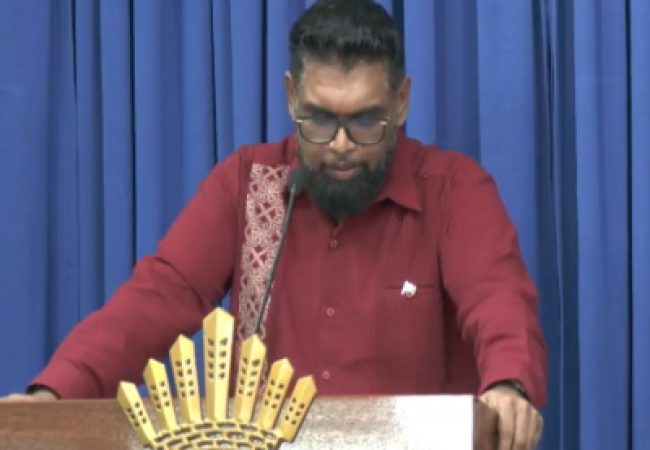
President Irfaan Ali, speaking at a news conference on Friday (CMC Photo)
President Irfaan Ali, speaking at a news conference here, praised the legal team that represented the country earlier this month at the hearings in the Hague, noting that the oral presentations by both countries “brought the contentious part of the proceedings to a close.
“Both Guyana and Venezuela had already presented extensive written pleadings on the merits of the case between 2021 and 2025.
“All that now remains is for the Court to deliberate on the matter before it, especially on the validity of the 1899 arbitral award that determined the international boundary between the two countries and issue its final judgment, which will be legally binding on both parties.
“We anticipate the court’s ruling at the end of this year,” Ali said, adding that the very fact that this case reached the ICJ and the written and oral phases of the proceedings were carried out to their completions represents a triumph for the rule of law and rules-based international order.
“Disputes between states must be resolved peacefully, finally, and in conformity with international law. They must not be allowed to fester indefinitely. They must never be resolved by threat or use of military force.
“Guyana has pledged repeatedly, including at these oral hearings, that it will abide by the court’s judgement, whatever it may be,” he said, adding “Guyana is confident, in fact, that after the oral hearings, we are even more confident than ever that the court will uphold the legal validity of the 1899 arbitral award and the finality and prominence of the international boundary between Guyana and Venezuela.”
Guyana brought the case before the ICJ in 2018, seeking confirmation that the 1899 Arbitral Award, which established the boundary between the two countries, is legally valid. The award had been accepted for over 60 years before Venezuela declared it null in 1962 and revived its claim to the territory.
The matter is being addressed under the 1966 Geneva Agreement, which outlines mechanisms for a peaceful settlement. After bilateral efforts failed, the dispute was referred to the ICJ by the United Nations Secretary-General.
President Ali told reporters that Guyana is very proud of the presentations made at the oral hearings, saying, “We believe that our arguments were compelling and convincing and they show the lack of merit in Venezuela’s case, both on the facts and on the law.”
During the oral presentations that ended on May 11, Venezuela, despite making an appearance, said that it would not allow the ICJ to settle the decades-old border dispute with Guyana.
“Venezuela will never endorse a violation of the Geneva Agreement and international law. There is no legal way of recognizing a decision resulting from this process, whatever that may be,” said Acting President Delcy Rodriquez.
The ICJ, established in June 1945 by the Charter of the United Nations (UN) as the principal judicial organ of the UN, has in the past ruled that it has the authority to adjudicate the border dispute.
In her closing arguments lasting just under half an hour, Rodriquez, who appeared before the ICJ panel of judges wearing a brooch depicting Venezuela’s claim to the Essequibo, said that controversy must be resolved politically under the 1966 Geneva Agreement.
She repeated several times that Venezuela does not recognize the Court’s jurisdiction, stating that her appearance “does not imply in any way recognition of the court’s jurisdiction in the territorial controversy”.
But Ali told reporters that Georgetown is “grateful to our representatives in these proceedings” and that “the court’s judgment will bring to an end the controversy that arose in 1962 when Venezuela, for the first time, challenged the lawfulness of the 1899 arbitral award and the international boundary it established”.
He said that after “accepting, respecting, and complying with the award and the boundary without protests for 63 years, the oral hearings established that Venezuela made this very belated protest precisely at a time Guyana was nearing its independence.
“British troops would be departing, and Venezuela would have a significant military advantage with which to press its unfounded claim to nearly three-quarters of Guyana’s territory, the very claim that a tribunal of five preeminent arbitrators unanimously rejected in 1899.”
Ali said before departing Guyana in 1966, the British negotiated an agreement with Venezuela” to assure that its challenge to the validity of the 1899 arbitral award would be resolved peacefully.
“The Geneva Agreement of 1966, for which Guyana became a party upon its independence that year, provided for four years of bilateral negotiations to resolve this dispute. These negotiations were unsuccessful.
“In the circumstances, the Geneva Agreement further provided that the Secretary-General of the United Nations would choose the proper means of final settlement of the controversy with the power to choose such means if the prior means that he selected failed to achieve such a settlement.”
Ali said that in January 2018, after more than 50 years had passed without a settlement, Secretary-General Antonio Guterres decided that the International Court of Justice should settle the controversy.
Ali said his decision was binding on the two parties, and Guyana then initiated proceedings before the ICJ in March 2018.
“We will await the Court’s final judgment on the merits with patience, dignity, and optimism. We will continue to address Venezuela in a spirit of peace, cooperation, and friendship, and as sovereign equals.
“We respect Venezuela’s sovereignty, as we have always done, and insist that Venezuela refrain from trespassing on or threatening Guyana’s sovereignty,” Ali told reporters.
“We have heard the statements of Venezuela’s officials that they do not accept the ICJ’s jurisdiction and will not abide by its rulings. This would be a breach of its most solemn obligations under the United Nations Charter, the Charter of the Organization of American States, and the general international law.
Ali said the Venezuela position “will not be tolerated by the international community, which demands a world order based on law.
“It is our fervent hope that Venezuela’s expression of disrespect for the Court and for international law reflects the emotions that often accompany litigation of this kind.
“We hope that after passions received and responsible government officials reflect, they will conclude, as we have done, that both States are best served by an end to this longstanding conflict, and that the only way to secure a just and lasting peace and an enduring friendship is by respect for and compliance with the Court’s final judgement, whatever it may be, as required by the United Nations Charter,” Ali told reporters.