





































GEORGETOWN, Guyana, CMC – The Guyana government is to table an Integrated Solid Waste Management Bill and Regulations that will allow for hefty fines, tighter controls on e-waste and oil and gas waste, and mandatory financial security for operators.
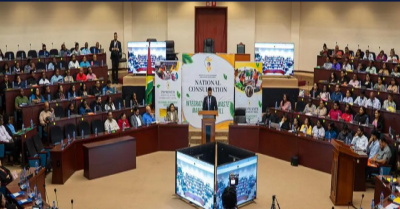
The Irfaan Ali government on Friday discussed the proposed legislation at a national consultation, with the legal consultant for the United Nations Environment Programme (UNEP) Zero Waste Programme, Romel St. Hill, presenting findings from a comprehensive analysis that served as the basis for the bill.
Under the proposed legislation, operators who engage in willful negligence or cause serious environmental harm could face fines exceeding two million Guyana dollars (One Guyana dollar = 0.004 cents) and imprisonment ranging from three to five years.
The draft bill establishes a comprehensive e-waste management control framework to address the growing risks associated with electronic waste. The framework provides multi-layered protection against heavy metals and hazardous components, safeguards public health, and promotes material recovery through controlled collection systems, licensed processing facilities, and Extended Producer Responsibility (EPR) funding mechanisms.
The bill also introduces an Oil and Gas Waste Integration Framework, ensuring that waste generated by petroleum operations is managed within a coordinated national system. While aligning with the Petroleum Activities Act, the framework preserves the Environmental Protection Agency’s (EPA) authority over hazardous waste classification, transportation, and disposal.
There is also a requirement for financial security and closure obligations, with waste operators required to provide financial guarantees, such as bank guarantees, bonds, trusts, or escrow accounts, to ensure funds are available for site closure, post-closure care, and environmental remediation if a facility is abandoned or an operator defaults.
The draft legislation follows an analysis aimed at identifying current challenges in Guyana’s waste management system and providing evidence-based recommendations aligned with international best practices and environmental law principles.
The assessment found that while multiple EPA regulations exist, including the Hazardous Waste Regulations (2000), Water Quality Regulations (2000), and Litter Enforcement Regulations (2013), they lack integration into a cohesive national waste management framework.
Among the system’s strengths are constitutional provisions for environmental protection, an established regulatory framework, EPA enforcement capacity, and the involvement of multiple stakeholder institutions. However, critical weaknesses were identified, including a fragmented legal framework, overlapping institutional mandates, outdated regulations, weak penalties, limited enforcement mechanisms, and the absence of circular economy principles and a formal waste hierarchy.
The analysis also highlighted external threats, including climate change impacts, rising waste generation, transboundary pollution, funding constraints, political instability, and a lack of public awareness. Environmental impacts linked to these gaps include continued landfilling and open dumping, soil and water contamination, and biodiversity loss. Public health concerns include exposure to hazardous waste, disease vectors, landfill odours, and air and water pollution in vulnerable communities.
To address these challenges, the proposed legislation incorporates proven global principles, including those promoted by UNEP and international environmental law, such as the waste hierarchy, circular economy approaches, and Extended Producer Responsibility (EPR) schemes.
The key features of the proposed legislation include updated definitions using modern, circular economy-aligned terminology; clearly defined institutional roles and coordination mechanisms; comprehensive licensing and permitting systems; waste segregation, recycling, and recovery requirements; and innovative financial instruments to ensure sustainable funding and cost recovery.










 and then