






































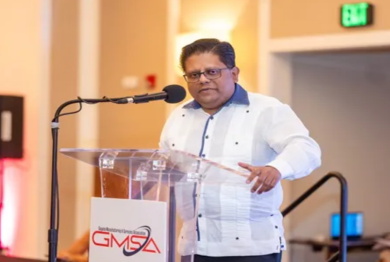
GEORGETOWN, Guyana, CMC – The Guyana government says it will continue to implement prudent socio-economic policies in an unpredictable world economic environment, as it lauded the achievements of local manufacturers.
“Everybody has been alive long enough to remember an era when oil was US$138 a barrel and we should remember not only the era of oil being US$138 per barrel but we’ve also in recent memory lived through a period more recently when oil was as low as US$13 per barrel and the reality is that oil did not stay at US$138 per barrel for very long,” said the Senior Minister in the Office of the President with Responsibility for Finance Dr. Ashni Singh.
Singh told the Guyana Manufacturing and Services Association’s (GMSA) 30th Anniversary Dinner and Awards Ceremony that just about two and a half years ago, oil was US$98 per barrel.
“It’s not US$98 a barrel today, it’s closer to maybe 60 something dollars – a third less than it was two and a half years ago. That’s the reality of the world in which we live.
“Gold is, of course, an essential contributor to our economy, and all of us in this room we celebrate the fact that gold today is US$4,000 an ounce, but we can all in this room remember a period when we were excited about gold even crossing the US$400 threshold and we can all remember a time when gold was just US$450 an ounce.
“Today it is US$4,000 an ounce. I don’t know who will wager whether it will remain at US$4,000 an ounce,” Singh said, alluding to freight prices, which he reminded have skyrocketed over the last five years.
“And so we must never forget that we live in a very uncertain and unpredictable period, and we know this as a government, and as a responsible government that recognizes the reality that we are living in an unpredictable world, and as a government that takes its responsibility seriously, and not only its responsibilities today and tomorrow, but its responsibilities next year and the year after that…” he said.
Singh said that, as a commodity-producing economy, one of the things that matter most is not only ensuring survival but also the country’s success and the realization of its prosperity, notwithstanding these uncertainties, long into the future.
He told the audience that in relation to responsible policy-making, “we must never underestimate the importance of preserving the democratic credentials of our country and preserving our standing in the international community, including the integrity of our financial system as part of an integrated, unavoidable, global financial and economic system.
He said that as the country celebrates its successes, it must never take them for granted, as they can quickly disappear if the country’s democratic credentials are ever undermined.
Acknowledging the presence of the United States Ambassador to Guyana, Nicole Theriot, the Finance Minister said that if Guyana takes its current position for granted, it could risk becoming a pariah state or being isolated by those who have traditionally been its friends, such as the USA.
“We must also never take for granted the importance of macroeconomic stability and macroeconomic resilience.
“We must never take those things for granted, and when we speak of a resilient economy, we are speaking, of course, of an economy that has strong institutional structures, including now as an oil and gas producer, an economy with a strong natural resource fund, a sound sovereign wealth fund with clear and transparent governance arrangements and clear and transparent rules, for the management of the resources in that fund”.
He said that Guyana is currently one of the very few countries in the world that has accumulated enough resources in its sovereign wealth fund to pay off the country’s entire external debt and still have cash remaining.
“But also, when we speak of resilience, we are speaking also of an economy that is more diversified and needs to be more diversified because we know that resilience can only be achieved if we diversify the sources of growth and the sources of macroeconomic and fiscal space and so you will hear us speaking incessantly about the importance of the non-oil economy, and importantly, the importance of a globally competitive non-oil economy.”
He told the audience that they are an essential part of ensuring that this is realised.
Irrespective of the sector you’re operating in, you too play an essential role in this mission to ensure that whatever we produce is globally competitive.
“So, you will see in our fiscal priorities a very significant reorientation of the budget away from government consumption and towards investment in economic infrastructure that is critical to competitiveness,” Singh said, recalling that in 2020, when government came into office, the public investment component of the capital budget in 2019 accounted for less than 25 per cent of the total budget.
He said that the public investment component of the 2024 budget accounted for more than 50 per cent of the overall budget, reflecting the government’s deliberate policy position.
“The policy position that we will not engage in inefficient government consumption but instead, focus on investing in the things that matter for long-term economic growth and long-term prosperity and for long-term competitiveness,” he said, adding that the government had to make hard choices as to what should be priority investments.
“Because investing in the things that matter for the long term are not necessarily the things that are most popular in the short term, but you have in President Ali’s government, a government that will not sacrifice the long term at the altar of short term or immediate term expediency,” he said, adding that ‘it requires an explicit policy position, it requires strong leadership and a strong government to ensure that the right decisions can be realized, ensuring fiscal sustainability.
“We will ensure that our economy continues to grow rapidly, but to be equally clear, particularly in this era of soundbites and competing promises and counter promises, you have in this government, a government that is keenly focused on responsible economic policy-making because, more so than any other time in our country’s history, that is what is needed, not soundbites. This is a serious time for our country. We need to be responsible, and we need to be strategic,” Singh said.
BMSA president, Rafeek Khan, said his organisation is entering into the fourth Industrial Revolution (Industry 4.0), characterised by the fusion of physical, digital, and biological systems through technologies and genetic engineering.
He said that this revolution is driven by data and connectivity, creating a new era of intelligent, automated, and interconnected systems, and that it is a time when the service sectors of the economy will bridge the gap and drive overall economic growth.
Khan referred to some of the primary interconnected services to bridge the gap in manufacturing, including transportation and distribution, Finance and Investment, communication, storage and warehousing, and professional services.
He urged the GMSA, in preparation for the new wave of industrial development, to prepare itself to serve its members and support the overall growth of our new economy. At this point, he unveiled a future campus that he noted would bring value to all stakeholders.
“About five years ago, I stood on this platform serving then as President of GMSA, and I echoed a voice from our President, Dr Mohammed Irfaan Ali, to build consortia. This is the only way for many Guyanese companies to realize the benefits of the major economic growth. Today I am pleased to say that we have witnessed successful consortia formed with international companies within various sectors of the economy,” he added.









 and then