
















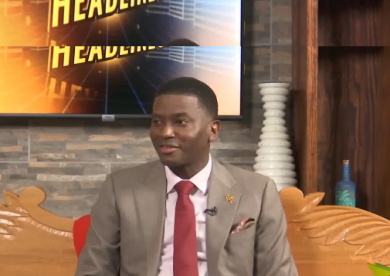
ST. GEORGE’S, Grenada, CMC – Grenada’s Prime Minister, Dickon Mitchell, says the weekend events in Venezuela have not advanced the causes of any parties nor have they narrowed differences, and instead, “are pushing the region into more instability.
“We again reiterate our position that diplomacy, dialogue, negotiation, and compromise are the only means of achieving any sustainable, long-term resolution to differences,” Mitchell said on the Grenada Broadcasting Networks (GBN) “Beyond the Headlines” programme on Monday night.
Last weekend, the United States military invaded Venezuela and seized President Nicolas Maduro on allegations of being involved in the illegal drug trade.
Maduro and his wife appeared in a Federal Court in New York on Monday, where they both pleaded not guilty to the charges. The matter was adjourned to March 17 this year.
The 25-page indictment accuses Maduro and others of working with drug cartels to facilitate the shipment of thousands of tons of cocaine into the US. They could face life in prison if convicted.
The United Nations Security Council met on Monday against a sharply altered diplomatic backdrop, with Council members split over whether Washington’s move upholds accountability or undermines a foundational principle of international order.
Some delegations argue the action was exceptional and justified; others warn it risks normalising the use of unilateral force and eroding state sovereignty.
The United States rejected characterisations of its actions as military aggression, describing the operation as a targeted law enforcement measure facilitated by the military to arrest an indicted fugitive.
Its Ambassador Michael Waltz said Maduro is not a legitimate head of State following the disputed 2024 elections, and that last Saturday’s operation was necessary to combat narcotics trafficking and transnational organised crime threatening US and regional security.
“There is no war against Venezuela or its people. We are not occupying a country,” he said, adding, “this was a law-enforcement operation in furtherance of lawful indictments that have existed for decades.
But the Venezuelan Ambassador, Samuel Moncada, described his country as the target of an illegitimate armed attack lacking any legal justification, accusing the US of bombing Venezuelan territory, the loss of civilian and military lives, and the “kidnapping” of President Maduro and his wife, Cilia Flores.
“We cannot ignore a central element of this US aggression. Venezuela is the victim of these attacks because of its natural resources,” he said, calling on the UN Security Council to act under its Charter mandate.
He said the US would be required to respect the immunities of the president and his wife and ensure their immediate release and safe return, as well as the use of force against Venezuela would be clearly and unequivocally condemned.
Mitchell, an attorney, told television viewers that all parties should respect international norms, the rules of global engagement, and the territorial integrity and sovereignty of all countries in the Western Hemisphere and the Americas.
“That is the only way we will make progress…whenever differences arise between certain countries or amongst countries,” he said, side-stepping Washington’s announcement that it intends to “run” Venezuela following the removal of President Maduro.
“I don’t think I have a response to that. The only way a country can run another country, let me put it this way. A country runs its own country, and the only way you can run another country is if that territory belongs to that country or is a colony of that country,” Mitchell said, adding, “So I really think the question should be directed at President (Donald) Trump and his team as to what they mean by that.
Mitchell said he was being honest in saying he could not explain those statements by US officials regarding Venezuela, saying, “I think really it is for the officials in the US government to explain what they mean by those statements. I am not in a position to comment on what it means.
Prime Minister Mitchell told Grenadians that his administration is reviewing a memorandum of understanding (MOU) proposed by Washington regarding the acceptance of third-country nationals as “safe third countries,” as the United States seeks to shift asylum processing away from the North American country.
He said that no agreement has been reached, acknowledging also that while the US has approached several Caribbean countries with this proposal, Grenada has not committed to the arrangement.
“For some time now, the US government has approached Caribbean countries, including Grenada, to enter into a memorandum of understanding about third-country nationals,” Mitchell said.
“We’ve been in discussions with the United States on this. Discussions along with texts of the MOU have been shared,” Prime Minister Mitchell said, explaining that the proposal would involve Grenada potentially hosting individuals on a case-by-case basis when the US is unable to return deportees to their countries of origin.
However, he stressed that technical officers and the Ministry of Foreign Affairs have been engaged in discussions with the United States Agency for International Development (USAID) and the US Embassy in Washington, and “to date we have not agreed to accept.”
Mitchell declined to disclose details of Grenada’s counter-proposal, citing national security concerns.
On Monday, both Dominica and Antigua and Barbuda announced that they had reached an agreement with the United States to facilitate the resettlement of third-country refugees.
“I believe this will further deepen our longstanding relationship and signal clearly that Dominica remains a willing and reliable partner of the United States in the region,” said Dominica’s Prime Minister Roosevelt Skerrit.
For its part, Antigua and Barbuda said it has not entered into any “binding agreement with the United States to accept deportees or refugees.
“What exists is a non-binding Memorandum of Understanding proposed by the United States, as part of its global efforts to share responsibility for refugees already present in its territory.
“Antigua and Barbuda was approached by the United States, along with more than one hundred governments worldwide, including several within the Caribbean Community (CARICOM), to consider this non-binding arrangement,” the government said in its statement.
CMC/ls/ah/ir/2026




 and then