




















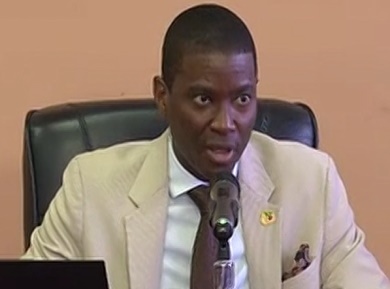
ST. GEORGE’S, Grenada, CMC—Prime Minister Dickon Mitchell said Tuesday that Caribbean Community (CARICOM) countries do not regard their presence at the United Nations Climate Change Conference (COP) “as a trip that is fun.”
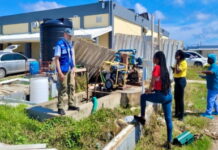
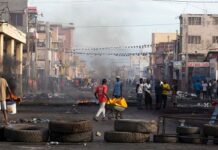
Speaking at a news conference after heavy rains over the past few days caused widespread floods and damage here, Mitchell, who last week addressed the ongoing COP 29 in Baku, Azerbaijan, said the presence of the regional countries was necessary to deal with the impact of climate change.
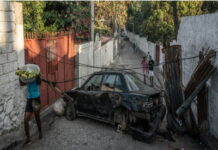
He said he never expected that while speaking at COP 29, which ends on Friday, “I w, would be seeing pictures of my son standing on top of the desks as a result of the flooding” at his school.
“But I think it brought home graphically to the international community that this is not a joke; we are not coming to COP because we want to or think it is a fun trip. We are there to advocate for fairness in the climate financing system and address the significant challenges we are dealing with.”:
Mitchell, also the current chairman of the regional integration movement CARICOM, told reporters that leaders are given three minutes to speak at COP, with at least half a minute taken up exchanging pleasantries and thanking the host.
“We were very direct in asking for partnerships, and that is financial partnerships to deal with the challenges that we face due to the climatic events,” he said, adding that the regional countries have spoken about the loss and damage fund.
“That fund should be properly funded and available for us to respond to the obvious loss and damage as in Grenada’s case, which we are facing due to the climatic events,” Mitchell said.
But he acknowledged the need to appreciate “that these things take a lot of willpower, an enormous amount of advocacy…to get the big countries, the G20 countries, the major polluters and emitters to fund and fund in a transparent and easily accessible manner.
“Often the funds are pledged, but they are pledged in very sophisticated complex agencies that are located, for example, the Green Climate Fund, in Korea, Europe, or North America.”
He said that, as a result, Caribbean and other small island developing states (SIDS) do not have the opportunity to have “direct access.
‘You have to be accredited. The procurement process for projects takes a long time,” he said, noting that we “ are hoping that coming out of COP that there are larger pledges and more importantly actual funding of the loss and damage find and that the rules about how monies will be disbursed will be directly based on a compensatory basis for small island developing states that have suffered loss and damage.”
When COP28 officially launched the Loss and Damage Fund, early pledges from countries like the United Arab Emirates, Germany, the United States, and Japan raised US$700 million, a mere 0.1 percent of the US$671 billion.
The Loss and Damage Fund aims to provide financial assistance to poorer nations as they deal with the negative consequences that arise from the unavoidable risks of climate change – for example, rising sea levels, extreme heat waves, desertification, forest fires, crop failures
Mitchell said while in Bahu, he also used the opportunity to engage in bilateral discussions with several partners, including China, “to be able to impress upon them that outside of the multilateral system, on a bilateral level, they can also provide assistance to small island developing states to address issues like energy transition, which we need to do to have energy security, which is part and parcel of this entire climatic situation…
Mitchell said Azerbaijan, as the host, supported SIDS in areas like food security and that he visited a greenhouse owned by a private investor keen on investing in Grenada.
He said such an investment would be welcomed in Grenada, noting that the old traditional way of growing tomatoes, for example, on the ground right now in a low-lying area would be washed away by the floods.
“With greenhouses, you could elevate off the ground…and you need a significant level of flooding to reach the plots of land, no larger than a shoe box in which the tomatoes are grown…
“So bringing technology, sustainability, and resilience to our farming will be critical to address our food security,” Mitchell said, noting that farmers on the West Coast have suffered significant losses from the rains and floods.
He said that, therefore, SIDS must stick together “so we could have greater impact and greater voting power within the multilateral space where we are negotiating.”





 and then
  countries do not regard their presence)