


































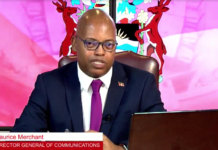

ST. GEORGE’S, Grenada, CMC – Prime Minister Dickon Mitchell Friday warned local contractors that they could face the termination of their government contracts if they fail to adhere to the terms and conditions of their contractual agreement.
“The days when contracts are not terminated, retention clauses and delayed payments are not enforced, it will become a thing of the past,” Mitchell said, as he contributed to the EC$1.9 billion (One EC dollar=US$0.37 cents) national budget presented to Parliament on Monday, by Finance Minister Dennis Cornwall.
“You cannot bid for a project, have the designs, have the plans, get the contracts and then you decide you want to re-engineer and re-design to delay the work or decide you not complying with the contract because you feel it suits you,” Prime Minister Mitchell said, while reminding contractors “it is the taxpayers money that is paying for Infrastructure in Grenada.
Mitchell, who has responsibility for Infrastructure, told legislators that over the last three and a half years, he has supported and fought for contractors, but that some local contractors are not fighting for themselves at all.
“They seem to think the Government is blind; they can give us shoddy work, improper work, delayed work, and believe they should not be held accountable. Well, I have fought for three and a half years, often on their behalf, and I now intend to fight on behalf of the citizens of Grenada.
“So, for contractors who have the Government’s contracts, deliver the people’s work. Put the resources on the sites,” he said, saying also that many of the contractors don’t want to work together.
“They have no capacity, they don’t want to collaborate, and that is what is driving the foreign work permits, that is what is driving more and more foreign non-Grenadians entering the construction industry in Grenada,” said the Prime Minister.
“Many of our local contractors prefer to remain small rather than collaborating and doing things or entering into ventures so that they will get bigger contracts,” he said, telling legislators that the lack of collaboration or working together is hindering the growth and development of local contractors.
“Many of them don’t qualify under the Caribbean Development Bank (CDB) procurement guidance,” he said.
The Government has said that millions in infrastructure contracts are awarded annually, with some significant projects in recent years having to be extended beyond the contractual period.
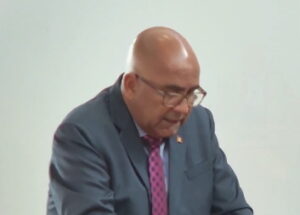
Meanwhile, independent legislator Peter David says he is concerned by the decision of the Government to suspend the Fiscal Rules of the Fiscal Resilience Act for a third time since the passage of Hurricane Beryl in July 2024.
Section 9(1) of the Fiscal Resilience Act, states that the Minister of Finance may, subject to negative resolution, suspend the public debt target and primary balance rule under section 8 of the Act, at any time during a fiscal year where any one or more of the events specified in section 9(1)(a)(b) or (c) of the legislation occurs.
The legislation further states that if the Minister determines that implementing the public debt target and primary balance rule in the fiscal year would be unduly harmful to the public finances and macroeconomic or financial stability, this will constitute additional justification for the suspension.
A natural disaster, such as a hurricane, is one justification. Following the passage of the hurricane in July 2024, the Government triggered the enforcement of the clause with a revocation date of December 3, 2024.
But instead of revoking the Order, the suspension was extended for 2025, and Finance Minister Cornwall told legislators on Monday that it will be extended for 2026.
“Looking ahead in 2026, the fiscal position is projected to improve relative to the 2025 budget and largely unchanged relative to the estimated outturn, signalling, as planned, a gradual return to the fiscal rules and targets under the Fiscal Resilience Act in 2027,” Cornwall said.
But David said one of the most concerning aspects of the budget for him is the casual admission that rules and targets under the Fiscal Resilience Act are “further suspended” in 2026.
“The Minister assures us of steadfast commitment to sound fiscal management while asking us to trust that this Government will return to compliance once conditions permit.
“Mr. Speaker, the FRA exists precisely because past governments could not discipline themselves. If this Government can suspend fiscal rules in 2024, 2025, and now 2026, citing Hurricane Beryl, what precedent are we setting? When will conditions ever permit fiscal discipline?” he asked.
David, a former government minister in a previous ruling New National Party government, said he is also concerned about the more than EC$300 million deficit in the 2026 budget.
“The overall deficit is projected at EC$309.8 million, financed primarily through a EC$257.3 million drawdown of Government deposits. In plain language, we are spending down our savings. How much remains in the tank? What happens when the deposits run dry?” David asked.










 and then