

































CASTRIES, St. Lucia, CMC -Professor Justin Robinson of UWI Five Isles has issued a courageous clarion call in his widely circulated article “No One is Coming to Save Us”. He is right – no one is coming to save us. When our Prophet Bob Marley warned us in Real Situation, to
“Check out the real situation/nation war against nation.. well it seems like destruction, the only solution,/And there ain’t no use – nobody can stop them now.”
Marley foresaw 45 years ago that this is where we were heading. And now Prof. Robinson has stepped out of the comfortable cave of academia to proclaim that no one is coming to save us, and in so doing, he has stepped up to the challenge that “non but ourselves can free our minds (and nations)”.
The past year has stripped away a long-standing Caribbean illusion: that the international system, benevolent partners, or historical ties would ultimately cushion us when things became difficult. They will not. Major powers are recalibrating in their own interests. Concessional finance is shrinking. Migration doors are narrowing. The rules-based order we were taught to trust bends when it becomes inconvenient for the powerful.
This is not a temporary shock. It is a growing structural shift.
But here is the part we must not miss: that no one coming to save us is not a tragedy; it should be a moment of clarity. It forces us to confront a deeper question we have postponed for far too long: what does saving ourselves actually mean, in practice, for small states like ours?
For the OECS, the answer is neither isolation nor bravado. It is about design.
Self-Reliance Is Not Going It Alone
There is a persistent myth that self-reliance means standing alone. In a globalized world, this does not even hold for large states despite the advantages of size, because global interdependence is real. For small states (pygmies in a world of clashing giants), that myth is dangerous. Real sovereignty is not exercised by pretending size does not matter. It is exercised by pooling capacity when size is a disadvantage and by acting collectively when fragmentation weakens leverage.
That is precisely why the OECS exists.
The Eastern Caribbean has already demonstrated that shared institutions can deepen, not dilute, sovereignty. A common currency. A single Supreme Court. Free movement of people. Coordinated external representation. These are not theoretical constructs. They are lived realities. They show that small states survive not by being self-sufficient, but by being system-smart.
The challenge now is to apply that same logic more deliberately to the economic and geopolitical realities we face today.
The World Has Changed, and Our Operating Model Must Too
The environment confronting the Caribbean is no longer one where incremental reform will suffice. Geopolitics now directly shapes access to finance, trade, data, energy, and mobility. Donor funding is becoming more conditional and less reliable. Policy space is narrowing, often without warning.
In this context, fragmentation – across countries, across sectors, across institutions – is no longer a manageable inconvenience but a strategic liability.
Saving ourselves, therefore, requires a shift in how we think and act. Not more projects, but stronger systems. No longer plans, but an adaptive strategy. Not reactive compliance, but interest-anchored engagement.
What Does Saving Ourselves Look Like in Practice
First, we must treat regional systems as strategic assets. Education, digital infrastructure, climate resilience, energy systems, and data governance are not social expenditures alone. They are sources of competitiveness, resilience, and bargaining power. If they collapse when donor funding ends, they were never developed to begin with.
Second, we must make fragmentation politically and economically expensive. Integration works in the OECS because the cost of going it alone is clear. That clarity must now extend to investment, regulation, climate resilience, and external negotiations. Regional platforms reduce transaction costs, attract capital, and amplify voice.
This also places a responsibility on both governments and opposition parties. In an era of heightened external pressure, sovereignty can be weakened not only by force but by short-term political expediency.
As difficult as this may be in highly combative domestic environments, there is now a compelling case for establishing clear national-interest red lines that transcend electoral cycles – positions on core matters such as regional integration, citizenship, data governance, security cooperation, and external alignment that are not traded in the heat of political contestation.
This is not a call for consensus on everything, but for restraint on the essentials. When sovereignty becomes a tactical instrument in the quest for office, it is rarely recovered once power changes hands. Put more explicitly, it might appear to opposition parties that this is a good time to warn of all the dangers and make it seem as if governments are not doing enough, but the reality is that no one but our governments truly understands the impossible “choices” they are being presented with.
In the current global climate, safeguarding national and regional autonomy requires a minimum level of shared discipline across the political divide.
Third, we must replace rigid planning with disciplined adaptability. Uncertainty is no longer an exception; it is the operating environment. Institutions must be designed to learn, adjust, and course-correct without losing credibility. Data is no longer just for reporting; it is strategic intelligence.
Fourth, we must convert vulnerability into exportable expertise. Climate resilience, disaster risk management, renewable energy, digital services, and human capacity development are not only survival imperatives; they are also essential to sustainable development. They are opportunity spaces, but only if built at a regional scale rather than as isolated national experiments.
Finally, we must speak with one voice or accept being spoken for. In a fragmenting world, fifteen small, uncoordinated positions are easily ignored. A coherent regional stance, grounded in data, discipline, and shared interests, is not idealism. It is survival.
A Moment of Choice
Professor Robinson is correct that development is not a technical problem awaiting another report. It is a political and institutional choice. Who benefits from the status quo? Who bears the cost of fragmentation? Who pays when resilience is postponed?
No one is coming to save us. That illusion is over.
But the OECS experience shows something equally important: saving ourselves is not beyond our capacity. It requires clarity of purpose, courage to integrate more deeply, and the discipline to build systems that endure.
This is not about rejecting the world. It is about engaging it on terms that protect agency, dignity, and future choice.
The question is no longer whether we understand the moment. It is whether we will act as we do.
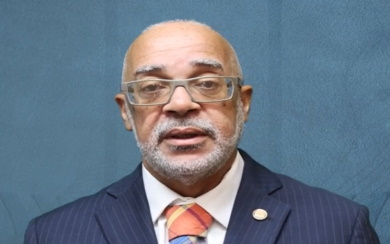
*Dr. Didacus Jules is the Director General of the Organisation of Eastern Caribbean States (OECS), based in St. Lucia.










 and then