























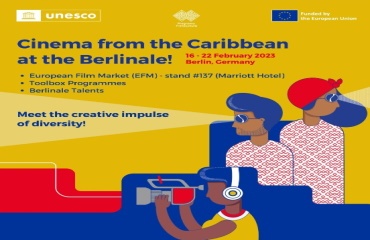
HAVANA, Cuba, CMC – The Caribbean film industry is, for the first time in its history, being promoted at one of the sector’s most important international markets with a dedicated stand at the European Film Market (EFM).
The UNESCO program Transcultural: Integrating Cuba, the Caribbean, and the European Union through Culture and Creativity, funded by the European Union, is financing the region’s participation at the Berlin International Film Festival (Berlinale), which ends on February 22 and attracting more than 10,000 representatives of the international film and media industries from over 100 countries.
“The Caribbean is rich in cultures, traditions, and mutual influences, making it an endless reservoir for creativity and innovation. Through the Transcultura program, UNESCO is committed to supporting the region’s cultural and creative industries and making their stories accessible to the world,’ said Alessandra Borchi, Transcultura Programme Coordinator.
Under the slogan ‘Meet the creative impulse of diversity,’ Transcultura’s ‘Cinema from the Caribbean’ stand will offer a promotional display window to institutions and festivals from 10 countries in the region, including the International Havana Film Festival, the production house Collectif 2004 Images from Haiti and the National Film Commission of Barbados.
These, in turn, will mainly focus on promoting the work of young filmmakers from their countries.
Supporting young people to promote diversity
Transcultural also supports the participation of five young Caribbean producers in the EFM’s Toolbox programs. With projects ranging from an LGTBI+ documentary in Jamaica to a feature film about motherhood in Trinidad and Tobago, the young producing filmmakers will attend a three-week professional mentoring program to provide business, marketing, and networking tools to underrepresented groups in the film industry.
In addition, the talent development program Berlinale Talents welcomes a female filmmaker from St. Lucia for the first time. Transcultural supports the participation of Zenzii Michelle Serieux in these training workshops to boost her project ‘Imagine Caribbean,’ which promotes young filmmaking in the rural community of Mamiku in her country.
With the financial support of Euros15 million (One Euro=US$1.29 cents) from the European Union, Transcultural represents UNESCO’s most ambitious cooperation initiative in the Latin American and the Caribbean region.
It aims at creating professional opportunities for young people in the cultural and creative industries through exchange and cooperation in the Caribbean and with the European Union.
The 17 beneficiary countries of Transcultural are Antigua and Barbuda, Bahamas, Barbados, Belize, Cuba, Dominica, Dominican Republic, Grenada, Guyana, Haiti, Jamaica, Montserrat, Saint Kitts and Nevis, St. Lucia, St. Vincent, and the Grenadines, Suriname and Trinidad and Tobago. To date, around 3,000 people have participated in the activities organized by the program.
The ‘Cinema from the Caribbean’ stand is integrated by the Motion Picture Association of Antigua and Barbuda, Barbados Film Commission, Havana Film Festival (Cuba), Dominican Republic Film Commission, Collectif 2004 Images (Haiti), Jamaican Promotions Corporations, The Audiovisual and Film Association of St. Lucia, Hairouna Film Festival (St Vincent and the Grenadines), The Back Lot International Documentary Festival (Suriname) and FILMCO (Trinidad and Tobago).
Caribbean filmmakers participating in the Toolbox Programmes are Letay Tamara Williams (Jamaica), Sophie Walcott (Trinidad and Tobago), Klieon C. John (St. Kitts and Nevis), and Leidy Laura González (Dominican Republic). Berlinale Talents: Zenzii Michelle Serieux (St. Lucia)







 and then