


































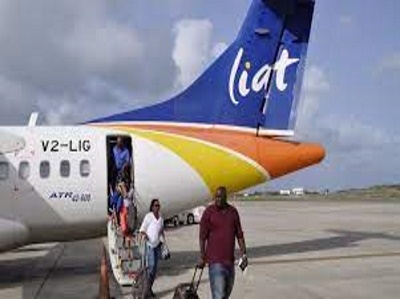
BRIDGETOWN, Barbados, CMC – The Barbados-based Caribbean Development Bank (CDB) says it is encouraged to help find a solution to the air transportation problems in the Caribbean, acknowledging that the current situation is now at crisis level in the Eastern Caribbean, where the demise of regional airline LIAT in 2020, meant a loss of airlift from an average of 500 weekly flights in 2019 to 50 flights in 2022.
“We don’t have to have a critical mass of political will to get to a unified solution, at least. We are encouraged because at least seven governments approached us in August last year to begin the study… (and) at least it is the start of a process,” said CDB’s Vice President (Operations), Isaac Solomon.
He told the bank’s annual regional news conference that the initial intervention is to “ease the pain we are feeling now, and the long-term intervention would be to treat with the entire…system that addresses the cost of transportation, addresses the regulatory aspects, addresses the bottlenecks that are in place preventing folks from moving seamlessly from country to country”.
Solomon told reporters that the CDB views the regional transportation situation as a “public good,” recalling that in 1970, one of the first loans made by the region’s premier financial institution was to LIAT for US$5.8 million.
“So we have been in this game for a long time, but we are thinking we have an opportunity to get it right,” he added.
LIAT (1974) has since gone into liquidation after more than four decades of operation in the region. The airline is owned by the governments of Antigua and Barbuda, Barbados, Dominica, St Vincent, and the Grenadines (SVG). Antigua and Barbuda had said previously that a decision had been taken that would allow Barbados and SVG to turn over their shares in LIAT to St John’s for one EC dollar (One Ec dollar=US$0.37 cents).
Earlier, CDB President, Dr. Hyginus ‘Gene’ Leon, said the bank views dependable and cost-effective air transportation services as essential for transforming several of the region’s economies. “Consequently, to safeguard the region’s future, governments need to take decisive and integrated action to reform the air transportation operating environment,” he said.
He acknowledged that there would be a series of hurdles to overcome, including the assets that would be required, the financing of those assets, the legal framework and environment in which those assets would be deployed, and the demand for the services.
“Then you must have the political arrangements to say we benefit from this. Networks cannot exist in segments. They must exist entirely, so network connectivity becomes a global public good.”
Leon said establishing a regional transportation system is “not a trivial exercise and what we are looking at now is how can we provide a framework, provide guidance on what does the region need to be able to make it work because we believe it is essential that the region cannot go forward without solving the transportation problem that we have now.”
Leon said the situation would require two phases, with the first phase getting people to move freely in some parts of the region.
You cannot move from one country to the other without necessarily getting a visa to go through the US as a connecting point,” he said, noting that such a situation would be disruptive to a young person seeking to travel through the region, given that the US reserves the right to decide whether or not to provide the visa.
“That is a significant problem not only for the people but equally for our heads of state, our governments because those people should be able to say we reserve the right as citizens to be able to move across the region.
“Now, if we are citizens of the region, why can’t we ask for that right to be able to move freely across the region? So transportation is part of the CSME (CARICOM Single Market and Economy allowing for free movement of goods, skills, labor, and services across the region) issue that we have to solve.
“We need to solve this urgent part now, and how we do it may or may not be optimal or efficient. We need to get a service going,” he added.
Asked by a journalist to trade places and give the ordinary person an update on the transportation situation in the Caribbean, Leon replied in two lines.
“Line one is that all the regional governments agree that the transportation nightmare we have cannot continue. Point two, all the governments agree, which is why they have asked for some partnership to help solve the problem. They agree that they need to do something and do it quickly because the countries, the people are hurting”.
Leon added a third line, saying, “they also agree they will do whatever is possible to solve the problem today while we put together a solution that will be sustainable, viable over the long term.
“So your headline can be “Help is Coming,” Leon said, too much laughing.











 and then
  says it is encouraged to help find a solution to the air transportation)