





































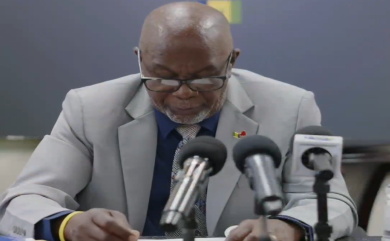
KINGSTOWN, St. Vincent, CMC – The chairman of the Barbados-based Regional Security System (RSS), St. Clair Leacock, says he has been informed that the United States will not punish Caribbean countries that refuse to accept third-country nationals (TCNs)
Late last month, the Dominican government said it had signed an agreement with the United States to facilitate the resettlement of third-country refugees on the island in cases where Washington cannot return them to their state of birth or origin.
Dominica is among several Caribbean Community (CARICOM) countries that have agreed to accept refugees from third countries deported by the Donald Trump administration.
Leacock, who is also the St. Vincent and the Grenadines Minister of National Security and Immigration, read at a news conference here what he said were responses to questions about the implications of Washington’s third-party, refugee, and deportee relocation to selected Caribbean States.
He said Washington had indicated that it would not tell one country whether a TCN had been refused entry by another country.
“Each country needs to determine its own individual needs, and just because someone would not be accepted by one country does not mean another would reject that individual,” Leacock quoted from the US response.
He said another question was whether all the TCNs had valid travel documents issued by their home countries, with the rationale that if they did not, they could not return home.
“Why would a home country issue a document for them?” Leacock said.
Washington’s position was that while some individuals may lack valid travel documents, the United States did not expect significant issues in obtaining new documents, and the International Organization for Migration (IOM) could support such efforts.
Washington said that when it refers to individuals unable to return to the home country, it was specifically describing cases where the United States is “unable to facilitate their return, not because of any formal prohibition or adverse action by the country of origin, but rather due to other circumstances that don’t impact the eligibility to be issued documents”.
Another question related to the legal status of TCNs upon arrival.
“The specific status is a decision each country will make. The United States expects that the receiving country will provide an appropriate immigration status or a legal accommodation for individuals transferred under the arrangement.”
As regards the duration and conditions attached to their stay, namely how TCNs are expected to stay and the status the receiving country is expected to grant them:
“In the experience of the United States, almost all individuals transferred under these arrangements seek to depart third countries as soon as possible,” Leacock said, citing the response provided by the US authorities.
“It is each country’s decision whether to grant any individual a more enduring status in line with their own immigration laws and procedures.”
The United States, when asked about the limits of funding, said that if the receiving country has additional funding needs beyond the services provided by IOM, “the United States asks that they send the requested activities and amounts for the United States to consider”.
Another question concerned the details the United States will include in the background and medical information provided for TCNs.
Washington said that the Department of Homeland Security would provide the following information, if available: medical screening documents, biometric information, nationality, information regarding whether the person is accompanied, the date of birth, the sex, criminal record, or confirmation or lack of known criminal record to the extent known to the United States of America, and medical screening before boarding.
“The in-flight medical professional conducts the medical record review to ensure all detainees have the proper medical clearances to travel. The review includes tuberculosis checks, prior medical history, and current medical treatments, and notes for any medication that must be provided during the fight.”
As regards the IOM’s role in the process, Washington said the IOM’s global assisted voluntary return program (AVR) can facilitate the departure of individuals to the United States.
“IOM can support the immediate needs, such as food, shelter, and emergency medical care, of such individuals. And this support can last up to one week. And during that period, IOM will counsel individuals on voluntary options to return to their home countries or another country that will accept them.”
Asked about the responsibility for the onward and return movement of TCNs, the United States said that IOM will support individuals who elect to use AVR while they are in the receiving country and facilitate their departure.
“If any individuals do not seek to depart the receiving country, they should handle those individuals in accordance with their domestic immigration laws and procedures,” Leacock quoted the US as saying.
Leacock, who last week assumed the revolving one-year chairmanship of the eight-member RSS at its meeting in St. Lucia, told reporters “if I can summarise what I’ve just read there to the listening public, because this question of deportees from the United States to Caribbean countries, who generally are not welcoming them with open arms, is that they will not force you. …
“If you don’t want them, they will not force you, and there will be no penalties for not accepting refugees.
“I think that came out to be very, very clear. If you do not want and you did not accept, there would be no penalty. So, in the end, it will be left up to the Caribbean countries to accept and or reject deportees coming from the United States of America,” Leacock added.









 and then
 , St. Clair Leacock, says he has been informed that the United States will not punish Caribbean countries that refuse to accept third-country nationals (TCNs))