

















WASHINGTON, CMC—A failed resolution demanding electoral transparency in last Sunday’s presidential elections in Venezuela has underscored the divisions within the Caribbean Community (CARICOM) countries regarding their relationship with Caracas.
Before the special meeting of the Permanent Council of the Organization of American States (OAS), the resolution was at the request of several Latin and North American countries.
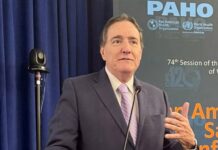
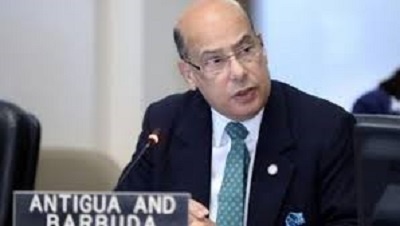
Antigua and Barbuda’s representative to the OAS, Sir Ronald Sanders, who chaired the special Council meeting, said that member states had failed to agree to the full text of the resolution, citing differences with “one sentence in one paragraph in the entire resolution.”
While he did not specify which paragraph he was referring to, Sir Ronald described the situation as “a matter of great regret” but not one he felt the Council should be disheartened by.
“We were within a hare’s whisker of a consensus resolution on Venezuela; we did not get there because of people’s inflexibility on one point.
“That one point, in the Chair’s view, is not worth the resolution we lost. Nonetheless, certain countries took up this position because of their passion and strong feelings—feelings that they could not overcome to achieve a broader objective,” Sir Ronald said.
In addition to Antigua and Barbuda, the Caribbean countries that abstained were the Bahamas, Barbados, Belize, Grenada, St Kitts and Nevis, and St Lucia, while Jamaica, Haiti, Guyana, and Suriname voted in favor of the draft resolution.
Dominica, St Vincent and the Grenadines, and Trinidad and Tobago did not participate in the session. Sir Ronald said that after the vote, many representatives felt that “the Permanent Council had failed democracy.”
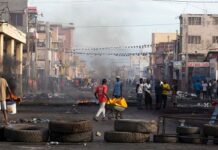
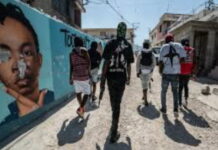
Protests have been rocking the South American country after the election board declared on Monday that President Nicolas Maduro had won a third term with 51 percent of votes to extend the “Chavista” movement’s quarter-century rule.
But the opposition, which considers the election body to be in the “pocket of a dictatorial government,” said the 80 percent of vote tallies to which it had access showed its candidate Edmundo Gonzalez had more than twice as many votes as Maduro.
The renewed instability has prompted an international reaction, including from the United States, which says it is considering fresh sanctions on individuals linked to the election and recognizes the opposition candidate as the winner of the polls.
The issue has also resulted in different CARICOM countries welcoming the results and others adopting a diplomatic stance.
CARICOM chairman and Grenada’s Prime Minister Dickon Mitchell told a news conference at the end of the summit on Tuesday that the issue should not be regarded as dividing the regional bloc.
“It’s not an indication that CARICOM is divided on this issue,” Mitchell said, adding that the Venezuelan election is a domestic affair.
“Second, Venezuela is not a member of CARICOM, and I think we expect, and it has already happened, that members will indicate their positions. CARICOM noted that the elections are taking place. We are happy that the people of Venezuela got the opportunity to exercise their democratic right to engage in elections.
“And so no, there is no division within CARICOM on the issue because there’s no need for CARICOM to have a division, honestly,” he told reporters.
The resolution at the OAS called for Venezuelan electoral officials to immediately publish the results of each polling station and conduct a comprehensive verification in the presence of independent organizations and observers to ensure the transparency and credibility of the process.
It needed an absolute majority to be approved. Seventeen votes were received in favor, 11 were abstentions, no votes were received against, and five were absences.








 and then