



















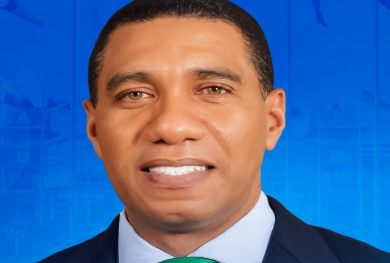
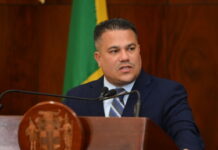
KINGSTON, Jamaica, CMC – Outgoing Caribbean Community (CARICOM) chairman, Prime Minister Andrew Holness, has reiterated the need for the Region to remain a “Zone of Peace” grounded in respect for international law, the peaceful settlement of disputes, and the de-escalation of conflict.
In his outgoing message as chairman of the 15-member regional integration grouping, Holness, who is also the Prime Minister of Jamaica, said the grouping “is consistent and unequivocal in its firm support for the sovereignty and territorial integrity of its member states.
“We are also firm in our stances against transnational organized criminal networks and the impact of drugs, guns, and human trafficking on the security of our Region. We do, however, recognize that member states may, from time to time, express differing national perspectives.”
Holness, while he did not make any particular reference to the current situation involving Trinidad and Tobago, whose Prime Minister Kamla Persad-Bissessar, has said that CARICOM is not a reliable partner and “has lost its way”, Holness said “such diversity of views is a natural feature of a Community of sovereign nations and does not alter the institutional mandate, the economic interdependence, or the organic people-to-people ties that bind us, regardless of exigencies as may arise from time to time”.
Persad-Bissessar has fully supported the United States war on drugs in the Region, which political observers say is a pretext for regime change in Venezuela, given that President Donald Trump has made it clear that the leader of the South American country, Nicolas Maduro, is involved in the drugs trade.
“An organisation that chooses to disparage our greatest ally, the United States, but lends support to the Maduro narco-government headed by a dictator who has imprisoned and killed thousands of civilians and opposition members, as well as threatened two Caricom members, has clearly lost its way,” Persad-Bissessar said
The US military attacks on vessels in the international waters off Venezuela have left nearly 100 people dead, including two Trinidad and Tobago nationals, and Washington has provided no proof of their engagement in the illegal drugs trade.
In his statement, Holness said that “at this moment in our history, we are also reminded that the Caribbean must now navigate a rapidly shifting geopolitical landscape” and that the “current international environment requires our Region to act with clarity, cohesion, and strategic discipline.
He said as global tensions intensify and external geopolitical developments increasingly intersect with the Caribbean countries’ interests, affecting their economies, security, and diplomatic relationships, “we must ensure, as best as possible, that our shared principles guide our responses: respect for sovereignty, adherence to international law, peaceful engagement, and the resolution of differences through dialogue and mutual respect.
“CARICOM’s credibility has always rested on its ability to manage differences through diplomacy rather than division, and through cooperation rather than confrontation. In moments of uncertainty, those commitments will remain essential to safeguarding the peace, development, and independence of member states.
” Despite the challenges of the year, CARICOM, one of the most enduring integration movements in the world, achieved a great deal. We will therefore continue to work to ensure that the CommunityCommunity acts in a spirit of dialogue, mutual respect, and fidelity to the principles that underpin regional and international cooperation.”
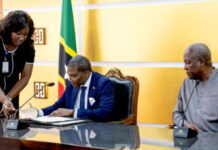
Holness, who hands over the chairmanship to St. Kitts-Nevis Prime Minister Dr. Terrance Drew, said he wanted to put on record his ‘sincere gratitude for the spirit of unity and shared purpose that has defined our work throughout 2025, and which continues to anchor our Caribbean identity and integration process.
“This spirit was especially evident as Jamaica and other countries across the Region grappled with the devastation of record-breaking Hurricane Melissa. The extraordinary outpouring of support at the regional, international, and individual levels affirmed a simple truth of our Community: as members of the Caribbean family, we are never alone.”
Holness said that this year, CARICOM made meaningful progress in advancing regional integration and economic growth.
He said that at the summit held here in July, regional leaders announced the historic decision by Barbados, Belize, Dominica, and St. Vincent and the Grenadines to implement the full free movement of persons among themselves as of 1 October 2025.
“This concentric circles approach, which is consistent with integration models elsewhere in the world, allows willing States to deepen cooperation while keeping the door open for others to participate when ready.
” As global trade conditions shifted, we successfully defended CARICOM’s interests through coordinated advocacy with the CARICOM Private Sector Organization (CPSO) and key strategic partners. Furthermore, expanded intra-regional and international airlift, strengthened trade, and directly supported initiatives to improve food and nutrition security for the people of our Region.”
He said that in an increasingly uncertain global environment, CARICOM continued to speak with a unified voice on critical international issues. Through joint regional statements and representation at high-level forums, including the United Nations General Assembly, the Group of Twenty (G20) Leaders’ Summit, and the Fourth Community of Latin American and Caribbean States–European Union (CELAC–EU) Summit, “our positions were clearly articulated, strengthening foreign policy coordination and enabling proactive crisis response.
” We also remained seized of the emerging security challenges confronting our Region, as underscored in the Montego Bay Declaration on Transnational Organised Crime and Gangs, issued at our July Meeting in Jamaica. The Conference continues to address these concerns through multiple mechanisms, recognizing that security and development are inseparable.”
Holness said that at the 30th Conference of the Parties (COP30) in Belém, the international CommunityCommunity reaffirmed its commitment to multilateralism and made progress on adaptation. But he said, “The outcomes sadly fell short of the urgency demanded by the lived realities of our vulnerable Small Island and Low-lying Coastal Developing States. Hurricanes, rising seas, and biodiversity loss continue to erode hard-won development gains.
“We therefore commend the indispensable work of the Caribbean Community Climate Change Centre (CCCCC), the Caribbean Disaster Emergency Management Agency (CDEMA), the Caribbean Public Health Agency (CARPHA), and the Caribbean Development Bank (CDB), whose leadership strengthens our collective capacity for preparedness and response.
“CARICOM remains firmly committed to the 1.5°C goal, fully aware from bitter experience that building climate resilience is fundamental to safeguarding lives, livelihoods, and long-term development.”
Holness also noted that throughout the year, CARICOM deepened strategic engagement with Africa. The Second Africa–CARICOM Summit in Addis Ababa strengthened historic bonds and advanced the vision of an “Atlantic Bridge” for development and shared prosperity.
He said that through CARICOM–African Union cooperation and partnerships with the African Export–Import Bank (Afreximbank), the countries expanded collaboration on trade, investment, culture, and global advocacy, including on reparations, which remains a priority of this Region.
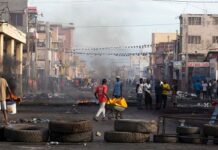
On the issue of Haiti, where efforts are being made to bring back stability and security to the French-speaking CARICOM member state following the assassination of its head of state in 2021, Holness said CARICOM continued its sustained advocacy for increased international support for Haiti.
He said these efforts kept Haiti firmly on the global agenda and contributed to the adoption of a United Nations Security Council Resolution establishing a Gang Suppression Force, supported in part by United Nations funding.
“CARICOM is now a key partner in the tripartite coordination of the Organization of American States’ Roadmap toward Stability and Peace in Haiti, and we look forward with optimism to the preparations for free and fair elections in 2026,” Holness added.



 and then
  chairman, Prime Minister Andrew Holness, has reiterated the need for the Region to remain a "Zone of Peace" grounded in respect for international law)