




























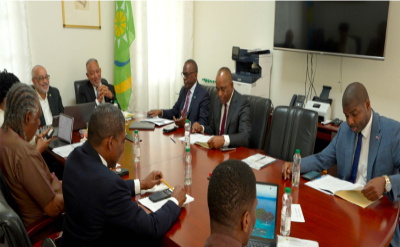
CASTRIES, St. Lucia, CMC – The leaders of the Organisation of Eastern Caribbean States (OECS) have discussed the ongoing developments between Venezuela and the United States, as well as the potential implications for the Eastern Caribbean, according to an official statement issued here.
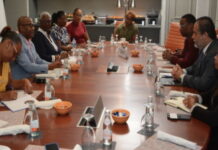
The statement by the St. Lucia-based OECS Commission said that the leaders of the sub-regional grouping met here earlier this week under the chairmanship of the recently elected St. Vincent and the Grenadines Prime Minister, Dr. Godwin Friday.
The statement said that the meeting was attended by Dominica’s Prime Minister Roosevelt Skerrit, Grenada’s Prime Minister Dickon Mitchell, St. Kitts and Nevis Prime Minister Dr. Terrance Drew, who is also the chairman of the wider Caribbean Community (CARICOM) grouping, the host Prime Minister Phillip J Pierre as well as Premier Reuben T. Meade of Montserrat; Premier Dr. Natalio Wheatley of the British Virgin Islands and Premier Cora Richardson-Hodge of Anguilla. The statement gave no reason for the non-mention of the Antigua and Barbuda Prime Minister, Gaston Browne.
“The meeting addressed several critical regional and international issues, including the emerging geopolitical environment, regional developments, and proposals being discussed with the United States of America.”
The statement said that the leaders “continue to monitor the ongoing developments between the Bolivarian Republic of Venezuela and the United States, as well as the potential implications for the Eastern Caribbean” following the US military invasion of the South American country earlier this month and the imprisonment of its leader, Nicolas Maduro, and his wife on drug related charges in the United States.
“These include impacts on economic stability, regional security, energy security, migration flows, and diplomatic relations. In this context, the Heads reaffirmed the OECS’ commitment to peace, stability, and good neighbourly relations within the hemisphere.”
The statement said that the sub-regional leaders also discussed the United States’ requests to OECS member states, including Grenada, St. Lucia, Dominica, Antigua and Barbuda, and St. Kitts and Nevis, to accept third-country nationals (TCNs) from the North American country.
“They noted that some OECS member states have already signed Non-Legally Binding Memoranda of Understanding with the United States to enter into further discussions with the United States on the matter.
“The Heads of Government have therefore agreed to establish a broad-based, high-level negotiating team, comprising representatives from OECS member states, to undertake technical negotiations with the United States on this matter.”
The statement said that the leaders also “reaffirmed” their commitment to the Citizenship by Investment Programmes (CBI) in the five relevant OECS jurisdictions, committing to “ongoing improvements and best practices in the CBIs, noting the significant efforts undertaken over the past nine months toward establishing an independent regional regulatory authority, together with proposed legislative reforms to the CIP frameworks, and the need for continued engagement with partners including the European Union”.
Under the CBI programme, foreign investors are granted citizenship of the islands involved in return for making a substantial investment in their socio-economic development.
They have expressed their commitment “to adopting and implementing in the future traveller biometrics systems throughout the OECS to enhance regional border security, hassle-free and seamless travel, and to improve the traveller experience for citizens and visitors alike within the OECS”.
The sub-regional leaders said that given “the dynamic and rapidly evolving geopolitical environment” they have agreed to convene in political caucus as “frequently as required to ensure coordinated and responsive decision-making and reaffirmed their commitment to collective action, regional solidarity, and continued principled and practical engagement with the international community, including the United States, in safeguarding the security, stability, and sustainable development of the OECS.
“The Heads of Government are committed to continuing and enhancing public communication with their citizens to assure them that any decisions made, or to be made, will be done in the best interest of the citizens of the OECS,” the statement added.
The OECS groups the islands of Antigua and Barbuda, Dominica, Grenada, St. Vincent and the Grenadines, St. Kitts and Nevis, Montserrat, Anguilla, and the British Virgin Islands.








 and then
  have discussed the ongoing developments between Venezuela and the United States)