

































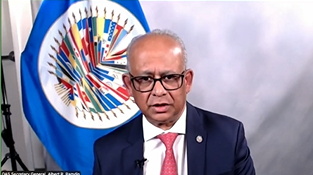
WASHINGTON, CMC – The Secretary General of the Organization of American States (OAS), Albert Ramdin, on Tuesday called on Venezuela and the United States to use means other than warfare to settle their differences, insisting that the hemisphere must remain a zone of peace.
“I hope that both countries, Venezuela and the United States …restrain themselves and make sure whatever other path can be found diplomatically, negotiations to solve their problems at a different level that should be…a priority.
“We don’t want any war in our hemisphere. Peace in the end is what everybody in this hemisphere wants. Nobody gains from a war. So I think if we can achieve that and maintain at the same time this unity going forward on that consensus-based agenda, we possibly will end up after five or 10 years in a better environment…and prosperity in the Americas.
“That is all the people of the Americas want, in every single country,” Ramdin said during a wide-ranging “Dialogue for the Americas: Conversation with OAS Secretary General,” discussion with the Trinidad-based journalist, Wesley Gibbings.
United States President Donald Trump has ramped up his country’s military presence in the Caribbean Sea, ordering an amphibious squadron to the southern Caribbean as part of his effort to address threats from Latin American drug cartels.
A nuclear-powered attack submarine, additional P-8 Poseidon reconnaissance aircraft, several destroyers, and a guided-missile cruiser have also been allocated to US Southern Command as part of the mission. In addition, the US’s largest carrier, the Gerald Ford, has joined the build-up.
But the United States military has been bombing vessels in international waters, claiming that the occupants were drug traffickers without offering any evidence of such activity. Venezuela regards the US presence as a means of removing the Nicolas Maduro administration from office, with Caracas warning that it would not allow such an event to occur.
The United Nations High Commissioner for Human Rights also strongly condemned the airstrikes carried out by the United States against alleged drug trafficking boats in the Caribbean and Pacific.
Volker Türk said in a statement that the strikes “violate international human rights law” and demanded that they be stopped immediately.
Last month, the Guyana-based CARICOM Secretariat said that regional leaders had discussed several issues on the regional agenda, including the security build-up in parts of the Caribbean and its potential impact on member states.
It said that the government of Trinidad and Tobago did not endorse the position at that meeting.
Ramdin, a former foreign affairs minister of Suriname who took up the position of OAS Secretary General on May 26 this year, said that, when it comes to the fight against transnational crime, he believes no country will object.
“Everybody is in favour of fighting transnational organised crime. “Transnational organised crime has a devastating impact in each country, in our region, the whole hemisphere,” he said, adding that the “objective of the goal to fight it, I have not heard any country saying it is not a good thing to do.”
“I think it is much more in the method in the implementation of that goal, the way it is being done, and I made the point that we must do these things, carrying these attacks out in the context of international law and also human rights, but with also justifiable evidence.”
Ramdin said that while “this matter” had not been discussed within the OAS “for a long time,” it was only about 10 days ago that Colombia raised the issue in the context of organised crime and “how we are going to battle that.
“I am still following the debate within the OAS on how they want to go about this,” he said, adding that he mentioned. He intends to raise it as Secretary General, given that fighting transnational organised crime is an unequal battle; governments with the same tools will not be able to fight it effectively.
He said those involved in transnational crime are not abiding by any law.
“They don’t care for law, or rules, or regulations, or protocols, or people. They kill at random. It is in their organisational interest, and they have advanced technology and revenues, all of which are illegal.
“On the other hand, you have law enforcement or the government to fight them, but in a way where they have to keep in mind all kinds of constitutional or legal arrangements,” Ramdin said, adding that he is all in favour of respecting the constitution and laws.
“But when you have this unequal battle, and we want to win that battle, then you will need to find, in a creative way, a new legal framework that gives the authority to the governments to fight crime with more tools, with due respect for human rights“.
Ramdin said that for too long “we have thought we would have been able to battle trans-national organised crime in that way”.
He said that regarding the current situation in the Caribbean, the United States has decided “unilaterally” to fight the illegal drug trade. While no one is against the objective, “it is the way it is being done that requires some more discussion.
“I don’t have all the information as well,” he said, noting that in terms of the positioning of some countries on the issue, “that is primarily a matter for the regional organisation, CARICOM.
“I have spoken to some about this, also at the prime ministerial level, to get an impression about what the situation is,” he said, adding that others are also asking him about it.
“So there is an interest. CARICOM is a united front; this one does not look like it is, and this is for CARICOM to discuss. Whatever we can do to facilitate, we will do. But I think it is a matter of time that CARICOM will be able to see eye to eye within the region on this matter”.
He said governments in today’s world have different inter-state relationships and “we see that with the United States, we accept that reality, the same reality we must take in the Caribbean as long as we keep talking and keeping our eyes on the ball, which is to create a more safer hemisphere because we are not in favour of any incident lead into an escalation or a war type situation.
“We must keep the hemisphere as a zone of peace; otherwise, we will be further home,” Ramdin added.







 and then
 , Albert Ramdin, on Tuesday called on Venezuela and the United States)